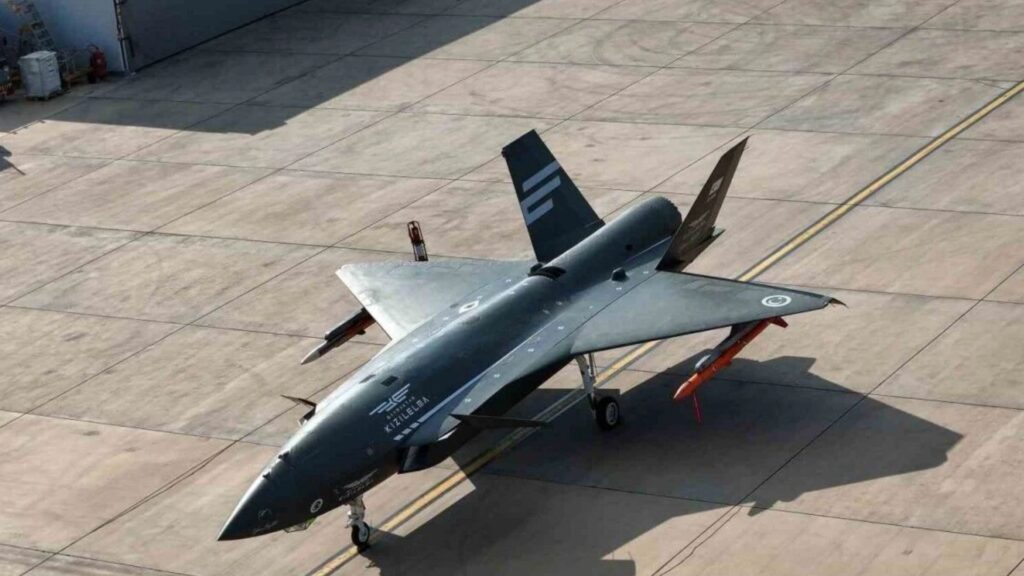
Pakistan Air Force Chief of Air Staff Air Chief Marshal Zaheer Ahmed Baber Sidhu was photographed in front of a Bayraktar Kizilelma unmanned combat aerial vehicle (UCAV) at Baykar Technologies’ facilities in Turkey on May 22, 2026. That image — a four-star air chief standing beside a jet-powered stealth drone that shot down a target with a beyond-visual-range missile just six months ago — is not incidental. It points toward one of the most consequential procurement decisions the Pakistan Air Force (PAF) has weighed in a generation.
But the Bayraktar Kizilelma itself is only half the story. What makes this moment significant is what the PAF appears to be doing around the airframe: building an independent combat architecture — sovereign sensors, indigenous data links, domestically integrated weapons — that would give Pakistan autonomous control over its next-generation unmanned warfare stack. That is a fundamentally different proposition from buying a drone off the shelf.
Get the Full Picture on Pakistan’s Defence and National Security
Get dedicated Pakistani defence news, force analysis, procurement tracking, and national security policy insight, backed by more than a decade of documented reporting and depth general news coverage cannot match.


The PAF Already Has a Deep Relationship with Baykar Technologies
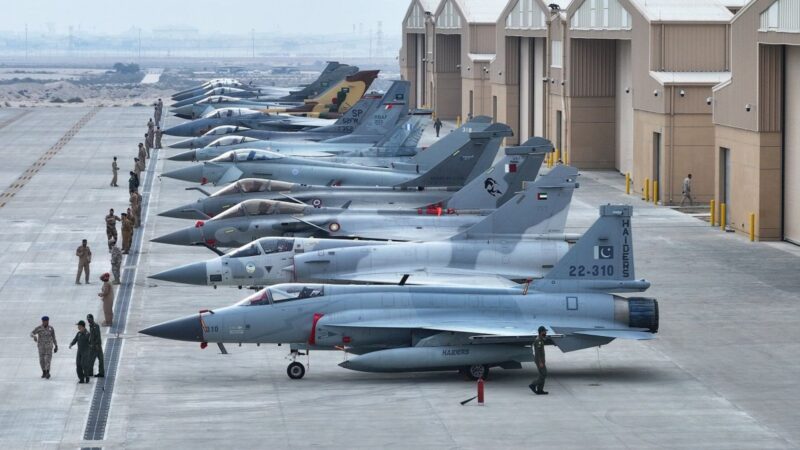
The visit did not occur in a vacuum. The PAF has already inducted the Bayraktar Akinci heavy UCAV and the Bayraktar TB2 medium-altitude drone. Baykar Technologies, meanwhile, has established a full subsidiary in Pakistan — Bayraktar Teknoloji Pakistan — and signed a cooperation agreement with the National Aerospace Science and Technology Park (NASTP) for research and development work.
Baykar’s Growing Industrial Footprint Inside Pakistan
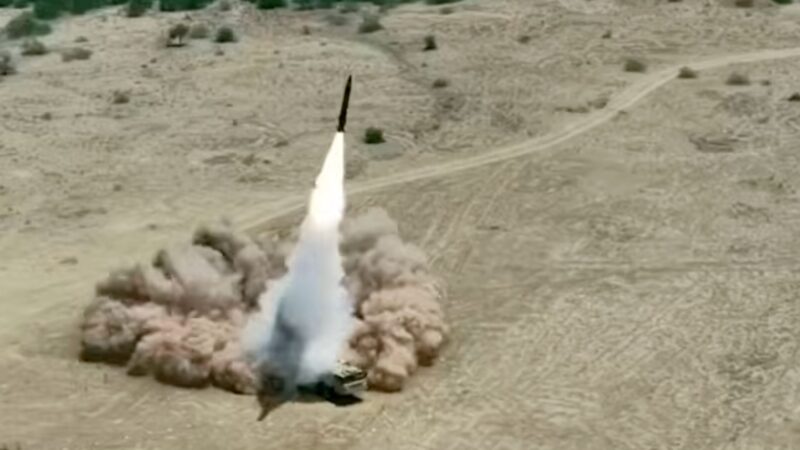
The company is constructing a significant production facility within Pakistan and has been on a sustained engineering recruitment drive. Baykar’s work at NASTP previously yielded the KaGeM V3 miniature air-launched cruise missile, though the company has since moved to engage directly with Air Headquarters through its own subsidiary. Whatever Baykar envisions building on Pakistani soil, it is clearly more than incremental assembly work.
What the PAF’s Own Publications Reveal About UCAV Interest
The PAF’s semi-official publication Second to None disclosed approximately a year and a half ago that the air force was actively seeking jet-powered stealthy UCAVs. The question was never whether the PAF was interested in this class of platform — it was which partner would give them the most strategic flexibility. The answer, increasingly, points toward a loyal wingman UCAV concept that prioritises sovereign integration over turnkey convenience.
Why Did the PAF Choose Baykar Over a Turnkey Chinese or Turkish Package?
This is where the choice of Baykar becomes revealing.
Turkish Aerospace Industries (TAI) is developing the Anka-3 tailless stealth UCAV and could theoretically bundle it with the Hürjet advanced jet trainer and the Kaan fifth-generation fighter as an integrated stack. China’s AVIC could similarly offer the J-35 stealth fighter alongside its own loyal wingman drones and the KJ-500 airborne early warning aircraft — a complete ecosystem, ready to deploy.
The Sovereign Integration Advantage
Both options carry the same drawback: the original equipment manufacturer controls the internal architecture. Integrating a NESCOM-designed weapon, a NASTP-developed AESA radar, or an indigenous data link into a proprietary Chinese or Turkish system would require the OEM’s cooperation — cooperation that may be expensive, slow, or withheld entirely.
Baykar operates differently. The company builds the airframe, but the critical subsystems — the AESA radar, the electro-optical targeting system (EOTS), the electronic warfare suite, the tactical data link — come from separate vendors like Aselsan, Havelsan, and Milsoft. That separation creates a seam the PAF appears keen to exploit, potentially allowing NASTP to develop and integrate its own sensor and communications stack into a Pakistan-specific Kizilelma variant.
How the Bayraktar Kizilelma Already Made Aviation History
The First BVR Missile Kill by a Jet-Powered UCAV
On November 29, 2025, the Bayraktar Kizilelma conducted the first-ever beyond-visual-range air-to-air missile engagement by a jet-powered UCAV. Flying alongside five Turkish Air Force F-16 fighters over the Black Sea, it fired a TÜBİTAK SAGE-developed Gökdoğan missile, guided by the Aselsan MURAD-100A AESA radar, and intercepted a high-speed target drone. Every component in the kill chain — the aircraft, the radar, the missile — was Turkish-made.
Performance Specifications and Standalone Combat Capability
The afterburning Bayraktar Kizilelma-B variant, powered by Ukraine’s Ivchenko-Progress AI-322F turbofan, produces approximately 44 kilonewtons of thrust with afterburner. It cruises at Mach 0.8, carries up to 1,500 kilograms of payload, and uses internal weapons bays to preserve its low radar cross-section.
The critical distinction is this: the Kizilelma is a self-contained sensor-shooter. It carries its own AESA radar, EOTS, electronic warfare systems, and internal weapons bay. It can find and prosecute targets independently — no off-board sensor, no manned mothership required. That differentiates it from dedicated loyal wingman concepts like Boeing’s MQ-28 Ghost Bat, which are designed primarily as adjuncts to manned fighters.
What Do Leonardo’s MUM-T Tests Mean for the Data Link Architecture?
In March 2026, Leonardo CEO Roberto Cingolani announced MUM-T demonstrations using the M-346 Fighter Attack light combat aircraft as a mothership controlling two Kizilelma UCAVs. The tests are being run through LBA Systems, a 50:50 joint venture between Leonardo and Baykar established in June 2025.
Two Separate Airframers, One Shared Turkish Data Link Backbone
Separately, Turkish Aerospace demonstrated comparable man-unmanned teaming with the Hürjet and the Anka-3. The common denominator in both demonstrations is Turkey — specifically, the next-generation data link architecture being developed by Aselsan. When two separate airframers from two different countries can each team with unmanned combat aircraft using a shared Turkish data link backbone, that technology has reached a level of maturity and interoperability beyond any single manufacturer.
How the JF-17B Could Serve as Pakistan’s MUM-T Mothership
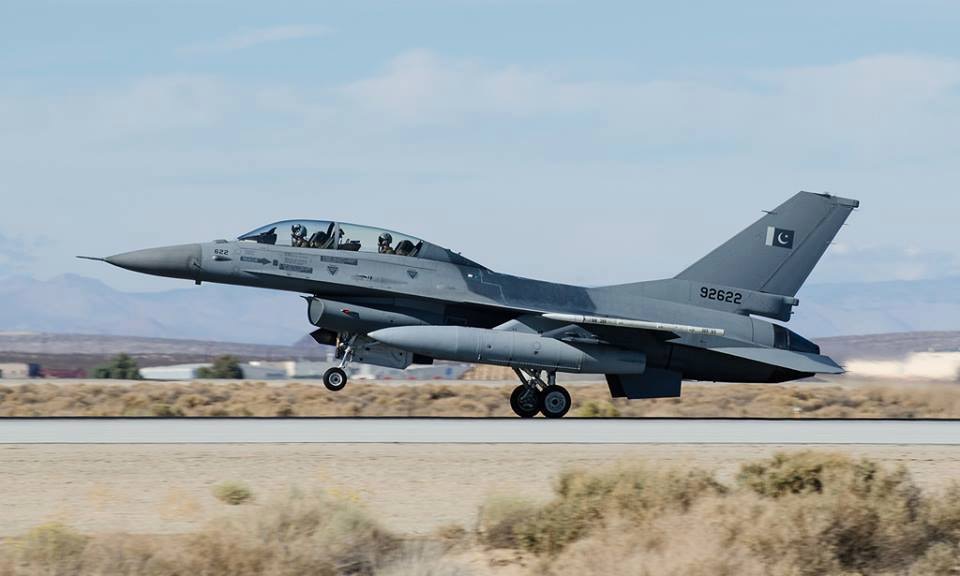
For the Pakistan Air Force, this is the key signal. The JF-17 Block III, equipped with the KLJ-7A AESA radar and a modern glass cockpit, could serve as a comparable MUM-T mothership — particularly the twin-seat JF-17B variant, which offers the cockpit real estate for a dedicated weapons systems officer to manage unmanned wingmen. If the PAF integrates a next-generation data link, developed with Aselsan’s assistance or co-developed through NASTP alongside Pakistan’s existing Link-17 system, it could field manned-unmanned teaming capability now — without waiting a decade for fifth-generation fighters to reach operational maturity.
Can Ukraine’s AI-322 Engine Supply Be Sustained? Turkey’s TEI Has an Answer
The Ukrainian Engine Dependency
Both the non-afterburning Kizilelma-A (AI-25TLT engine) and the afterburning Kizilelma-B (AI-322F) rely on powerplants from Ukraine’s Ivchenko-Progress Motor Sich design bureau. Ukraine’s war with Russia has inevitably strained its capacity to guarantee consistent engine supply and long-term maintenance to foreign customers.
The precedent is sobering. The AI-25, also used in the Aero L-39 Albatros trainer, became increasingly difficult to service after the war began. The PAF itself chose a Honeywell engine for its K-8 Karakorum trainers over the original AI-25 variant.
Turkey’s TEI-TF6000 and TEI-TF10000 Replacement Engines
Turkey’s TUSAS Engine Industries (TEI) is developing two replacements: the TEI-TF6000, a non-afterburning turbofan producing approximately 6,000 pounds-force, and the TEI-TF10000, an afterburning variant delivering roughly 10,000 pounds-force from the same core. The TF6000 ran successfully at Teknofest 2025, but neither engine has been flight-tested in its intended application.
Until TEI delivers a proven, production-ready alternative, engine supply remains the principal constraint. Any serious Pakistani procurement would need to address this contractually — whether through licensed production, strategic stockpiling, or an accelerated co-development track.
Indonesia’s 60-Aircraft Kizilelma Order Signals Production Readiness
The Bayraktar Kizilelma crossed a critical commercial threshold on May 6, 2026.
At the SAHA 2026 defence exhibition in Istanbul, Baykar signed an agreement with Indonesia’s Republikorp Group for an initial batch of 12 Kizilelma aircraft with options for up to 48 more — a potential fleet of 60 UCAVs. Deliveries are scheduled to begin in 2028, and the deal includes a local manufacturing facility in Indonesia.
Indonesia is the Bayraktar Kizilelma’s first export customer. For the Pakistan Air Force, the signal is unambiguous: Baykar has moved beyond prototyping. The platform is entering production, and the industrial model — co-production partnerships, technology transfer, local facility construction — mirrors exactly what Baykar is already building inside Pakistan.
How the US Air Force’s MQ-Next Shift Points to a Complementary Pakistani Need
The Bayraktar Kizilelma addresses the Pakistan Air Force’s deep-strike needs in contested airspace. But the PAF also needs something cheaper and more expendable — a two-to-three-ton class attritable UCAV designed for mass production, limited lifespan, and acceptable combat losses.
What the MQ-Next Requirements Reveal About the Future of Drone Warfare
This is not speculative. The US Air Force recently greenlighted requirements for MQ-Next, the successor to the General Atomics MQ-9A Reaper. The specification is striking: modular, mass-producible, open-architecture, and explicitly attritable, with a required lifespan of only 100 missions. The emphasis on expendability reflects the loss of at least 24 MQ-9A Reapers to Iranian air defences — losses the service could not replace because General Atomics had already shut down the production line.
Why NESCOM’s Cruise Missile Expertise Makes It Ideally Positioned
Pakistan’s NESCOM is well positioned for this kind of programme. The organisation behind the Babur cruise missile family, the Ra’ad air-launched cruise missile, and the Harbah naval cruise missile possesses exactly the cruise-missile-derived competency that companies like General Atomics, Anduril Industries, and Kratos Defense have used as springboards for their own attritable UCAV designs.
In 2022, GIDS released a roadmap that briefly included a Group 5 UAV before quietly removing it — suggesting an internal pivot away from large turboprop drones toward jet-powered attritable platforms. A NESCOM-led UCAV in this class, potentially co-developed with Baykar’s Pakistan subsidiary, could complement the Kizilelma the way the XQ-58A Valkyrie complements the F-35 in US Air Force doctrine.
Could the Pakistan Navy Build a Strike UCAV Wing With the Kizilelma?
Maritime Strike and ISR Without a Carrier Air Wing
The Pakistan Navy has spent decades seeking fixed-wing combat capability without the institutional and financial burden of a carrier-based air wing. The Kizilelma’s standalone sensor-shooter architecture means it could be shore-deployed for long-range anti-surface warfare, maritime strike, and ISR across the Arabian Sea — no fifth-generation mothership required.
Naval Drone Investments Already Underway
The Navy is already investing heavily in unmanned systems through its Shahpar-3 programme and is developing naval-oriented payloads including the Evrak lightweight torpedo, sonobuoy pods, and the Robust ESM system. A Kizilelma fleet, capable of carrying weapons like the Roketsan SOM cruise missile, would provide credible long-range strike against surface combatants.
More critically, as the Pakistan Navy extends the range of its anti-ship fires — including capabilities like the Harbah NG anti-ship cruise missile — it will need a distributed network of airborne sensor nodes for over-the-horizon targeting. The Kizilelma, with its AESA radar and EOTS, could serve as exactly that kind of node, feeding targeting data to the Navy’s growing submarine fleet and surface combatants alike.
Saab’s Quiet Data Link Expertise Could Prove Decisive for Pakistan
One actor rarely discussed in public but potentially pivotal is Sweden’s Saab Group.
The Erieye Relationship Pakistan Doesn’t Talk About
Saab has publicly stated it will no longer support Pakistan. Yet the Erieye airborne early warning systems operated by the PAF have received visible sensor upgrades, and Saab technologies feature in Pakistani systems including the GIDS Spider counter-UAS platform, which reportedly uses the Saab Sirius electronic support measures suite.
Why Saab’s Thai Data Link Deal Matters for the PAF
The bigger opportunity is Saab’s expertise in network-centric warfare architecture. In its recent deal with the Royal Thai Air Force, Saab committed to building a custom next-generation data link connecting Gripen E/F fighters, AEW&C platforms, and naval vessels — with a reported 130 percent offset. Saab is also developing its own fighter-sized low-observable unmanned aircraft, scheduled to fly in 2027, requiring exactly the kind of data link the PAF needs for its own MUM-T architecture.
NASTP could work with Saab through knowledge transfer and engineering consultancy rather than a visible hardware sale. Combined with Baykar’s willingness to accommodate Pakistani-designed subsystems, this could create an informal consortium — NASTP, Baykar, and Saab — each contributing a distinct layer toward a sovereign combat network. The PAF’s existing Erieye fleet would serve as the foundation for this architecture.
The Strategic Logic: Build the Foundation Before the Fifth-Generation Capstone
The Pakistan Air Force’s approach to the Bayraktar Kizilelma is not a procurement decision in isolation. It is one piece of a broader philosophy: build from the ground up rather than buy turnkey solutions that create dependency.
Why the PAF Has Not Rushed to Commit to the J-35 or the Kaan
This explains why the PAF has not rushed to commit to the Shenyang J-35 or the TAI Kaan. Both offer fifth-generation performance. Both lock you into an OEM-controlled architecture. As Pakistan lays out its next procurement steps, the emphasis has been on incremental capability building rather than a single transformative leap.
The Kizilelma as a Proving Ground for Sovereign Combat Architecture
The Baykar model creates space. By working with a company that builds the airframe but sources avionics from separable vendors, the PAF can develop its own parallel sensor and communications stack. The Kizilelma becomes the proving ground for NASTP’s domestic AESA programme, its next-generation data link, and its electronic warfare initiatives — all tested and validated operationally years before a fifth-generation manned fighter arrives.
The next-generation fighter is the capstone. But the data links, sensor networks, autonomous teaming algorithms, and munitions integration framework are the foundation. The Kizilelma is where that foundation gets built.
The maturation cycle will extend into the 2030s. But the starting gun has been fired — and the PAF appears to understand that beginning late carries a cost far higher than beginning imperfectly.
Quwa Plus · In-Depth Pakistan Coverage
Understand Pakistan’s Defence and National Security in Unmatched Depth
Understand what Pakistan is acquiring, how its armed forces are evolving, and where national security policy is heading through dedicated defence news, force analysis, procurement tracking, Pulse Check briefings, and more than a decade of documented reporting.
Featured & Trusted By