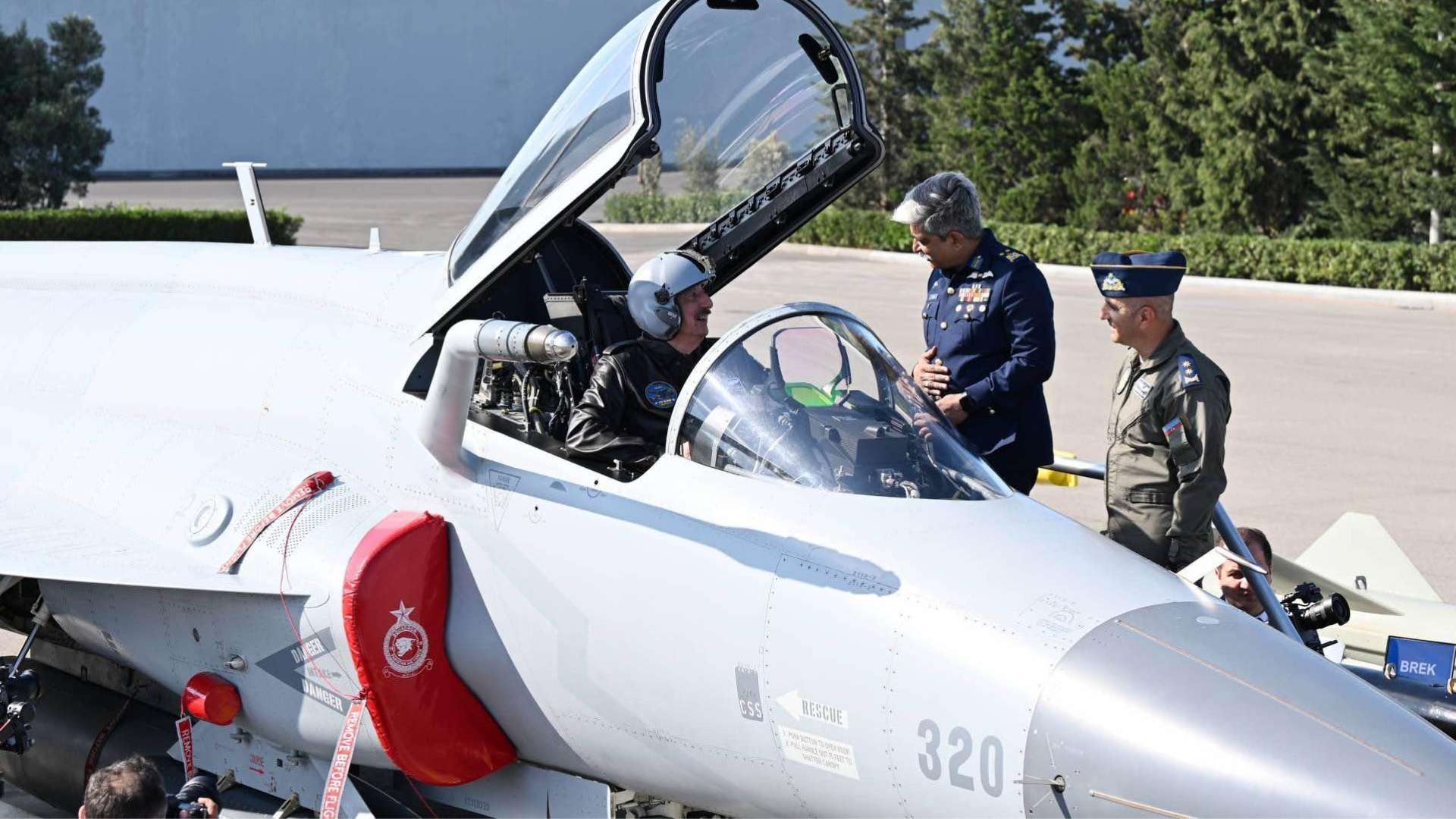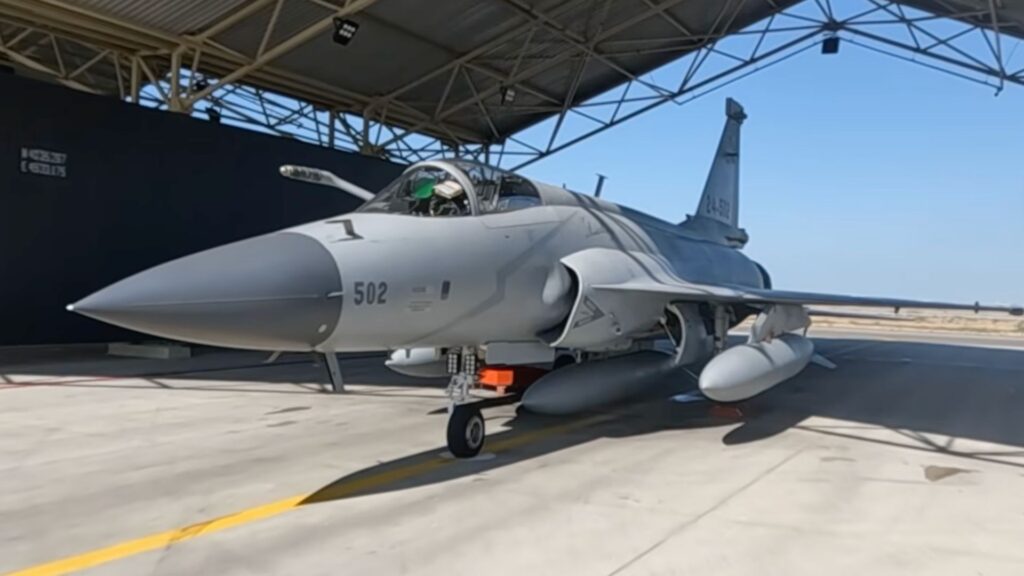
Azerbaijan’s Ministry of Defence has confirmed that its JF-17 Thunders are in service, releasing on 6 July its first footage of the type, which showed two single-seat JF-17C Block 3 fighters, serials 24-501 and 24-502, flying with three external fuel tanks and no weapons.
The aircraft were shown as part of a training cycle that also saw the fighters deploy to Türkiye for the multinational “Guardians of the Skies” exercise, the type’s first overseas activity under Azerbaijani control.
Baku’s order traces to a February 2024 contract for 16 aircraft worth about $1.6 billion, later expanded to 40 JF-17s in a deal reported at roughly $4.6 billion that makes Azerbaijan the fighter’s largest export customer and, by some accounts, Pakistan’s largest recorded defence export.
The type was first shown publicly over Baku during the November 2025 Victory Day parade, with training continuing since.
Open-source tracking puts at least nine Block 3 airframes in Azerbaijan, assigned to a newly raised 408th “Jaguar” Squadron, with further batches expected and full operational capability targeted around 2027.
Quwa assesses that these are 2024-built airframes rather than aircraft drawn from Pakistan Air Force (PAF) stocks, a reading the serial prefix supports, since the 24 denotes the production year and the 5 the Azerbaijani order.
The long gap between production and delivery most plausibly reflects Azeri crews completing conversion training in Pakistan before the jets were handed over.
The single-seaters appear externally identical to the PAF’s Block 3, including the same active electronically scanned array (AESA) radar and sensor fit.
The twin-seat JF-17B is the more ambiguous element. Quwa’s reading is that Azerbaijan’s B-models are delivered in a Block 2-equivalent configuration rather than full Block 3, consistent with the way the PAF itself expedited the JF-17B as a Block 2 trainer for its own conversion pipeline without activating the aircraft’s full Block 3 route.
On that basis, the B would serve Azerbaijan primarily as a trainer, following PAF practice of attaching a small number of two-seaters to each frontline squadron for continued acclimation.
No armament has been shown, and the weapons picture is the most consequential open question. For air-to-air, Quwa expects the Block 3’s standard fit, i.e., the PL-15 family already carried by the PAF.
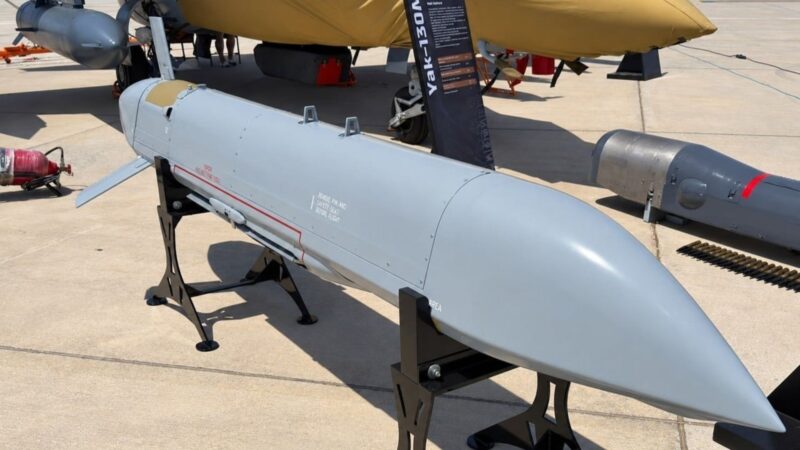
For strike, the more likely path is a Turkish standoff suite mirroring Azerbaijan’s Turkey-upgraded Su-25s, spanning the SOM cruise missile and HGK, KGK and Teber guided bombs, integrated through an intermediary launch adapter that sidesteps deep mission-computer work (e.g., the arrangement already fielded on those Su-25s).
The airframes alone do not account for a $4.6-billion figure, and Quwa assesses that much of the value sits in the surrounding ecosystem.
Satellite imagery shows Nasosnaya Air Base rebuilt with 16 new aircraft shelters alongside upgraded runways, taxiways, and support facilities, work on a scale that points as much to Pakistani engineering involvement as to the jets themselves.
Azerbaijan has run a Soviet- and Russian-patterned air force, and the JF-17. However, a Chinese-built platform is engineered around the PAF’s NATO-modelled training, processes and datalinks, which pulls Baku toward that framework, a transition reinforced by flying the type alongside Turkish F-16s in the Guardians of the Skies exercise.
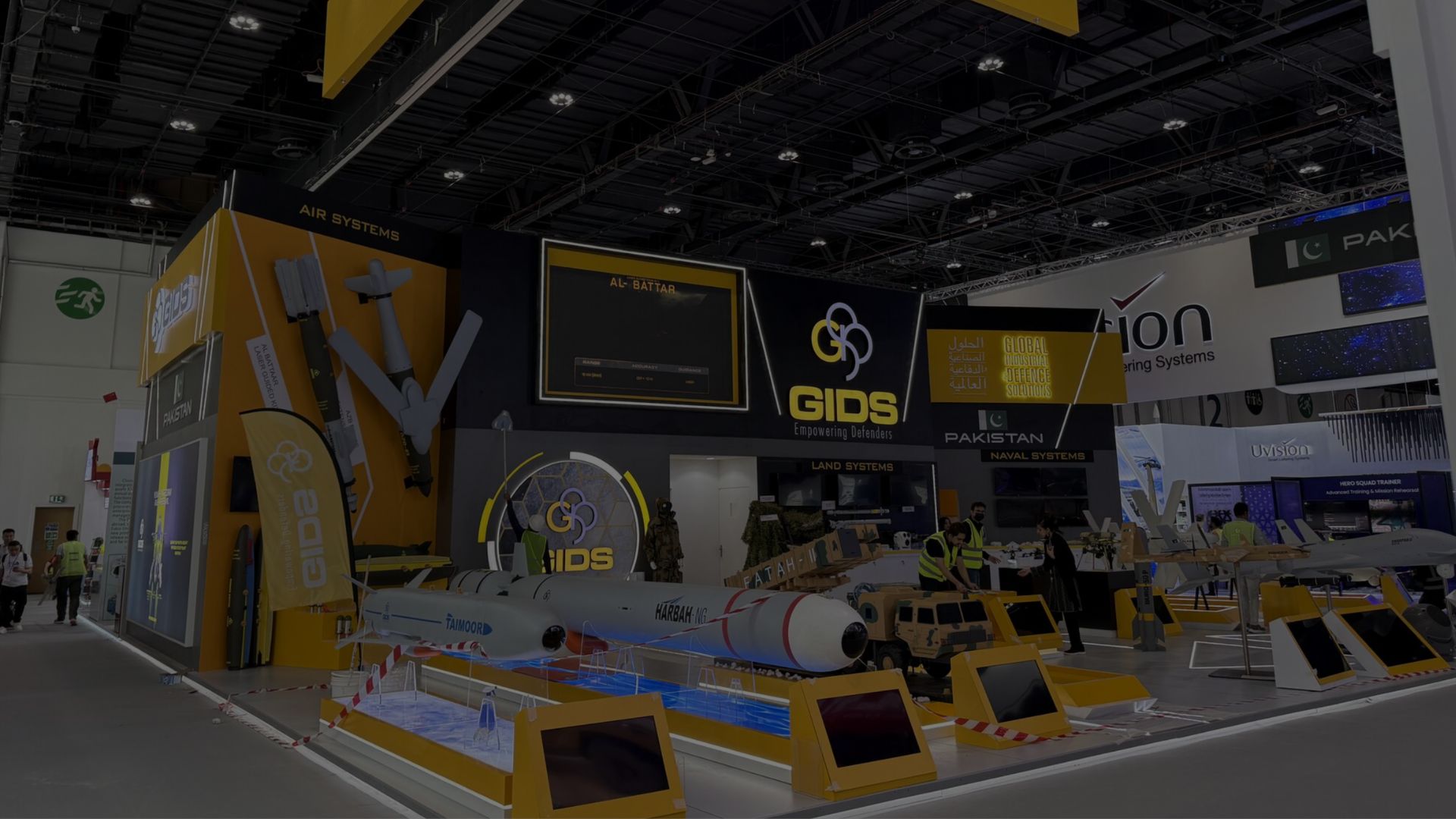
For Pakistan, the long-term effects matter as well. If the Pakistan Aeronautical Complex (PAC) performs the munitions integration for Azerbaijan, it opens pathways that the PAF could later draw on, from new standoff options to a wider export menu, and it gives Islamabad reason to track Türkiye’s two ramjet-powered air-to-air missiles in development as a complement to the solid-rocket PL-15.
The purchase further diversifies an inventory already spanning European, Israeli, Russian and U.S. equipment, and addresses a MiG-29 shortfall after several were lost when Russian strikes hit the Lviv facility where the aircraft were being overhauled.
Quwa expects the JF-17 to assume the MiG-29’s air-defence role, making Azerbaijan the fourth operator of the type after Pakistan, Myanmar and Nigeria.