
In June 2026, Pakistan launched a new institution to reform, manage, and expand its defence industry – the Defence Industrial Production and Regulatory Authority (DIPRA) – with the goal of growing exports and the wider economy. As discussed in an earlier Quwa analysis piece, DIPRA is promising in that it ‘questions’ – so to speak – some aspects of how the defence industry operates. For example, DIPRA acknowledges that there can be redundancy between what the private sector could be doing and the work of the state-owned enterprises (SOEs), and even empowers itself to dissolve SOEs on such grounds. However, legacy thinking is still pervasive, and some of those could dampen DIPRA’s long-term viability and success.
One of those legacy issues is the preference to vest authority with the SOEs and, by extension (albeit to varying degrees), the military. In itself, this is not an issue, but it could prove counterproductive – if not a blocker in itself – when such SOEs try to attract private capital. One of DIPRA’s immediate objectives is to generate investment in Pakistan’s defence industry, and the main avenue it seems to be pursuing is that of public-private partnerships (P3s).
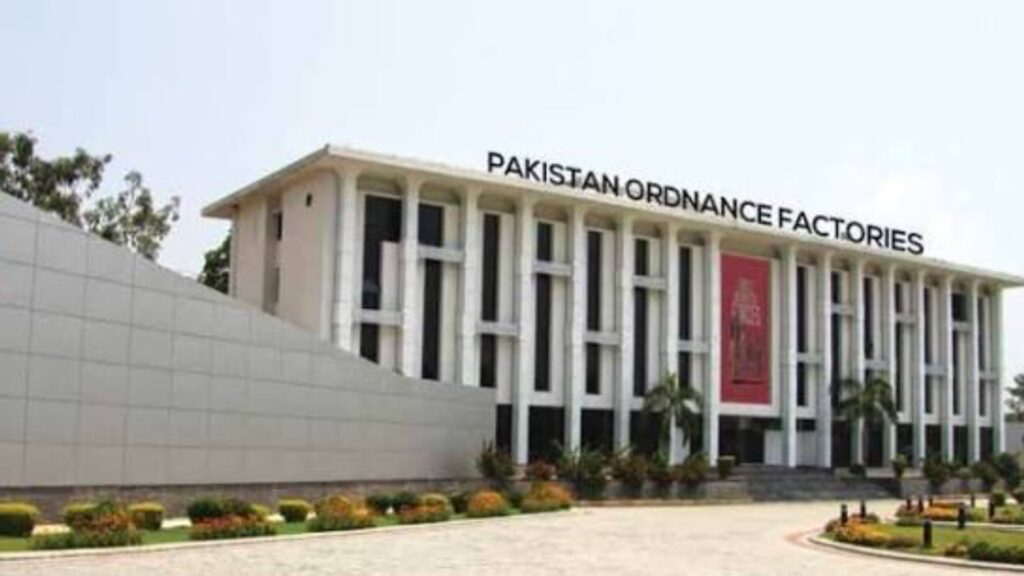
This author has had conversations with multiple sources and can confirm that, as of today, one of DIPRA’s priorities is to drive P3 investment into Pakistan Ordnance Factories (POF). In August 2026, POF announced that it was working to establish two new industrial plants aimed at supporting Pakistan’s defence needs as well as driving exports. As discussed in a previous Quwa analysis, POF has been shifting – or at least diversifying – from small arms and ammunition manufacturing to take on more upstream industrial activity, especially in chemicals and polymers. Hence, at one level, its continued industrial expansion is directionally moving in, arguably, the optimal direction. Pakistan’s SOEs should take on more scale-intensive work across upstream layers while freeing the productization work to private players.
However, to drive that upstream industrial growth, the Pakistani military – through DIPRA – is hoping to bring in private capital. Not only that, but Pakistan is inviting private investors from both within and outside the country. Thus, on the latter, it is likely – if not certain – that the Pakistani military will offer up planned facilities and future expansion programs to foreign OEMs as offset incentives. For example, to both save on foreign/hard-currency and re-leverage defence spending past solely procurement, offsets can be leveraged to bring some (or even all in some cases) hard-currency back to Pakistan. India does this quite a bit with its programs. So, Pakistan might procure 30 attack helicopters from Turkish Aerospace (TUSAŞ); however, as part of that USD $1.5 billion, TUSAŞ may spend $500 million within Pakistan (i.e., a net-currency spend of $1 billion to Pakistan) on a maintenance, repair, and overhaul (MRO) facility and a local R&D bureau. In addition, the MRO site and R&D bureau might take on first- and third-party work, which would lead to hard-currency gains within Pakistan. Thus, the actual hard-currency spend would be less than $1 billion, even though the contract was priced at $1.5 billion.
Granted, that was a simplistic view of offsets, but it outlines the gist of its intended mechanics. Where it gets interesting for Pakistan, however, is that its upstream or critical industrial growth can potentially come on the back of defence procurement, but without forcing acquisition-related trade-offs. For example, the Pakistan Navy (PN) requires a new multi-mission helicopter to one day replace its Sea Kings – an order potentially worth well over USD $1 billion. Now, in that situation, Pakistan will traditionally weigh the trade-offs of spending that $1 billion compared to increasing the production capacity in some other area. Through offsets, Pakistan can anchor that PN helicopter deal to a commitment where over half of that money must return to Pakistan through investment. In turn, that investment can be targeted and given to industrial output growth, such as raising new chemical facilities, revitalizing steel, going into alloys, or even net-new industrial domains.
In fact, Quwa can confirm that Turkish and Saudi investors are both interested in supporting POF’s growth. Thus, there is traction, and DIPRA is evidently taking the right steps in generating initial investor confidence.
Quwa Pro
See Where Emerging Defence Markets are Moving
Quwa Pro goes beyond tracking programs and equipment by explaining the policies, incentives, industry dynamics, and competitive pressures shaping South Asia's defence markets.