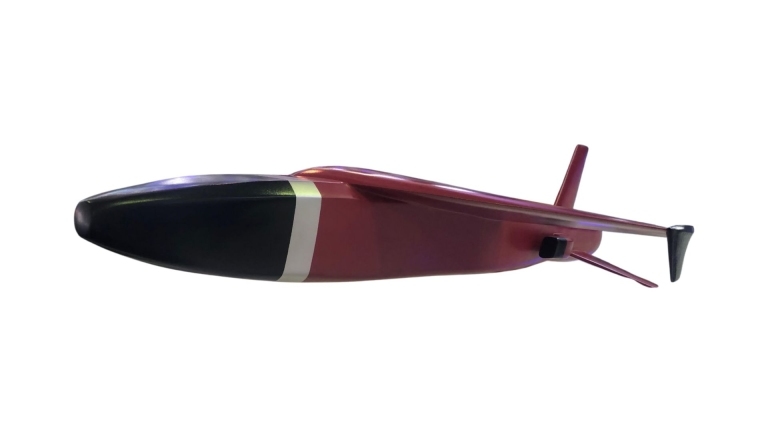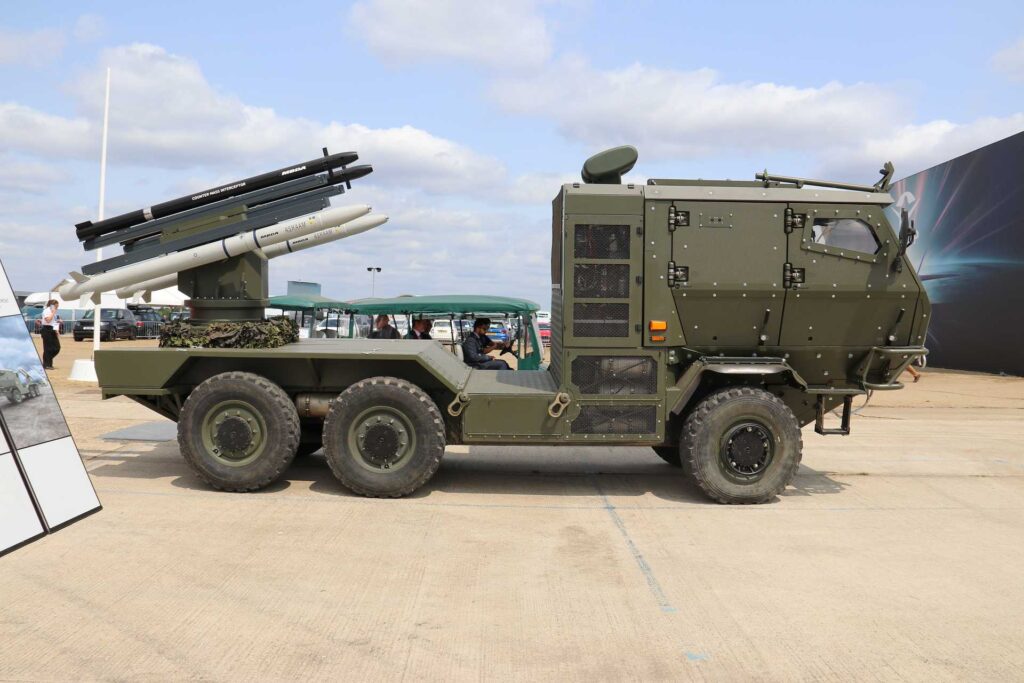
MBDA has launched the Counter Mass Interceptor (CMI), which the company describes as a mass-producible, low-cost effector for fire-and-forget engagements at range and altitude.
The interceptor was unveiled at the Farnborough International Airshow, paired with an upgrade to the firm’s ground-launched Advanced Short-Range Air-to-Air Missile (ASRAAM) air-defence system.
The name signals the intent: the CMI is built to blunt saturation attacks by cheap uncrewed systems, giving a ground-based launcher a round priced for the volume of threats that now shape short-range air defence.
The surface-launched ASRAAM system has recorded more than 400 intercepts since being fielded in Ukraine, according to Luke Webster, MBDA’s business-development manager in the United Kingdom for ASRAAM.
That combat record has become the reference point for the wider program.
Alongside the new interceptor, the launcher now carries a more capable electro-optical/infrared sensor and a moving turret.
The improved sensor and slewing turret let the system detect and track a wider set of low-signature targets, including small uncrewed aerial vehicles, before committing a round.
The CMI measures 122 mm in diameter and around 2.3 m in length.
It carries a blast-fragmentation warhead and a fixed field-of-view, low-wave infrared seeker.
The missile weighs about 53 kg and can intercept targets at more than 6 km.
Webster said the larger diameter gives the CMI greater performance than many other counter-drone interceptors.
Those dimensions place the CMI above the small, short-range munitions that many armies have adopted for counter-drone work.
MBDA argues the extra size buys the performance to cover threats from small drones to cruise missiles with a single effector, rather than fielding a separate system for each tier of the air picture.
Both the CMI and the ASRAAM lock on before launch, letting the infrared seeker acquire the target on the rail before the round flies the terminal engagement on its own.
Adding the CMI to the surface-launched ASRAAM system lets an operator engage lower-end targets such as drones, some basic helicopters that lack countermeasures, and cruise missiles.
The pairing is meant to lower the cost of each engagement, using the cheaper interceptor against the low end of the air picture while holding the more capable missile in reserve for harder targets.
That affordability is the point of a mass-producible effector, fielding interceptors in the numbers a drone-saturated battlefield now demands.
MBDA had for a long time run the effort as a quick-reaction program to aid Ukraine, but decided last year to convert it into a formal program, pursuing upgrades to drive further demand at home and abroad.
The step places its short-range air defence and counter-uncrewed aerial system (C-UAS) work on a more durable footing, moving a field-expedient answer toward a productized capability.
The launch lands within a broader Farnborough push toward affordable interceptors, with Destinus unveiling its Vorexon counter-rocket interceptor at the same show.
Lockheed Martin separately announced a lower-cost Patriot interceptor.
Within that field, the CMI sits at the low end of MBDA’s interceptor tier, beneath the more capable surface-launched ASRAAM round.
The CMI reflects a wider engineering turn toward cheap, mass-producible interceptors that narrow the cost gap against drone and cruise-missile salvos, the same pressure driving a growing field of low-cost counter-drone effectors.
Its 122 mm calibre – shared with the ubiquitous, cheaply produced 122 mm rocket-artillery family – shows how such interceptors can be built on existing, high-volume production bases rather than bespoke and expensive ones.
Quwa Pro – Defence Market Intelligence
See Where Defence Demand and Technology Are Moving Next
Track procurement priorities across Pakistan, the Gulf and wider MENA, and Central Europe. Follow emerging vendors, drones, AI, C-UAS, and affordable precision weapons, and see how lessons from today’s conflicts are reshaping military requirements and market opportunities.
Featured & Trusted By