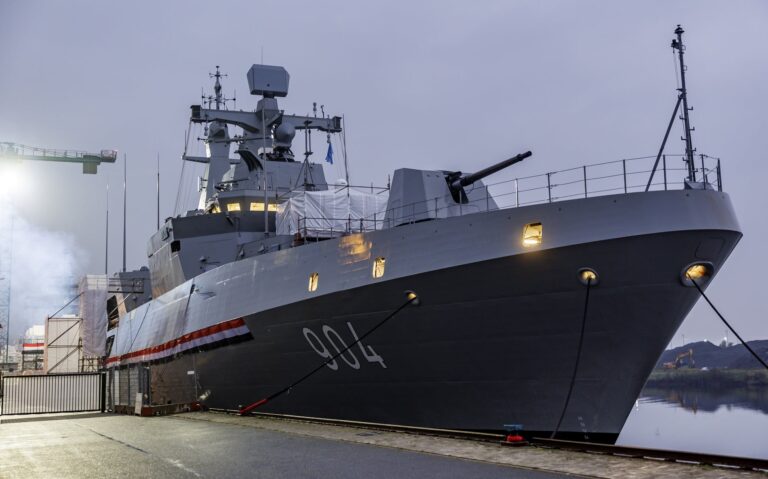

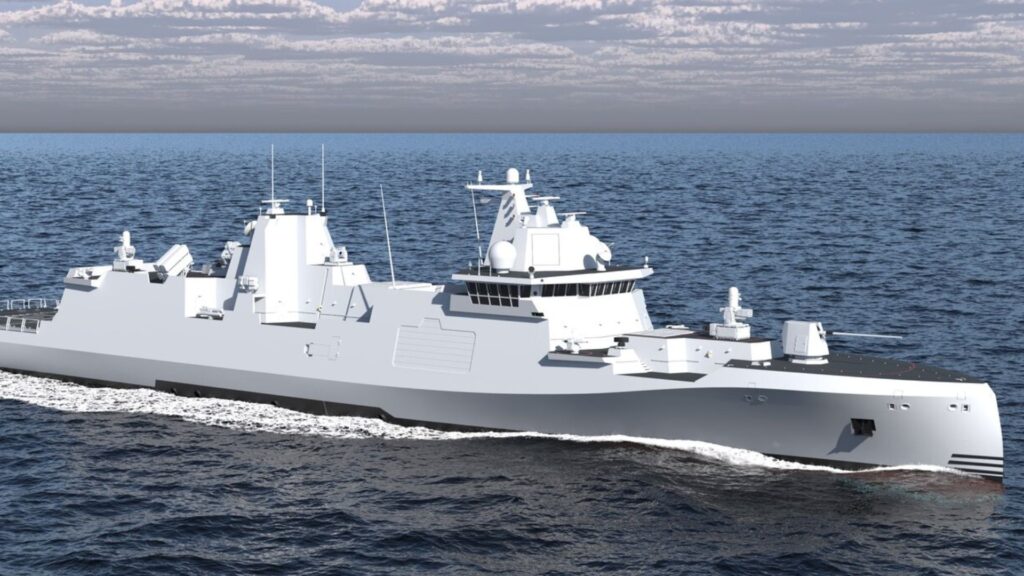
Rheinmetall unveiled the GMF 140 on 3 August 2026, a 140-metre guided missile frigate displacing approximately 6,000 tonnes that the company intends to offer initially as part of a procurement project in North America.
Rheinmetall shares rose 2% on the announcement.
Make Sense of Defence and Policy Shifts Across EMEA
Independent reporting and analysis designed to help you understand how military developments, policy choices, and regional tensions connect.
The declared armament of the GMF 140 is a 64-cell strike-length vertical launching system, a five-inch main gun, anti-ship missiles, torpedo tubes, a close-in weapon system, a laser, and both hull-mounted and towed sonar.
Rheinmetall describes the combat system as “AEGIS augmented with CMS330 as appropriate”, paired with a US-sourced air defence radar offered in configurations that include full ballistic missile defence tracking.
The GMF 140 also appears to be a stretch of a design NVL has already pitched under the same designation.
Lürssen presented the GMF-120 at DALO Industry Days in Denmark in August 2025 as a 121.1-metre, roughly 5,000-tonne frigate carrying 64 Mk 41 strike-length cells and reaching 30 knots on a diesel and gas turbine arrangement, fitted with a Thales APAR Block 2 and NS200 radar suite and a Leonardo 76 mm gun.
The GMF 140 keeps the cell count and the speed while substituting American sensors and a heavier gun.
The timing follows a domestic defeat. Germany cancelled the F126 frigate program on 24 June 2026 and ordered up to eight TKMS MEKO A-200 frigates instead, worth €6.3 billion for four hulls with a €5.3 billion option, after rejecting an NVL and Rheinmetall bid to take over as prime contractor at roughly €15.2 billion.
Quwa covered that decision when Germany turned to the TKMS MEKO A-200. Saab then won a SEK 8.7 billion order to arm those ships in July 2026.
TKMS subsequently took a second prize in a market Rheinmetall is now targeting, with Ottawa naming it preferred supplier for the Canadian Patrol Submarine Project on 6 July 2026 for up to 12 boats.
Rheinmetall Q2 results are due on 6 August 2026, three days after the GMF 140 reveal.
No announced Canadian requirement currently matches a 6,000-tonne air defence frigate. Canada contracted the first batch of three River-class destroyers on 3 March 2025 at $8.0 billion, leaving batches two and three uncontracted.
The other live surface program is a $5 billion project for 16 to 20 corvettes with 7,000 nautical miles of range and 30-day patrol endurance, intended to free the River-class to focus on high-end threats, missile defence and overseas deployments.
The United States offers the clearer opening.
Washington cancelled the Constellation-class frigate on 25 November 2025 after spending about $2 billion of a planned $7.6 billion. The FY2027 budget then carried $1.85 billion in research funding to study future frigates and destroyers built to foreign designs or in foreign shipyards, though public attention has centred on Korean and Japanese yards and Rheinmetall has no American shipyard.
That proposition sits on a trend Quwa has tracked in its EMEA Market Intelligence reporting, which found navies increasingly selecting warship designs that are cheaper, faster to field, and easier to scale over larger clean-sheet combatants. Rheinmetall is applying that logic to the air defence frigate segment by pairing a mid-size hull with a magazine sized for a destroyer.
Rheinmetall has not disclosed propulsion, beam, draught, range, unit price, build yard, radar model or in-service date, and no serial production contract exists. Chief executive Armin Papperger has set a target of €5 billion in naval revenue by 2030 and made a non-binding offer for German Naval Yards Kiel in May 2026, with due diligence underway.
EMEA Market Intelligence
Make Sense of Defence and Policy Shifts Across EMEA
Independent analysis, Pulse Check audio briefings, and a decade of reporting to help you understand what changed, why it matters, and how the wider strategic picture fits together.
Featured & Trusted By