
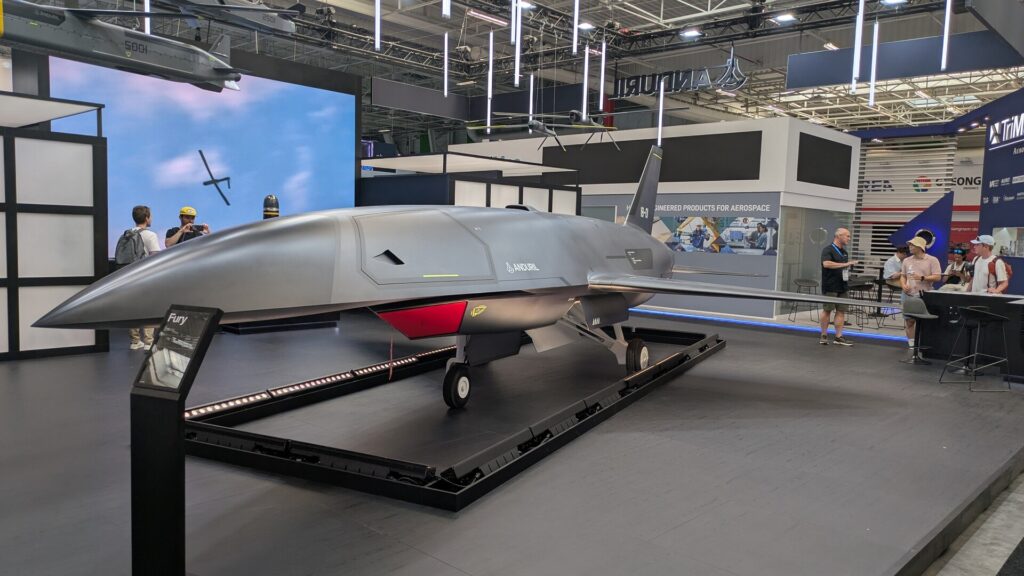
On 17 June 2026, the U.S. Air Force (USAF) signed its first production contracts for more than 150 ‘loyal wingman’ unmanned combat aerial vehicles (UCAVs) – the aircraft it designates collaborative combat aircraft (CCA) – divided across the Anduril Industries FQ-44A Fury and General Atomics FQ-42A Dark Merlin, at a target unit cost of USD $30 million. Though lower in cost than the F-35A stealth fighter, the pricing of these first production-ready loyal wingman drones is significantly higher than what was originally imagined for this category of uncrewed combat aircraft – i.e., less than $2 million.
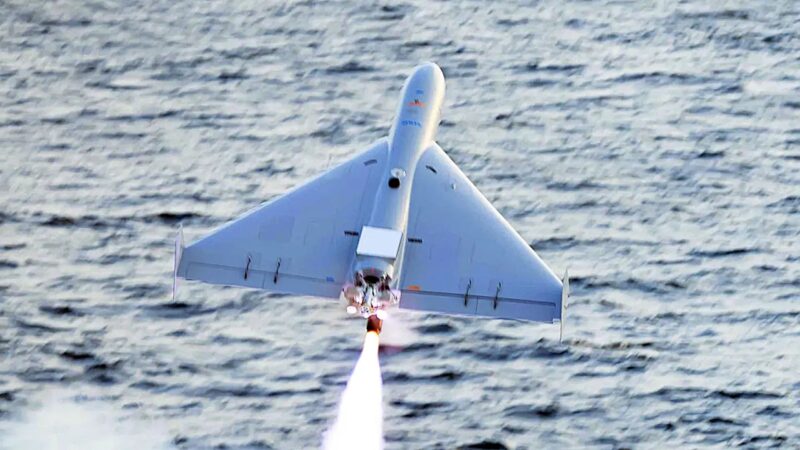
When reviewing the loyal wingman UCAVs under development around the world, the sharp vertical cost increase could be attributed to two factors: First, the actual collaborative combat aircraft becoming larger, more capable, and more complex than originally ideated for an attritable loyal wingman drone. Second, the ‘attritable’ aspects of these UCAVs – i.e., affordability and disposability – are being shifted to a new category of smaller, expendable drones, such as decoys, loitering munitions, and dual cruise-missile/decoy drones.
That said, the upward shift in cost and complexity has not dissuaded countries from pursuing their respective loyal wingman UCAVs – to the contrary, that list of collaborative combat aircraft programs is growing. However, it is worth exploring why the ostensibly lower-cost, attritable loyal wingman drone is not emerging.
The Origins of Loyal Wingman UCAVs
The loyal wingman concept emerged in 2019 under the USAF’s Low Cost Attritable Strike Demonstrator (LCASD) program, which sought a new jet-powered combat drone capable of air-to-air and air-to-surface missions, but with an aggressive focus on simplicity and cost control.
Under LCASD, these new UCAVs would fly alongside manned fighters in a manned-unmanned teaming (MUM-T) construct, assuming the roles of carrying additional air-to-air missiles (AAM) and air-to-ground munitions (AGM), serving as decoys to absorb the enemy’s AAMs, and executing specialized tasks like electronic attack (EA) jamming. These roles would, by necessity, force these uncrewed combat aircraft to absorb losses, hence the ‘attritability’ requirement where they should be cheap enough to buy and replace in large numbers.
Kratos, which was known for designing and producing target drones, led LCASD development through its XQ-58 Valkyrie. Kratos designed the Valkyrie to be a low-cost, runway-independent combat drone with a cost of less than $2 million per unit. However, looking back at the LCASD, that aggressive cost figure would only have been possible by omitting many subsystems and inputs – some of which would be necessary for the air-to-air and air-to-surface roles – and, at most, leveraging purely an airframe with basic systems. And, in turn, if the UCAVs start taking on systems like active electronically scanned array (AESA) radars, avionics, electronic warfare (EW) systems, and other inputs (e.g., to enable autonomous operations), then the idea of ‘attritability’ falls as well, since those are all high-value inputs.
Quwa Pro
See Where Emerging Defence Markets are Moving
Quwa Pro goes beyond tracking programs and equipment by explaining the policies, incentives, industry dynamics, and competitive pressures shaping South Asia's defence markets.