Germany has cancelled its F126 anti-submarine warfare (ASW) frigate program, the Federal Ministry of Defence (BMVg) announced on 24 June 2026, ending what would have been the largest surface-combatant project in post-war German naval history.
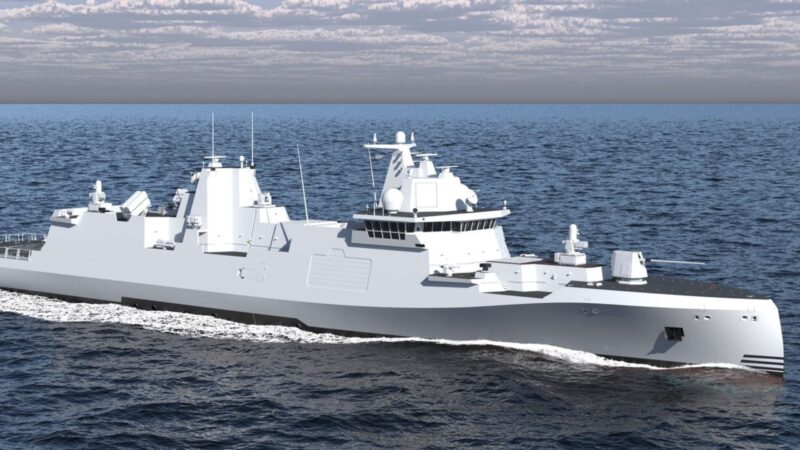
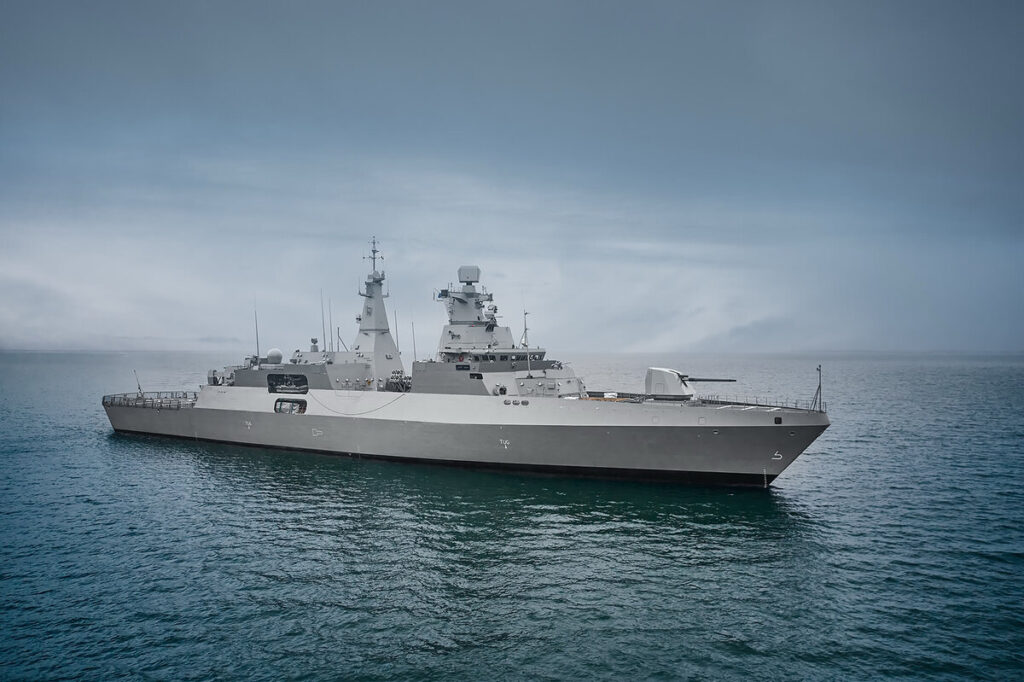
In its place, the Bundeswehr intends to procure up to eight Multi-purpose Combination (MEKO) A-200 DEU frigates from Thyssenkrupp Marine Systems (TKMS), subject to approval by the Bundestag’s budget committee (Haushaltsausschuss).
See Where Demand, Vendors, and Defence Priorities Are Shifting
Get clearer visibility into what procurement teams are looking for, how suppliers are positioning themselves, and where military requirements are evolving across EMEA.
The ministry cited significant delays, steep cost growth and what it assessed as unpredictable program risk. The six F126s, previously designated Mehrzweckkampfschiff 180 (MKS180), were intended primarily for ASW and were to succeed the F123 Brandenburg class. The replacement vessels are expected to carry the F128 designation.
The program had been awarded in 2020 to the Dutch shipbuilder Damen Schelde Naval Shipbuilding (DSNS), now Damen Naval, under a contract signed with the Federal Office of Bundeswehr Equipment, Information Technology and In-Service Support (BAAINBw) on 19 June 2020, with an initial value of around €10 billion (US$11.3 billion).
An option for two further ships, taking the class to six, was subsequently exercised. According to the ministry, Damen gave formal notice that the vessels could not be delivered to the agreed schedule or budget, with first delivery slipping to 2032 from an original 2028.
Berlin had, since 2025, examined transferring the prime-contractor role to Naval Vessels Lürssen (NVL), the shipbuilding group acquired by Rheinmetall. Negotiations placed an NVL-led continuation at roughly €15.2 billion for the six ships, and the ministry put the total financial requirement to complete the class at more than €18 billion, close to double the original estimate.
A change of contractor would also have obliged the federal government to waive potential damage claims against Damen, a condition the BMVg said ran counter to the responsible use of public funds.
Defence Minister Boris Pistorius said Germany had spent some €2.3 billion on the program since 2020 and saw little prospect of recovering damages. He framed the cancellation as preferable to an open-ended commitment, stating it was “better to have a tough ending than a drawn-out state of limbo.” The scale of any claims against Damen remains under legal review.
The BMVg estimates the first four MEKO A-200 DEU frigates at around €6.3 billion (US$7.15 billion), with an option for four more, exercisable by the end of 2026, at about €5.3 billion, for a combined €11.6 billion. Inspector of the Navy Vice Admiral Jan Christian Kaack, who heads the German Navy, confirmed after review that the design can fulfil the service’s core ASW mission and Germany’s NATO obligations. The ministry characterizes sea-based ASW as both an alliance and a national priority.
The decision drew cross-party support. Bastian Ernst, the CDU/CSU parliamentary group’s spokesperson on naval affairs, said the F126 had been conceived as an over-ambitious “jack-of-all-trades” whose schedule could no longer be reconciled with alliance commitments. “We have committed ourselves to our NATO allies to make significant contributions to defence against enemy submarines,” he said. “That’s time we don’t have.”
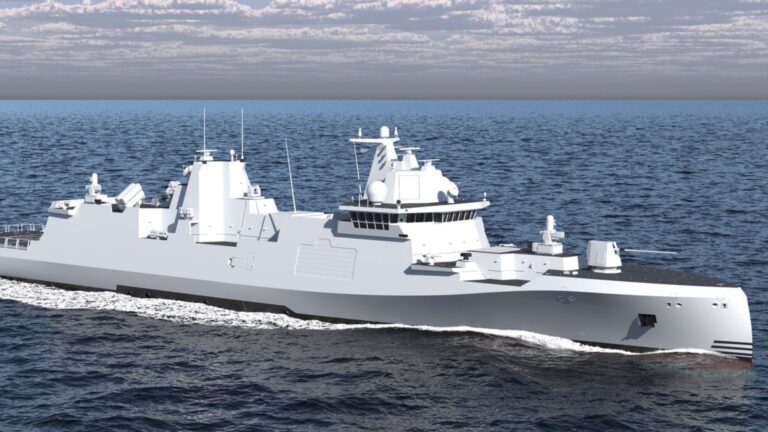
The MEKO A-200 DEU represents a marked reduction in size. The German design is reported at roughly 4,000 tonnes, placing it between the in-service A-200 (near 3,600 tonnes) and the larger A-210 that TKMS has marketed at around 4,700 tonnes. That compares with the F126’s planned 10,550 tonnes. It is based on an in-service type already operated by Algeria, Egypt and South Africa.
Related reading
A proven hull, a full-spectrum claim
In capability terms, the MEKO A-200 is marketed by TKMS as a multi-mission frigate offering, in the company’s words, “full-spectrum 4-dimensional warfare capabilities” across the air, surface, subsurface and electronic-warfare domains. The design is built around signature reduction: an X-form hull with screened deck equipment to lower the radar cross-section, funnel-less exhausts vented at or below the waterline with active cooling to suppress the infrared signature, and a tri-axial degaussing system to reduce the magnetic signature, according to TKMS product material.
For an anti-submarine combatant, the propulsion arrangement matters as much as the weapons. The A-200 uses a Combined Diesel and Gas, Water-jet and Refined Propeller (CODAG-WARP) plant, pairing two diesels driving refined propellers with a single gas turbine on a centreline water-jet. TKMS states this delivers both high transit speed and low acoustic self-noise through small, lightweight propellers and aft-mounted machinery. Low radiated noise is a precondition for effective sonar work, and it is one of the platform attributes that lets the ship credibly perform the submarine-hunting role the German Navy has assigned it.
A common platform, a customer-specific combat system
The central point about MEKO configuration is that the platform and the combat system are decoupled. TKMS notes that its three in-service A-200 sub-classes (South Africa’s Valour class, Algeria’s Erradii class and Egypt’s Al-Aziz class) share a near-identical ship platform but carry distinct combat systems from different suppliers — e.g., Denel Umkhonto and MBDA VL MICA NG surface-to-air missiles, RBS15 and Exocet anti-ship missiles, and Saab or Thales radars. This decoupling is what allows Germany to specify its own fit while holding to an off-the-shelf schedule.
The German configuration has not been formally disclosed; the BMVg has said only that navy-requested modifications account for around five per cent of cost, signalling a near-baseline design. The most detailed account of the intended fit comes from the German specialist outlet hartpunkt, whose reporting was translated by Naval News. According to that reporting, the German ships are to draw their sensor and effector packages from the bid TKMS assembled for Australia’s frigate competition, with the radar and combat management system (CMS) sourced from Sweden, a reduced role for German suppliers such as Hensoldt and Thales relative to the F126. The same reporting indicates the Swedish CMS could ultimately be replaced by the German Navy’s emerging standard, the CMS 330 supplied by Lockheed Martin Canada.
The submarine-hunting fit
On weapons and sensors, the reported and baseline picture is reasonably clear. For anti-submarine warfare, the German ships are to retain the Atlas Elektronik towed-array sonar originally selected for the F126. The same system is being fitted to the three F123 Brandenburg-class frigates now in ASW refit, a deliberate move to standardize the fleet’s core sonar and embarked-helicopter ASW package. Anti-surface strike is to be provided by the Kongsberg Naval Strike Missile (NSM), reported by hartpunkt in preference to the Swedish RBS15.
For air defence, the in-service A-200 pattern combines a Mk 41 vertical launching system (VLS) firing the Evolved Sea Sparrow Missile (ESSM) with a RIM-116 Rolling Airframe Missile (RAM) point-defence launcher. The German cell count and gun calibre have not been confirmed, though the evolved A-210 design TKMS offered to Australia carried 32 strike-length Mk 41 cells and a 127 mm gun. On the available evidence, the result is a focused submarine-hunter with self- and local-area air defence and a credible anti-ship punch — i.e., a ship matched to the core ASW mission Vice Admiral Kaack has endorsed, rather than the wider multi-role tasking once envisaged for the F126.
Outlook
TKMS, which said it had begun preliminary work in February, expects to deliver the lead ship in 2029, with subsequent vessels following at intervals of about nine months. Chief executive Oliver Burkhard called the decision “great news” and signalled scope to involve further German yards should the four-ship option be exercised. The proposal now passes to the Haushaltsausschuss, which has tracked the F126’s troubled history and will set the schedule on which Germany’s future frigate fleet takes shape.
Quwa Pro
Track Where EMEA Defence Demand Is Forming
See what vendors are doing, what militaries are prioritizing, and where procurement and strategic attention are moving across EMEA.
Featured & Trusted By