
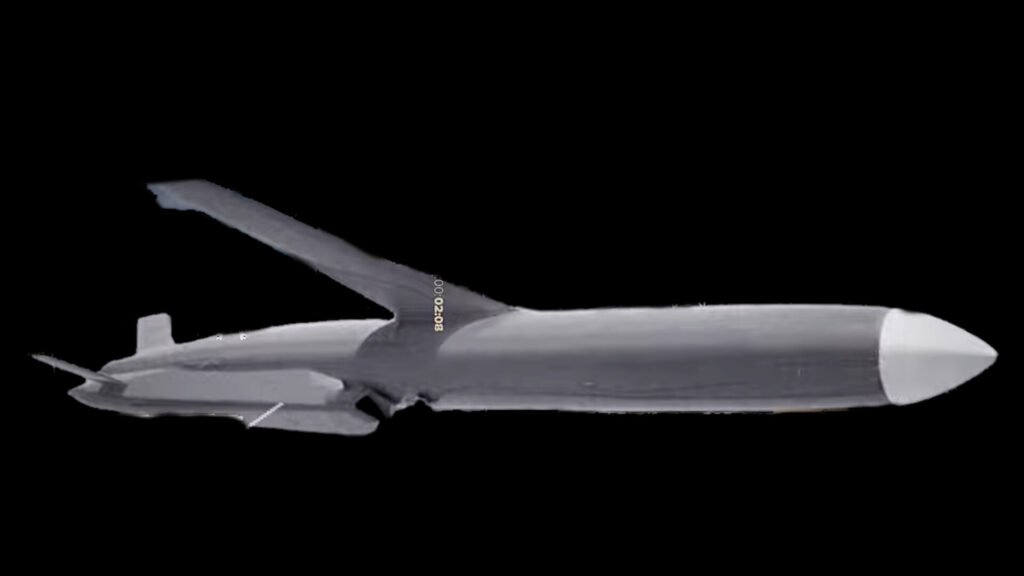
The Indian Air Force’s Sureshastra Mk1 loitering munition, built by Delhi-area startup Veda Aeronautics, has become the reference product behind the company’s push into a much larger Indian defence procurement pipeline.
The IAF signed a US$31 million (₹300 crore) contract for 200 units in August 2023 through its Mehar Baba Swarm Drone Competition, a deal reported at the time as the largest order any Indian startup had received from the government for unmanned systems.
Deliveries were reported underway from May 2025, following earlier user trials in the Thar desert.
The baseline Sureshastra Mk1 is a 3.5-metre, roughly 90-kilogram jet-powered fixed-wing aircraft with a V-tail configuration, catapult-launched without need of an airbase, carrying an explosive warhead to targets more than 150 kilometres away using satellite navigation and AI-enabled swarm coordination.
Veda managing director Dipesh Gupta described the company’s approach at Milipol India 2025: “we don’t follow the curve. We stay ahead of it,” pointing to a supply chain the company markets as “zero Chinese, 60% Make in India.”
Veda Is Developing a 500-Kilometre Air-Dropped Variant
Veda is now extending the platform into an air-dropped canisterised swarm variant, which Gupta announced in April 2026 would give the Indian Air Force a “force multiplier” capable of striking beyond 500 kilometres when released in canisters of eight or more drones from a C-17 Globemaster III, C-130J Super Hercules, or Airbus C-295 transport aircraft.
That variant remains in development and should not be conflated with the shorter-range, catapult-launched aircraft the IAF has already contracted and begun fielding.
The IAF separately issued a request for proposals in October 2025 for 800 medium-range swarm unmanned munition systems with range beyond 350 kilometres, an open competition whose winner has not been confirmed.
The Ministry of Defence’s own solicitation language argues such systems are effective because they “saturate enemy air defence systems, confuse enemy radars” – the same rationale Veda has cited for both the original Sureshastra Mk1 contract and its longer-range successor.
Veda Is Now Bidding a Sureshastra-Derived System for the Indian Army
India’s Defence Acquisition Council, chaired by Defence Minister Rajnath Singh, approved a US$5.4 billion (₹52,000 crore) capital acquisition package on 3 July 2026 that includes a jet-based kamikaze drone system for the Indian Army, distinct from the IAF’s existing requirement.
Veda confirmed on 5 July 2026 it would bid for that Army program, citing its Sureshastra Mk1 delivery record to the IAF as the basis for its credibility on a jet-powered kamikaze design.
The push into Indian loitering munitions extends well beyond Veda.
The Indian Army has fielded the Nagastra-1, built by Economic Explosives Limited and Z-Motion Autonomous Systems, in batches through 2024 and 2025, while Tata Advanced Systems has delivered its ALS-50 to the IAF and Bengaluru’s NewSpace Research and Technologies is developing the longer-range Sheshnaag-150.
That indigenization drive accelerated after Operation Sindoor, the May 2025 conflict with Pakistan in which the IAF employed its existing Israeli-built IAI Harop loitering munitions – a system Sureshastra Mk1 and its successors are designed to eventually supplement or replace with domestically built alternatives.