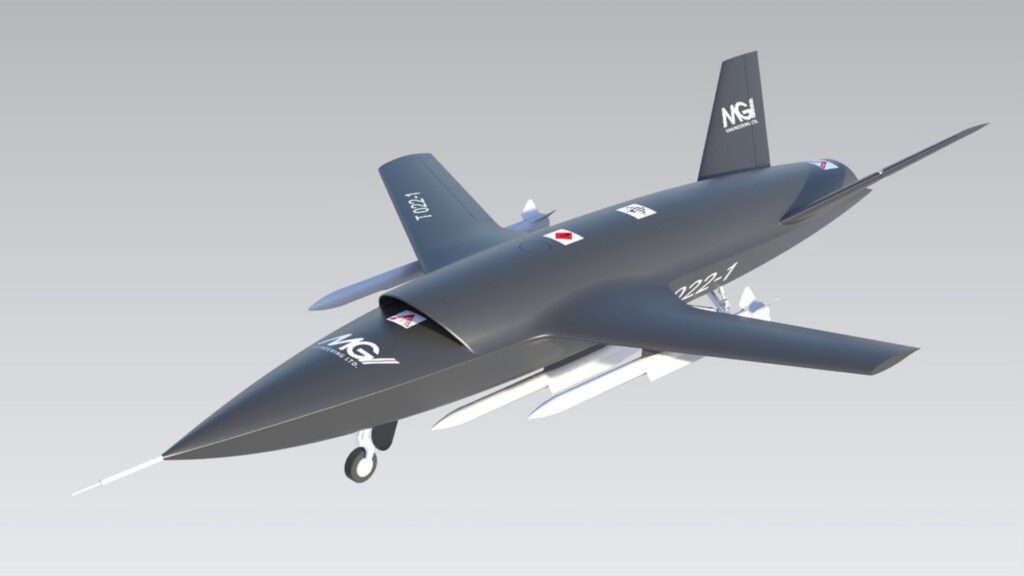
Oxfordshire-based MGI Engineering announced the T-022 Vortex on 24 July 2026, pitching the autonomous collaborative platform as a bid for the United Kingdom’s Storm Fighter requirement rather than a rival program to it.
MGI’s own product listing describes Vortex as an 11-metre, 3,500-kilogram-class aircraft with a 7.6-metre wingspan, a top speed of Mach 0.85, and a claimed range beyond 4,000 kilometres, priced at US$4 million to US$8 million (£3 million to £6 million) per unit depending on fit.
Chief executive Mike Gascoyne, a former Formula 1 technical director who founded MGI in 2003, said the aircraft “changes the economics of air power.”
He added that Vortex is “engineered at a price point that makes it possible to field at genuine scale,” arguing it lets the Royal Air Force put uncrewed aircraft into contested airspace “without putting a pilot there with it.”
Know What Defence Buyers in Will Need Next
See emerging requirements, likely suppliers, and routes to market across Pakistan, MENA, and fast-moving defence technologies, before demand becomes obvious.
Vortex Carries 1,000 Kilograms Across Four Weapon Stations
MGI’s spec sheet lists a 400-kilogram internal payload bay plus four external hardpoints carrying a further 600 kilograms, for missions spanning intelligence, surveillance and reconnaissance, electronic warfare, strike, suppression of enemy air defences, and decoy roles.
The company says Vortex is designed to operate autonomously in comms-denied or jammed environments under manned-unmanned teaming, with a single crewed Eurofighter Typhoon or F-35 directing multiple aircraft in formation.
MGI grounds the Vortex pitch in its existing effector line – the SkyShark and TigerShark one-way strike drones – and specifically in Project BRAKESTOP, the Ministry of Defence trial MGI credits with proving TigerShark’s design approach.
No government body has confirmed MGI as a formal Storm Fighter bidder, and the company has not disclosed a prototype, funding partner, or first-flight date for Vortex.
BAE’s Brontanax Already Has a Flightworthy Prototype
MGI’s reveal followed BAE Systems unveiling its own Storm Fighter contender, Brontanax, at Farnborough on 22 July 2026.
BAE says Brontanax already exists as a flightworthy prototype and is targeting first flight in the second half of 2027, backed by more than 500 employees and over 75 suppliers.
Defence Secretary Wes Streeting said at the unveiling that the government would “adopt this as our operational concept demonstrator.”
The contrast between an established prime with hardware already built and a 25-engineer specialist offering a lower price point and a design lineage in cheap effectors is the clearest evidence of how differently the two companies are approaching the same requirement.
Related reading
Storm Fighter Is Britain’s Bid to Build a Sixth-Generation Air Force
Minister of State for Defence Readiness and Industry Luke Pollard christened the Storm Fighter collaborative combat aircraft requirement on 16 July 2026 at the Global Air and Space Chiefs Conference, backed by an initial US$400 million (£300 million) drawn from the broader US$398 billion (£298 billion), four-year Defence Investment Plan published 30 June.
Chief of the Air Staff Air Chief Marshal Harv Smyth said the program would “markedly shift the economic calculus back in our favour, absorbing risk and enabling our crewed platforms to more readily survive,” and Pollard argued the effort would help make the RAF “Europe’s first six-generation air force.”
The Defence Investment Plan’s own target calls for a demonstrator flying by 2030, though Smyth has pushed for one paired with a Typhoon as early as 2027 – a gap between political ambition and the department’s own funded timeline that both MGI and BAE are now racing to close from opposite ends of the industrial spectrum.
Storm Fighter sits alongside sibling efforts Storm Chrome and Storm Fire, building on the StormShroud electronic-attack drone that entered RAF service in 2025, and is intended to operate alongside the Global Combat Air Programme’s crewed Tempest fighter rather than replace it.
Quwa Pro – Defence Market Intelligence
See Where Defence Demand and Technology Are Moving Next
Track procurement priorities across Pakistan, the Gulf and wider MENA, and Central Europe. Follow emerging vendors, drones, AI, C-UAS, and affordable precision weapons, and see how lessons from today’s conflicts are reshaping military requirements and market opportunities.
Featured & Trusted By