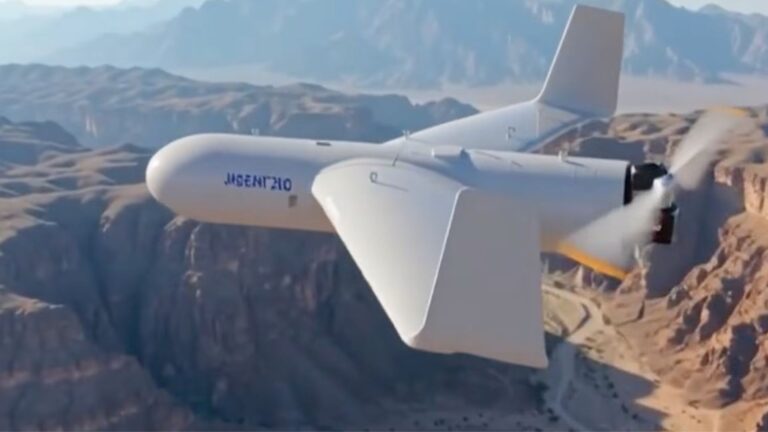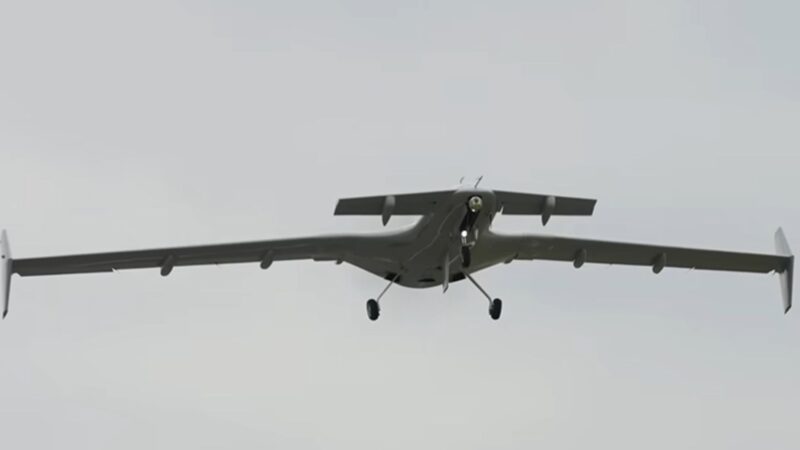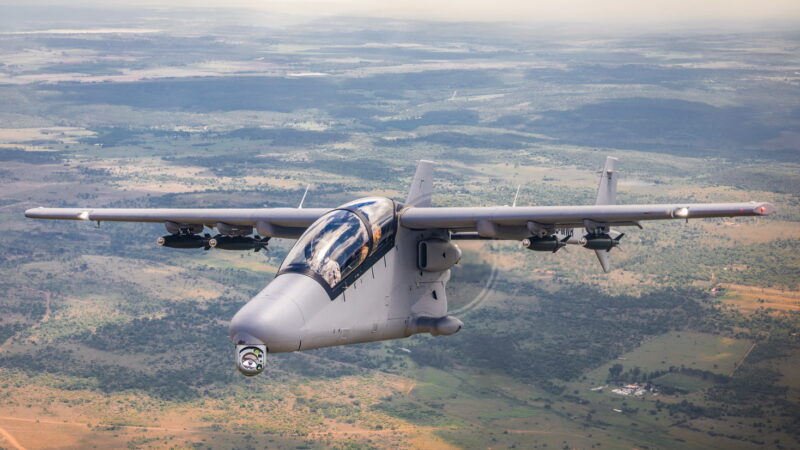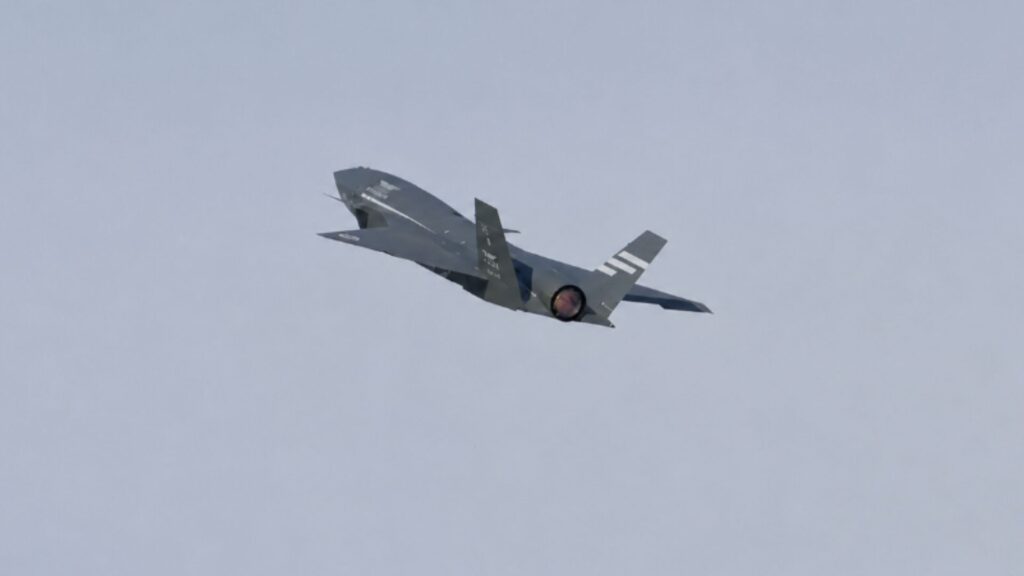
Baykar’s Bayraktar Kızılelma unmanned fighter aircraft has released precision-guided munitions from its internal weapons bay for the first time, scoring direct hits during two separate firing tests.
According to Baykar’s announcement on 30 July 2026, both tests were conducted at the Çorlu Flight Training and Test Centre in Tekirdağ using the S2 airframe. The significance of the aircraft involved is that S2 is a serial-production airframe, rather than one of the prototypes used throughout Kızılelma’s flight-test programme.
Baykar said that both munitions struck their designated targets directly. However, the company did not disclose the altitude, speed or launch envelope used during either test.
Two Munitions for Two Target Sets
The first test took place on Saturday, 25 July, using Roketsan’s TEBER-82. The TEBER-82 is a guidance kit that converts a conventional Mk-82 general-purpose bomb into a precision-guided weapon, with Roketsan rating it for a circular error probable (CEP) of less than 3 m.
A second test followed on Tuesday, 28 July, using Aselsan’s TOLUN. The TOLUN is a glide munition carrying a 105 kg penetrating warhead, rated for use against approximately 1 m of reinforced concrete and offering a stand-off range of up to 57 km from the launching aircraft.
Together, the two weapons give Kızılelma options against different target sets. The TEBER-82 provides a relatively low-cost means of engaging soft and semi-hardened targets at short range, while the TOLUN allows the aircraft to attack hardened points from beyond the engagement envelopes of most short-range and medium-range surface-to-air missile (SAM) systems.
Both weapons are Turkish-made. Roketsan supplies the TEBER-82 and Aselsan produces the TOLUN, making the strike package demonstrated during the July tests domestic at the weapons level.
Closing the Gap Between Carriage and Release
Kızılelma had already flown with both weapons before the July tests. Carriage trials involving the TEBER-82 and TOLUN took place in October 2025, although those flights were intended to validate weapon fit, aerodynamic behaviour and separation clearance. They did not involve live releases against targets.
Carrying weapons internally allows Kızılelma to retain a reduced radar cross-section (RCS) while armed. The trade-off is that the aircraft can carry fewer weapons on a given sortie, with the dimensions of the internal bay also restricting the size of the munitions that can be accommodated compared to external hardpoints.
An internal release presents engineering challenges that do not arise in the same way with externally mounted weapons. Once the bay doors open, the munition must separate cleanly through the aircraft’s boundary layer and clear the airframe without creating an unsafe aerodynamic interaction. Opening the bay also produces a transient increase in the aircraft’s RCS.
Baykar has not disclosed how long Kızılelma’s bay doors remain open during a weapon-release cycle.
Serial Production Ahead of Turkish Air Force Deliveries
In the same announcement, Baykar listed several earlier weapons trials involving Kızılelma. These included firings of the Gökdoğan air-to-air missile, the LGK-82 laser-guidance kit and Roketsan’s JET-230 supersonic air-to-ground missile.
The company also highlighted two events from late 2025. On 29 November, Kızılelma conducted what Baykar described as the first beyond-visual-range (BVR) air-to-air engagement by an unmanned fighter aircraft. On 27 December, the PT3 and PT5 prototypes completed the first autonomous close-formation flight involving two unmanned fighters.
Kızılelma entered serial production ahead of its first planned deliveries to the Turkish Air Force during 2026. Indonesia became the aircraft’s first export customer in May 2026. Since the same month, the Pakistan Air Force (PAF) has also been reported as interested in acquiring the type through an arrangement that would include a local production component.
Baykar reported $2.2 billion in drone exports during 2025, representing approximately 88% of the company’s revenue. Türkiye’s overall defence exports reached about $10.05 billion during the same year.
The S2 is powered by the Ukrainian Ivchenko-Progress AI-322F engine, which Baykar introduced from the fourth prototype onward in place of the less powerful AI-25TLT. Turkish industry continues to develop a domestic replacement.
A Serial Airframe With a Foreign Engine
The July tests place Kızılelma within the small group of combat aircraft that have demonstrated the ability to employ weapons from an internal bay. More importantly for the maturity of the programme, the releases were conducted using the configuration intended for Turkish Air Force units, rather than a dedicated development airframe.
A successful internal weapons release closes the remaining major gap between Kızılelma’s low-observable shaping and a practically usable strike capability. The aircraft can now carry a weapon internally, open its bay, release the munition cleanly and prosecute a target without depending on external hardpoints.
Propulsion remains the programme’s outstanding external dependency, reflecting a constraint that runs through Turkish combat aviation more broadly. The AI-322F comes from a Ukrainian supplier operating under wartime conditions, while no delivery schedule has been published for a Turkish replacement. Any export customer seeking licence production of Kızılelma would inherit that exposure directly.
Quwa has followed these overlapping issues through its coverage of KAAN’s engine-substitution problem, the case for the PAF front-loading its UCAV development around Kızılelma, and the evolution of loyal-wingman UCAVs into collaborative combat aircraft.
Taken together, these developments reflect a Turkish defence industry advancing more quickly in airframe development, autonomy and weapons integration than it has in propulsion. Prospective buyers are consequently being offered an increasingly mature unmanned strike capability whose principal foreign dependency remains concentrated in the engine bay.
Quwa Pro – Defence Market Intelligence
See Where Defence Demand and Technology Are Moving Next
Track procurement priorities across Pakistan, the Gulf and wider MENA, and Central Europe. Follow emerging vendors, drones, AI, C-UAS, and affordable precision weapons, and see how lessons from today’s conflicts are reshaping military requirements and market opportunities.
Featured & Trusted By