
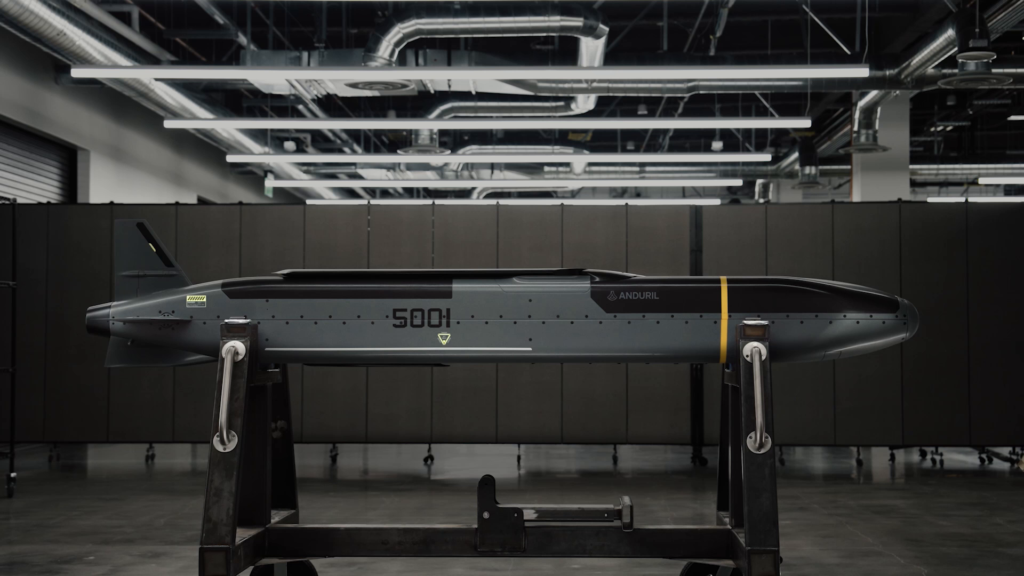
Barracuda is a family of air-breathing autonomous air vehicles built by Anduril Industries in the United States, and sold as low-cost cruise missiles in munition form. Anduril gives the largest variant, Barracuda-500, a range of more than 500 nautical miles (926 km).
The US Department of War signed framework agreements with Anduril for surface-launched Barracuda-500M in May 2026 and for pallet- and lug-launched Barracuda-500 in July 2026. First deliveries are scheduled for 2027.
Know What Defence Buyers in Will Need Next
See emerging requirements, likely suppliers, and routes to market across Pakistan, MENA, and fast-moving defence technologies, before demand becomes obvious.
Key facts
| Attribute | Value |
|---|---|
| Family | Barracuda-100, Barracuda-250, Barracuda-500; munition variants carry the -M suffix |
| US designation | AGM-189A (Barracuda-500M), allocated September 2025 |
| Manufacturer | Anduril Industries, Costa Mesa, California |
| Country of origin | United States |
| Category | Air-breathing autonomous air vehicle; cruise missile in -M configuration |
| First unveiled | 12 September 2024 |
| Range, Barracuda-500 | More than 500 nm / 926 km (Anduril-stated) |
| Payload, Barracuda-500 | More than 100 lb / 45 kg (Anduril-stated) |
| Speed | Up to 500 kt / about 930 km/h, all variants (Anduril-stated) |
| Manoeuvre load | 5 G (Anduril-stated) |
| Loiter | More than 120 minutes, family top-end (Anduril-stated) |
| Propulsion | Single air-breathing turbojet, 150 lb thrust class (Anduril-stated) |
| Guidance and seeker | Not disclosed. Optional integration with Anduril Lattice for Mission Autonomy |
| Contract value | Not disclosed for any Barracuda agreement to date |
| Reported unit cost | Not disclosed. Published and derived figures span US$100,000 to about US$450,000, each measuring something different |
| Operators | None in service. Framework agreements with the US Army and US Air Force |
What is the Anduril Barracuda?
The Anduril Barracuda is a family of turbojet-powered expendable air vehicles designed for high-rate production rather than for peak performance. Anduril describes the family as “air-breathing, software-defined expendable Autonomous Air Vehicles”.
Three sizes exist: Barracuda-100, Barracuda-250 and Barracuda-500. The suffix numbers indicate the weight class of the vehicle in pounds.
Each size has a base autonomous air vehicle configuration and a munition configuration marked with an -M suffix. The munition variants are the barracuda cruise missile products the US Department of War is buying.
Anduril does not market Barracuda as an Anduril loitering munition, though it gives the family a top-end loiter time of more than 120 minutes.
Who makes the Anduril Barracuda?
Anduril Industries was founded on 20 April 2017 by Palmer Luckey, Trae Stephens, Matt Grimm, Joe Chen and Brian Schimpf. Brian Schimpf is chief executive and Trae Stephens is executive chairman.
Christian Brose is president and chief strategy officer. Diem Salmon is vice-president for air dominance and strike, and Steve Milano is senior director for advanced effects, the closest to a named Barracuda programme lead in open sources.
Anduril closed a US$5 billion Series H round in May 2026 at a US$61 billion valuation, led by Thrive Capital and Andreessen Horowitz. Earlier rounds were led by Founders Fund and Sands Capital.
Barracuda production began in a dedicated Southern California facility of more than 115,000 sq ft, which Anduril says cost more than US$40 million.
Production is shifting to Arsenal-1 in Pickaway County, Ohio. Anduril values that plant at nearly US$1 billion and more than 5 million sq ft at completion.
Anduril Barracuda specifications
Anduril publishes range, speed and payload for each variant and withholds almost everything else.
| Specification | Barracuda-100 | Barracuda-250 | Barracuda-500 |
|---|---|---|---|
| Range, September 2026 figure | More than 120 nm | More than 200 nm | More than 500 nm |
| Range, September 2024 figure | 85 nm air, 60 nm surface | 200 nm air, 150 nm surface | 500+ nm air |
| Payload | 35 lb / 16 kg | 35 lb / 16 kg | More than 100 lb / 45 kg |
| Speed | Up to 500 kt | Up to 500 kt | Up to 500 kt |
| Length | 70-78 in form factor | Not disclosed | 111 in / 2.82 m (reference-compiled) |
| Wingspan | Not disclosed | Not disclosed | Not disclosed |
| Weight | Not disclosed | Not disclosed | About 200 kg / 450 lb (reference-compiled) |
| Propulsion | Air-breathing turbojet | Air-breathing turbojet | Turbojet, 150 lb thrust |
| Manoeuvre load | 5 G | 5 G | 5 G |
| Guidance | Not disclosed | Not disclosed | Not disclosed |
All figures are Anduril-stated unless marked. Rows marked “reference-compiled” come from Andreas Parsch’s US military designation directory, which warns its own figures may be inaccurate.
The Barracuda-100 range figure changed between September 2024 and September 2026 without any announcement, moving from 85 nm air-launched to more than 120 nm.
Payload did not change. Anduril gives Barracuda-100 and Barracuda-250 the same 35 lb (16 kg) capacity, and publishes no minimum speed for any variant.
Anduril states it has integrated four different turbojet engines into Barracuda-500 to remove a supply chain bottleneck. No engine model has been named.
Barracuda-500 and the AGM-189A designation
Barracuda-500 is the long-range member of the family and the only one under a US production framework.
The US Air Force allocated the designation AGM-189A to Barracuda-500M in September 2025, alongside AGM-188A for the rival Zone 5 Technologies design.
Anduril states that all Barracuda-500 variants share more than 90 per cent of their parts, so pallet-launched, lug-launched and surface-launched rounds run on the same line.
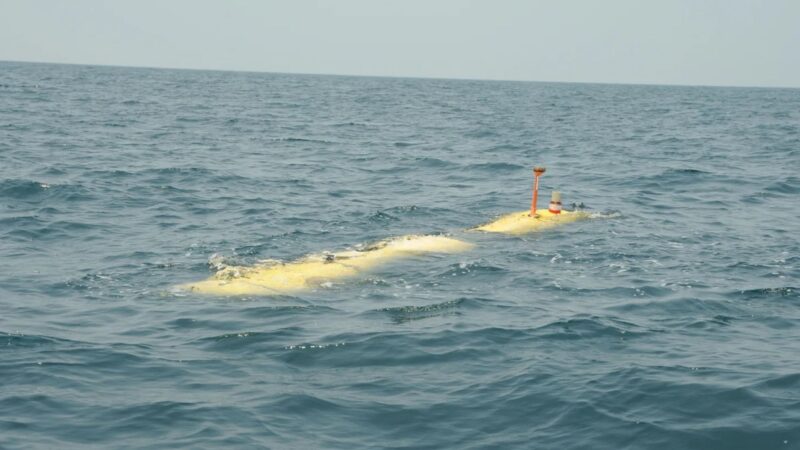
The surface-launched variant, SLB-500M, is a Barracuda-500M with a solid rocket booster. It is a land and maritime strike weapon, and should not be confused with Copperhead-500M, Anduril’s separate underwater munition.
How the Anduril Barracuda is launched
Anduril lists air, ground and maritime launch for the family. Barracuda-250 is sized for the internal weapons bays of fifth-generation fighters, and the smaller variants use external rails on fourth-generation fixed-wing and rotary-wing aircraft.
Reported carriage options include the AH-1Z Viper and AH-64 Apache for Barracuda-100, and the F-15E, F-16 and F/A-18E/F for Barracuda-250 and Barracuda-500. Anduril also cites MFOM launchers and Common Launch Tubes.
Palletized launch is the route into US Air Force service. The lineage runs from the Air Force Research Laboratory Rapid Dragon experiments to Dragon Cart, which became a programme of record on 1 April 2026 with a 2027 fielding target.
SLB-500M ships inside a standard 20-foot ISO container holding up to 16 all-up rounds. Anduril states the missile can also be deployed independently of the container.
Naval News has linked that launcher to Anduril uncrewed surface vessel work with Kraken Technology Group, HD Hyundai and Edison Chouest Offshore.
Anduril Barracuda programme timeline
| Date | Event |
|---|---|
| 3 June 2024 | The Defense Innovation Unit and US Air Force Armament Directorate select Anduril, Integrated Solutions for Systems, Leidos Dynetics and Zone 5 Technologies for the Enterprise Test Vehicle project |
| 12 September 2024 | Barracuda-M family unveiled |
| September 2024 | First successful pallet-launched Barracuda-500 flight test, with more than 30 minutes of autonomous navigation (Anduril-stated) |
| 5 March 2025 | Enterprise Test Vehicle down-select to Anduril and Zone 5 Technologies |
| May 2025 | Barracuda-100M flight tests for the US Army DEVCOM Aviation and Missile Center High-Speed Maneuverable Missile programme |
| September 2025 | AGM-189A designation allocated; ground-launched Barracuda-500M shown at AFA; Taiwan’s NCSIST announces co-production intent |
| 1 April 2026 | Dragon Cart becomes a programme of record |
| 13 May 2026 | Department of War framework agreement for a minimum 3,000 SLB-500M rounds over three years, with 60-plus containerized launchers in 2027 |
| 6 July 2026 | PGZ Barracuda production in Poland agreed at WZL-2 in Bydgoszcz |
| 15 July 2026 | FAMM framework agreements signed with Anduril, CoAspire and Zone 5 Technologies |
| 21 July 2026 | Embraer memorandum of understanding for palletized Barracuda-500M launch from the C-390 Millennium |
What makes the Anduril Barracuda different
The Barracuda pitch is manufacturing, not performance.
Anduril claims on its own product rationale page that a single Barracuda takes 50 per cent less time to produce, requires 95 per cent fewer tools and 50 per cent fewer parts than competing solutions, and is 30 per cent cheaper on average.
Anduril does not name the competing solutions those percentages are measured against. No government test report, congressional testimony or audit body has verified them.
Anduril further claims Barracuda needs ten or fewer tools to assemble, and that commercial automotive and consumer electronics workers can build it.
Forecast International has reported an assembly time of as little as 30 hours and about 70 per cent commercial content.
No dollar value has been published for any Barracuda contract. Both the May 2026 and July 2026 agreements are quantity and schedule frameworks with undisclosed values.
Six unit cost figures circulate, and they measure six different things.
| Figure | What it measures | Attribution |
|---|---|---|
| US$100,000 | Per-round aspiration of Franklin, a separate and earlier Defense Innovation Unit programme | Air & Space Forces Magazine |
| US$150,000 | Enterprise Test Vehicle bulk target, and the 2027 production cost given by Trae Stephens | ETV reporting; Anduril executive statement |
| About US$200,000 | Reported SLB-500M price. No contract value has been published | Forecast International |
| US$216,000 | Taiwan’s NT$6.5 million NCSIST co-production target, not a US price | NCSIST |
| About US$218,000 | Separately reported FAMM round figure | Defense News |
| About US$450,000 | FAMM budget average, US$12.6 billion divided by about 28,000 rounds across FY2027 to FY2031 | Derived from US Air Force budget figures |
The US$218,000 figure is not the result of dividing US$12.6 billion by 28,000 rounds. That division gives about US$450,000.
Anduril Barracuda compared to Rusty Dagger, CMMT and JASSM-ER
| System | Manufacturer | Range | Payload | Reported unit cost |
|---|---|---|---|---|
| Barracuda-500M / AGM-189A | Anduril | 500+ nm (Anduril-stated) | 100+ lb (Anduril-stated) | About US$200,000 |
| AGM-188A Rusty Dagger | Zone 5 Technologies (Kongsberg) | More than 930 km (reference-compiled) | 45 kg / 100 lb warhead | Not disclosed |
| CMMT | Lockheed Martin | “Multiple hundreds of miles” | Not disclosed | US$150,000 target (Lockheed-stated) |
| AGM-190A Black Arrow | Leidos | 740 km / 400 nm demonstrated | About 95 kg / 210 lb all-up | US$150,000 or less target |
| Ragnarök | Kratos | 500 nm | 80 lb | US$150,000 in lots of 100 |
| Red Wolf | L3Harris | 200+ nm, 60+ min | Not disclosed | About US$300,000 at 1,000 per year |
| AGM-158B JASSM-ER | Lockheed Martin | Over 900 km | 450 kg penetrating blast-fragmentation | US$1.1m to US$2.6m reported |
| Tomahawk Block V | RTX | 1,600+ km | 1,000 lb class | US$3.64m for Maritime Strike Tomahawk |
The barracuda cruise missile carries a 45 kg warhead against the 450 kg penetrating warhead of JASSM-ER, at a comparable range. Anduril’s affordable mass argument rests on that trade.
For scale on cruise missile cost, JASSM-ER is reported between US$1.1 million and US$2.6 million, and the Maritime Strike Tomahawk at US$3.64 million. Barracuda-500M is reported at about US$200,000.
The load-bearing unknown is survivability. Nothing is public on Barracuda radar cross-section, penetration aids or performance against a modern integrated air defence system, so cost per effect cannot be compared with a stealthy JASSM-ER.
Rusty Dagger is the closest peer, and the two are closer than earlier reporting suggested.
Andreas Parsch’s directory, which warns its own figures may vary, gives the PBS TJ80-powered AGM-188A more than 930 km of range and a 45 kg warhead. That is the same range band and the same warhead weight as Barracuda-500M.
The differentiators sit elsewhere. Rusty Dagger is entering service via Ukraine’s ERAM package, and Kongsberg’s roughly 90 per cent ownership of Zone 5 Technologies, completed in 2026, gives it a European industrial route.
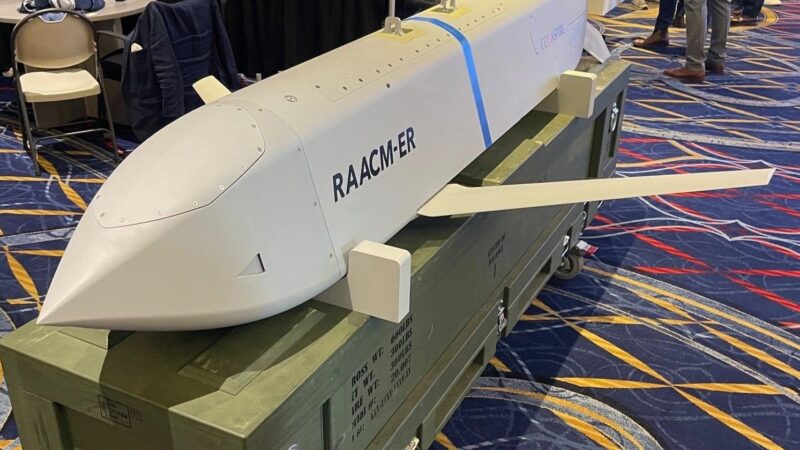
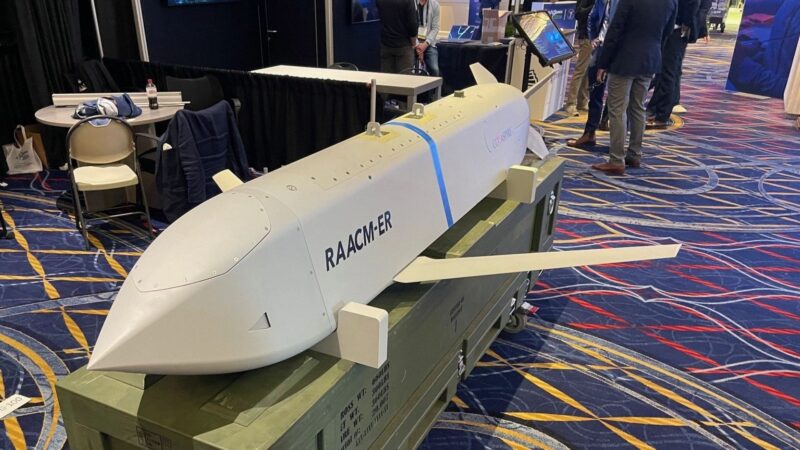
That Foreign Military Sale, announced on 28 August 2025, covers up to 3,350 ERAM rounds worth US$825 million across two designs, CoAspire RAACM and Zone 5 Rusty Dagger. Anduril is not an ERAM vendor.
Lockheed Martin’s CMMT was positioned for FAMM and was not among the three vendors selected in July 2026, a pattern visible across US affordable strike programmes.
Who operates the Anduril Barracuda?
No armed force operates Barracuda in service. Every current arrangement is a development, framework or production agreement.
Contracted: the US Army holds a framework for a minimum 3,000 SLB-500M rounds over three years, run through Lt. Gen. Frank Lozano as Portfolio Acquisition Executive for Fires. The US Air Force holds a seven-year FAMM framework for Barracuda-500.
Both depend on completing test and qualification, and on congressional approval of multiyear authority.
Agreed for production: Poland, where PGZ will build SLB-500M at WZL-2 in Bydgoszcz for the Polish Armed Forces. Quantities and value are not disclosed.
Reported: Taiwan, where NCSIST announced co-production intent in September 2025 with a target unit cost below NT$6.5 million, about US$216,000. No timeline or volume has been published.
There is no public indication of an Australian, British, Japanese or Ukrainian Barracuda requirement. Ukraine’s affordable cruise missile buy is ERAM, not Barracuda.
European competitor activity in this category was visible at MSPO 2026.
What is not publicly known about the Anduril Barracuda
- Contract value. No dollar figure has been published for any Barracuda agreement.
- Survivability. No data on radar cross-section, penetration aids or performance against a modern integrated air defence system.
- Guidance and seeker. No seeker type, datalink or anti-jam navigation detail, despite Anduril marketing SLB-500M against maritime targets.
- Engine. Anduril says four turbojets have been integrated. None has been named.
- Absolute parts and tool counts. Only the relative 50, 95, 50 and 30 per cent claims are published.
- Wingspan and launch weight for all variants.
- The comparator baseline for every design-for-production claim.
- Whether Barracuda-100M and Barracuda-250M have a funded production path. Neither appears in the FAMM or Low-Cost Containerized Munition (LCCM) awards.
- Independent verification of any kind. No GAO, CBO or DOT&E product on Barracuda has been published.
Barracuda has no connection to the Replicator initiative. Its funding path ran through Enterprise Test Vehicle, Franklin and FAMM, then Dragon Cart and the Low-Cost Containerized Munition (LCCM) programme.
Quwa Pro – Defence Market Intelligence
See Where Defence Demand and Technology Are Moving Next
Track procurement priorities across Pakistan, the Gulf and wider MENA, and Central Europe. Follow emerging vendors, drones, AI, C-UAS, and affordable precision weapons, and see how lessons from today’s conflicts are reshaping military requirements and market opportunities.
Featured & Trusted By







Frequently asked questions about the Anduril Barracuda
What is the Anduril Barracuda?
The Anduril Barracuda is a family of air-breathing autonomous air vehicles built by Anduril Industries in the United States, unveiled on 12 September 2024. It comes in three sizes, Barracuda-100, Barracuda-250 and Barracuda-500, with munition versions carrying an -M suffix.
Who makes the Anduril Barracuda?
Anduril Industries of Costa Mesa, California makes the Anduril Barracuda, and is moving production to Arsenal-1 in Pickaway County, Ohio. Anduril was founded in 2017 by Palmer Luckey, Trae Stephens and Brian Schimpf, and was valued at US$61 billion in May 2026.
How much does the Anduril Barracuda cost?
No contract value or unit price has been published for the Anduril Barracuda, and Forecast International reports about US$200,000 for surface-launched Barracuda-500M. The Enterprise Test Vehicle target was US$150,000, and the FAMM budget averages about US$450,000 per round.
What is the range of the Barracuda-500?
Anduril states the Barracuda-500 has a range of more than 500 nautical miles, or 926 km, with Barracuda-250 at more than 200 nm and Barracuda-100 at more than 120 nm. The Barracuda-100 figure was 85 nm air-launched at the September 2024 unveiling.
How fast is the Anduril Barracuda?
Anduril gives all three Barracuda variants a top speed of up to 500 knots, about 930 km/h, and publishes no minimum speed. Every variant is subsonic on a single air-breathing turbojet, and Anduril rates the family for 5 G manoeuvring.
What warhead does the Anduril Barracuda carry?
Anduril does not publish warhead types for the Barracuda, giving payload capacity only: more than 100 lb (45 kg) for Barracuda-500, and 35 lb (16 kg) for both Barracuda-250 and Barracuda-100. Anduril states each Barracuda variant accepts kinetic and non-kinetic payloads.
How is the Anduril Barracuda launched?
The Anduril Barracuda launches from fighter pylons, fifth-generation internal bays, helicopter rails, Common Launch Tubes, ground vehicles and surface vessels. Palletized launch runs through Dragon Cart, and Barracuda-500M uses a 16-round ISO container with a booster.
Is the Anduril Barracuda in production?
The Anduril Barracuda is not yet in series production. Anduril builds it at a Southern California facility, states it can reach high single-digit thousands of Barracuda-500 annually by the end of 2026, and is scheduled to make first contracted deliveries in 2027.
Who is buying the Anduril Barracuda?
The US Army has contracted for at least 3,000 surface-launched Barracuda-500M rounds and the US Air Force holds a seven-year FAMM framework. Poland’s PGZ will build the round at Bydgoszcz, Taiwan’s NCSIST announced co-production intent, and none is in service.
How does the Anduril Barracuda compare to the Rusty Dagger missile?
Barracuda-500M and the AGM-188A Rusty Dagger from Zone 5 Technologies are closely matched, both at more than 930 km with a 45 kg warhead. Rusty Dagger is entering service through Ukraine’s ERAM package, and Kongsberg ownership gives it a European production route.