
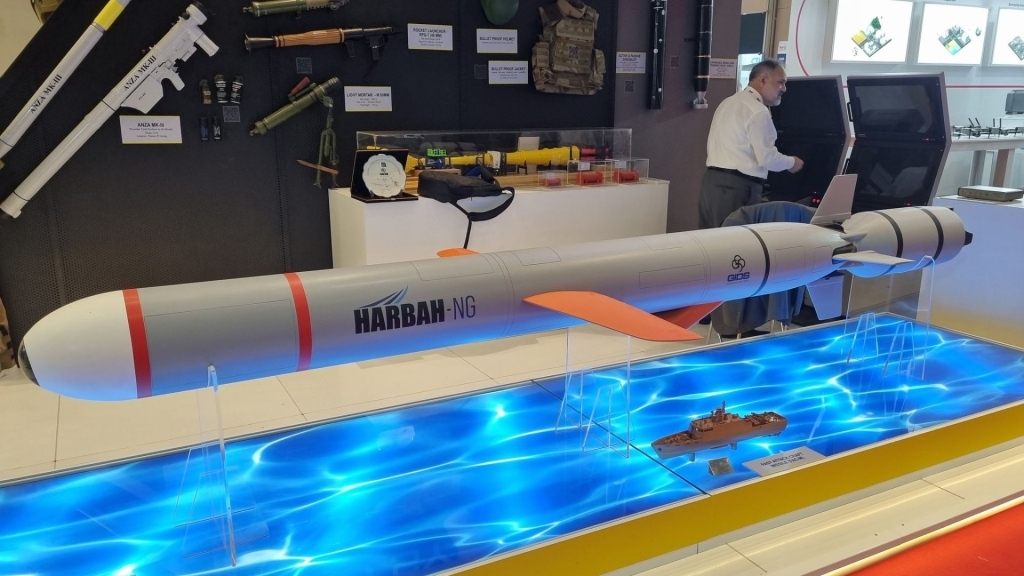
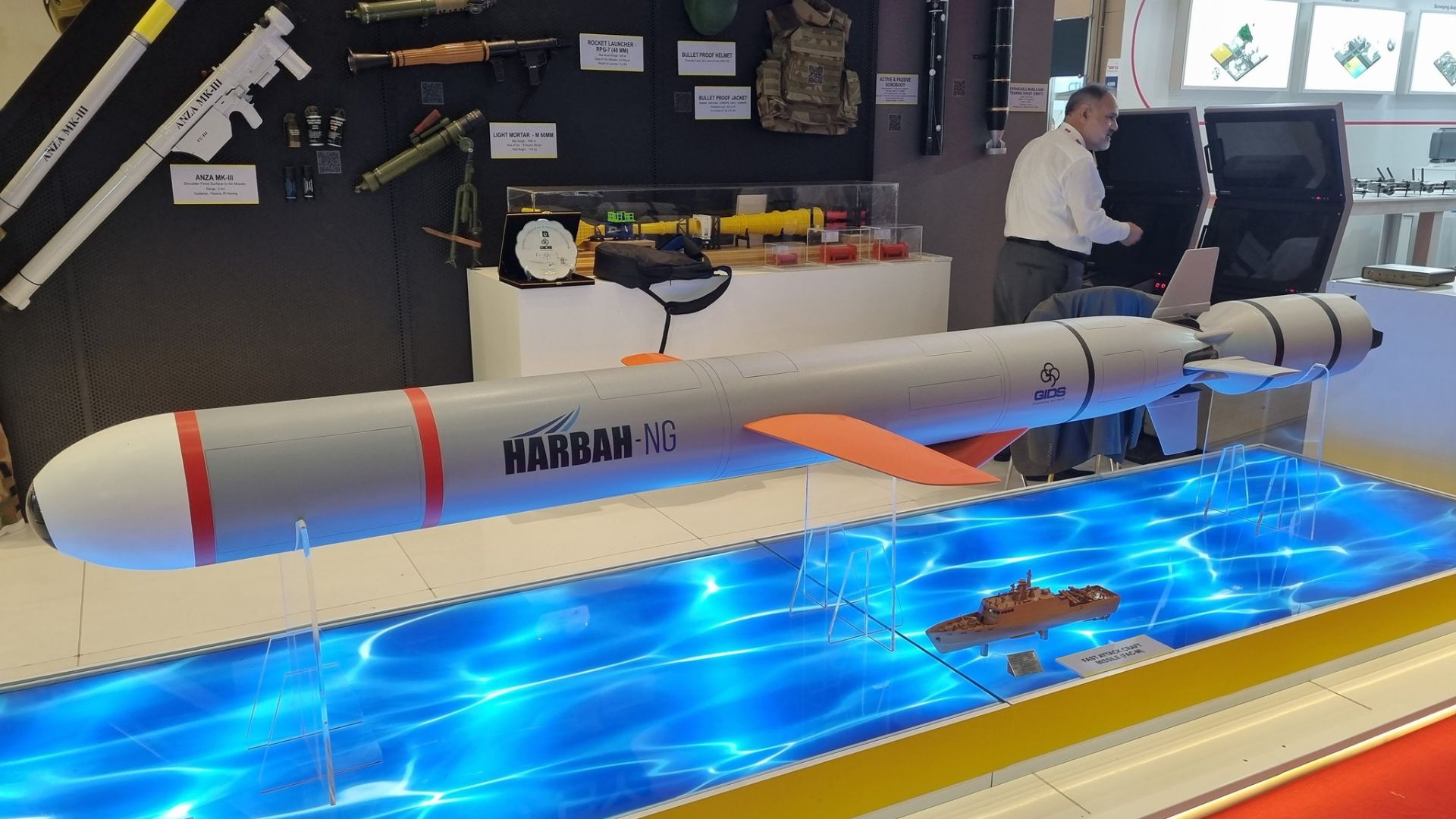
The Harbah NG is a subsonic anti-ship cruise missile (ASCM) developed by Pakistan’s National Engineering and Scientific Commission (NESCOM) and marketed for export by Global Industrial and Defence Solutions (GIDS). Derived from the strategic Babur land-attack cruise missile (LACM) platform, the Harbah NG is a dual-role weapon capable of both anti-ship and land-attack missions with a range of 280 km in its export configuration.
The Harbah NG is the export variant of the Harbah missile operated by the Pakistan Navy (PN). The PN first test-fired the Harbah in January 2021 from an Azmat-class fast attack craft (FAC), PNS Himmat. The domestic variant is understood to have a significantly longer range – potentially close to the Babur-3 SLCM’s 450 km – though this has not been officially confirmed.
The Harbah NG shares its Babur-derived platform lineage with the Fatah-4 ground-launched cruise missile (GLCM) – both use the same core airframe, miniature turbojet propulsion, and navigation architecture. This common-platform relationship mirrors the Fatah-2/SMASH ASBM pairing.
Know What Defence Buyers in Will Need Next
See emerging requirements, likely suppliers, and routes to market across Pakistan, MENA, and fast-moving defence technologies, before demand becomes obvious.
Harbah NG Specifications
| Parameter | Specification |
|---|---|
| Type | Anti-Ship Cruise Missile (ASCM) / Land-Attack Cruise Missile (LACM) |
| Developer | NESCOM / GIDS |
| Range | 280 km (export); domestic variant likely 400–450 km |
| Cruise Speed | Mach 0.6–0.8 |
| Length | 6.8 m |
| Diameter | 0.5 m |
| Weight | 1,350 kg |
| Mid-Course Guidance | GPS/GNSS-aided INS with DSMAC |
| Terminal Guidance | Imaging infrared (IIR) or active radar-homing (ARH) seeker |
| Propulsion | Miniature turbojet (possibly NESCOM NTJ-V1) |
| Common Platform | Fatah-4 GLCM (common Babur-derived platform) |
| Launch Platforms | Azmat-class FAC; Babur-class (MILGEM) corvette; Jinnah-class frigate (planned); submarines (Babur-3 derivative) |
| Status | Operational (PN); actively promoted for export |
Babur Platform Heritage
The Harbah NG is a variant or further development of the Babur-series of land-attack cruise missiles. The Babur was originally introduced as a ground-launched cruise missile for strategic deterrence. In 2017, the PN tested a submarine-launched cruise missile (SLCM) variant – the Babur-3 – with a range of 450 km, demonstrating the platform’s adaptability to naval launch environments.
The Harbah NG likely draws on the Babur-3’s truncated airframe design – adapted for ship-based launch canisters rather than submarine tubes. The stated export range of 280 km adheres to Missile Technology Control Regime (MTCR) thresholds, while the PN’s domestic Harbah is likely longer-ranged, potentially close to or exceeding the Babur-3’s 450 km.
This Babur heritage is shared with the Fatah-4 GLCM – the Pakistan Army’s conventional ground-launched derivative of the same platform. As Quwa has analysed in detail, this common-platform approach allows NESCOM to consolidate supply chains across the PA and PN, amortising production costs across a larger procurement base.
Guidance Suite
The Harbah NG employs a multi-mode guidance suite. For mid-course navigation, the missile uses GPS/GNSS-aided inertial navigation (INS) combined with a Digital Scene Matching Area Correlator (DSMAC) camera – the same guidance architecture used by the Fatah-4 GLCM. The DSMAC compares a real-time image of the terrain below the missile with a pre-loaded digital map database, providing GPS-independent terminal precision.
For the anti-ship warfare (AShW) role, the Harbah NG adds a terminal-stage seeker – optionally an imaging infrared (IIR) or active radar-homing (ARH) system. The IIR seeker offers passive, jam-resistant terminal guidance, while the ARH seeker provides all-weather target acquisition through sea clutter. The ability to select between seeker modes gives the operator flexibility to match the terminal guidance to the threat environment.
Platform Integration
The Harbah was first test-fired from PNS Himmat, an Azmat-class fast attack craft (FAC), in January 2021. When deployed aboard a surface warship, the Harbah is typically configured in two three-cell launchers – giving a single ship a six-round magazine.
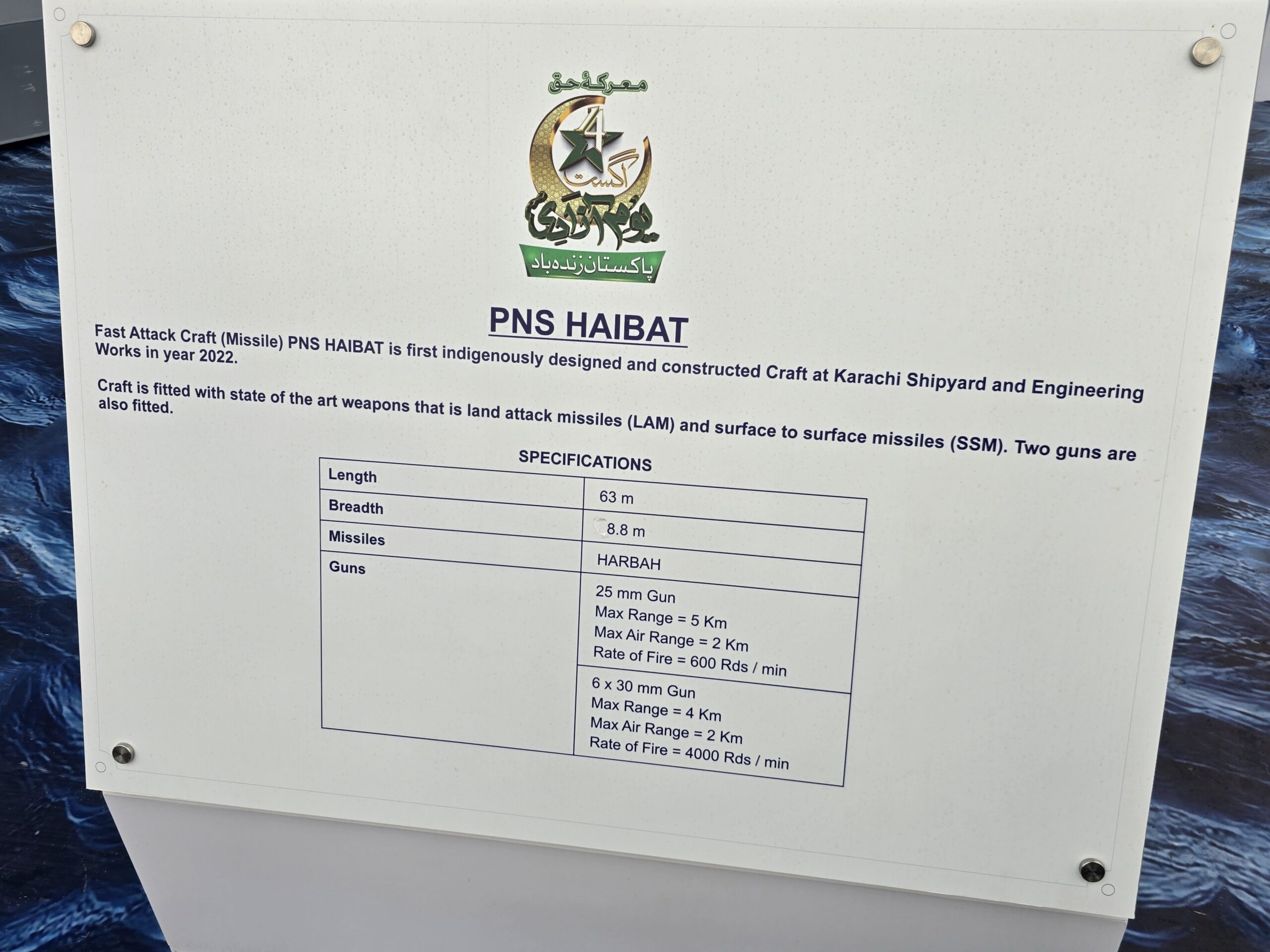
The Harbah’s integration extends beyond the Azmat-class. The missile is expected to be carried by the Babur-class (MILGEM) corvettes and the forthcoming Jinnah-class frigates. The Babur-3 SLCM variant provides a submarine-launched capability, giving the PN a subsonic cruise missile strike option across surface combatants, submarines, and potentially the Sea Sultan maritime patrol aircraft.
This breadth of platform integration – from sub-1,000-ton FACs to 3,000+ ton frigates and submarines – makes the Harbah one of the PN’s most versatile strike assets. A small FAC armed with Harbah missiles can pose a credible threat to both surface combatants and land targets at 280+ km range – a capability that was previously reserved for larger, more expensive platforms.
Common Platform With the Fatah-4
The Harbah NG and the Fatah-4 GLCM share the same Babur-derived core platform – airframe, turbojet propulsion, and navigation architecture. The Fatah-4 is the Pakistan Army’s conventional land-attack derivative; the Harbah NG is the Pakistan Navy’s anti-ship and land-attack derivative.
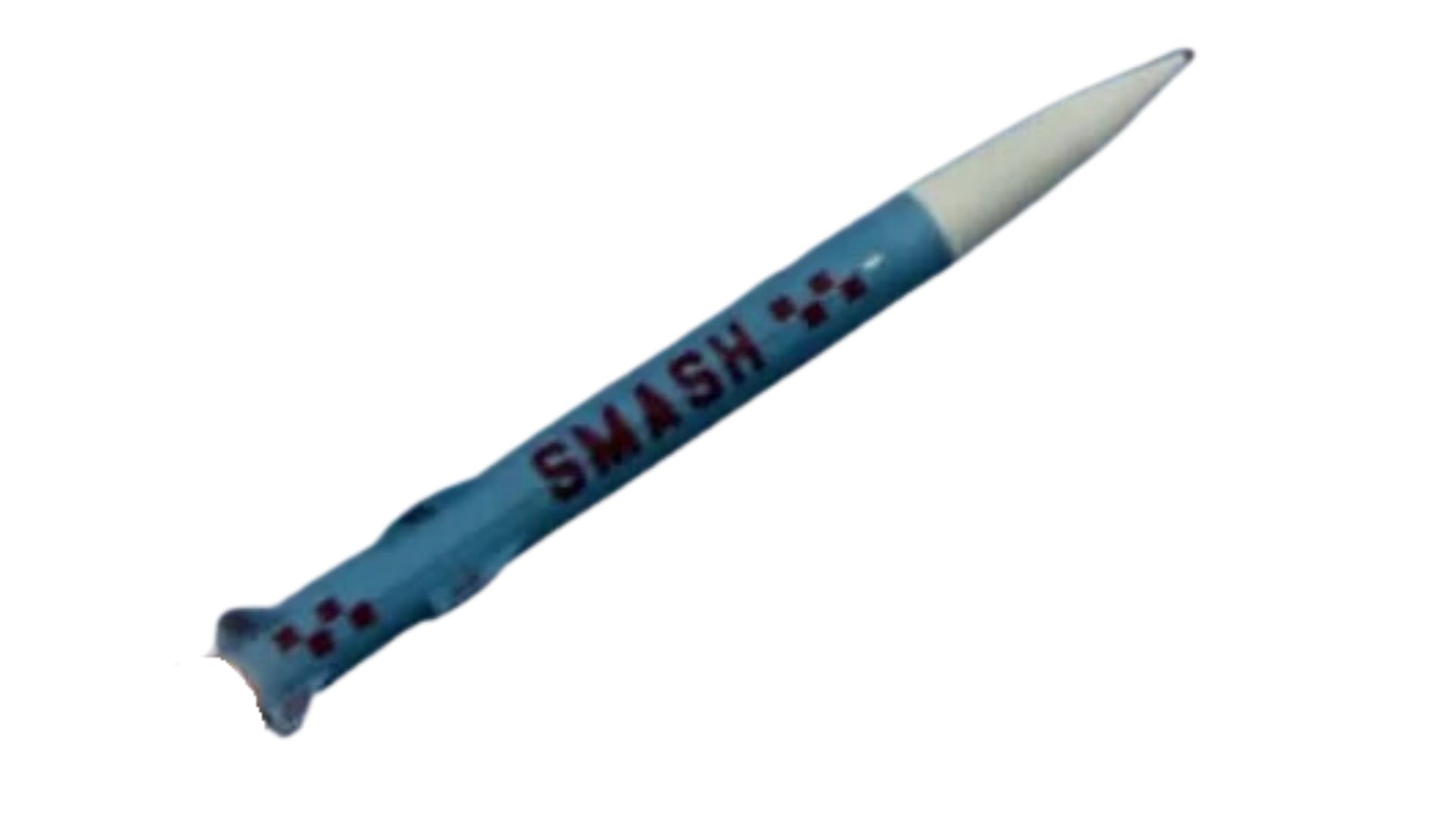
This common-platform relationship mirrors the Fatah-2/SMASH ASBM pairing – where a 600 mm-diameter ballistic missile platform serves both the PA (Fatah-2) and PN (SMASH). Together, these two platform families – Babur-derived (Harbah NG + Fatah-4) and 600 mm (SMASH + Fatah-2) – form the backbone of Pakistan’s conventional missile production infrastructure.
A2/AD Role and the Pakistan Navy’s Strike Mix
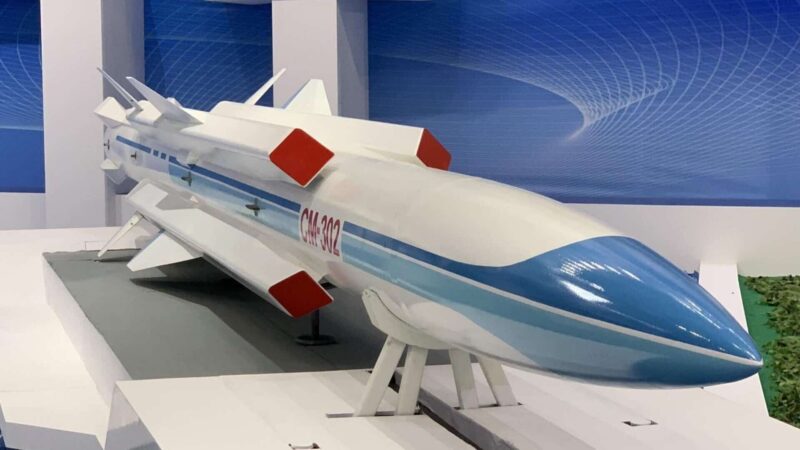
The Harbah NG occupies the subsonic, low-altitude tier of the PN’s anti-ship missile portfolio. It complements the CM-302 supersonic-cruising missile on the Tughril-class (Type 054A/P) frigates and the SMASH ASBM‘s quasi-ballistic approach vector.
A mixed salvo combining the Harbah’s sea-skimming approach with the SMASH’s high-altitude descent and the CM-302’s sustained supersonic cruise would force a defending ship to engage threats across three distinct flight profiles simultaneously – stressing the engagement capacity of any integrated air defence system.
The Harbah’s dual anti-ship and land-attack capability also supports the PN’s anti-access and area-denial (A2/AD) strategy. During the May 2025 conflict and the subsequent Hormuz crisis escort operations, the PN’s ability to threaten both surface targets and coastal infrastructure from dispersed, small-footprint platforms would have been operationally relevant.
Export Potential
GIDS has actively promoted the Harbah NG at international defence exhibitions, including the World Defense Show in Riyadh and IDEAS in Karachi. The system’s combination of dual-role capability, 280 km range, and relatively compact form factor makes it competitive for navies seeking a versatile ship-launched cruise missile.
For export buyers, the Harbah NG offers an integrated package alongside the Fatah-2 and SMASH – providing a modular family of land-attack and anti-ship missiles from a single production line with shared logistics. This is a differentiated offering that few mid-tier defence exporters can match, particularly in the Gulf defence market where naval rearmament is accelerating.
Quwa Pro – Defence Market Intelligence
See Where Defence Demand and Technology Are Moving Next
Track procurement priorities across Pakistan, the Gulf and wider MENA, and Central Europe. Follow emerging vendors, drones, AI, C-UAS, and affordable precision weapons, and see how lessons from today’s conflicts are reshaping military requirements and market opportunities.
Featured & Trusted By







Frequently Asked Questions About the Harbah NG
What is the range of the Harbah NG?
The export variant has a range of 280 km, capped under MTCR guidelines. The PN’s domestic Harbah likely has a significantly longer range – potentially 400–450 km based on the Babur-3 SLCM benchmark.
What is the relationship between the Harbah NG and the Fatah-4?
Both are derived from the Babur cruise missile platform. The Fatah-4 is the Pakistan Army’s ground-launched conventional variant (750 km). The Harbah NG is the Pakistan Navy’s ship-launched anti-ship and land-attack variant.
What ships carry the Harbah?
The Harbah was first test-fired from the Azmat-class FAC (PNS Himmat). It is expected on Babur-class corvettes, Jinnah-class frigates, and potentially submarines via the Babur-3 SLCM derivative.
Is the Harbah NG supersonic?
No. The Harbah NG is a subsonic cruise missile, cruising at Mach 0.6–0.8. Its survivability relies on sea-skimming flight rather than speed. For supersonic anti-ship capability, the PN uses the CM-302 and SMASH ASBM.
Who developed the Harbah NG?
The Harbah was developed by NESCOM and is marketed for export by GIDS. The system draws on Strategic Plans Division (SPD) expertise in cruise missile design, originally developed for the Babur programme.
Related Profiles
- GIDS Fatah Missile Family – Overview of the full Fatah-series and common-platform architecture.
- Fatah-4 Ground-Launched Cruise Missile – The PA’s conventional Babur-derived GLCM sharing the Harbah’s platform.
- SMASH Anti-Ship Ballistic Missile – The PN’s quasi-ballistic ASBM derived from the Fatah-2 platform.
- Fatah-2 Surface-to-Surface Missile – The PA’s 400 km-range tactical ballistic missile.
- Retrospective: PN Surface Combatants (2007–2026) – The Harbah in the context of the PN’s fleet modernisation.
- Beyond Nuclear: Pakistan’s Shift to Mass-Produced Conventional Strikes – The strategic context for common-platform missile production.