This Industry Brief is a follow-up to Quwa’s November 2025 Market Intelligence analysis, “Pakistan’s One-Way Effector (OWE) Market,” which assessed the state of Pakistan’s emerging OWE capability.
The original brief found that Pakistan was “more unintentionally than systematically” developing systems that could become jet-powered one-way attack or effector munitions (OWE), and that a coherent strategy to integrate these systems was absent. However, in this update, Quwa assesses that Pakistan is, as of 2026, actively pursuing a strategy to design, produce, and procure jet-powered OWEs.
In November 2025, Quwa assessed that Pakistan’s state-owned enterprises (SOEs) – i.e., National Engineering & Scientific Commission (NESCOM), Global Industrial & Defence Solutions (GIDS), and National Aerospace Science & Technology Park (NASTP) – had the capacity to develop jet-powered OWEs through their various loitering munition and small-factor cruise missile projects, but it was not pursuing a coherent strategy for producing or procuring such solutions.
The concern at the time was that siloed, service-specific programs were producing overlapping munitions without a unifying strategy to exploit the OWE concept’s core advantage, i.e., saturating enemy integrated air defence systems (IADS) through scale and speed. In other words, the country had the building blocks, but nobody had drawn up the blueprint.
By April 2026, however, both private-sector and state-owned Pakistani vendors had publicly revealed dedicated jet-powered OWE designs.
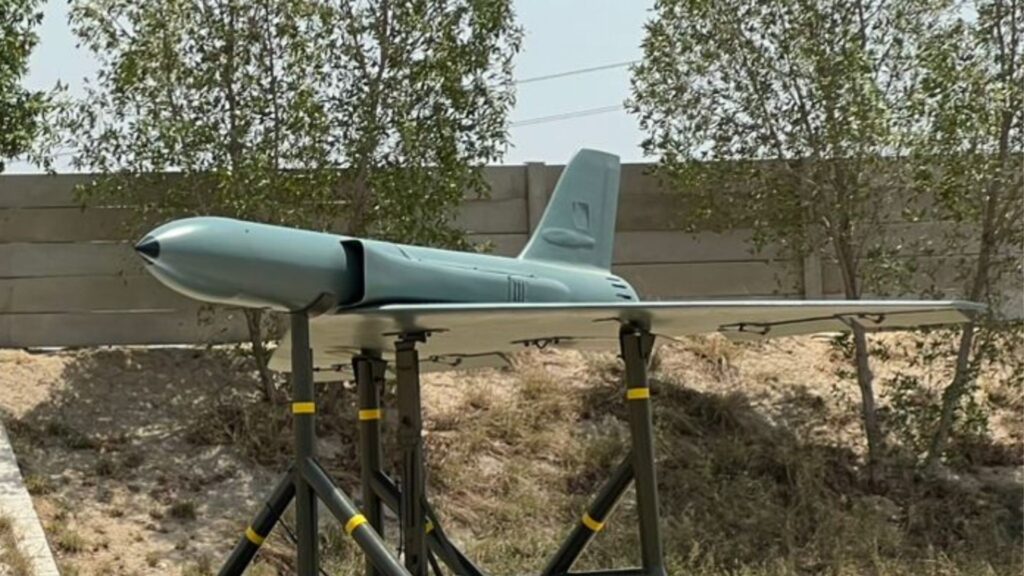
Woot-Tech Aerospace, a private company, unveiled the HiMark-25(TJ), a turbojet-powered variant of its propeller-driven HiMark-25 loitering munition, offering a 250 km range, 320 km/h dash speed, and a 25 kg warhead.
GIDS (which represents NESCOM) revealed the Baaz Delta, a jet-powered OWE occupying a broadly similar performance niche, joining miniature cruise missiles like the Sarfarosh/Sarkash and, possibly, Blaze 75, which provide ranges of 1,000 km and 500 km, respectively.
Through the HiMark-25(TJ) and Baaz Delta, the Pakistani defence industry has gone from passively accumulating OWE-adjacent capabilities to deliberately developing jet-powered OWEs.
The original brief identified four structural risks: ambiguity in intent, siloed requirements across service arms, a lack of tri-service coordination, and production constraints.
Quwa Pro
See Where Emerging Defence Markets are Moving
Quwa Pro goes beyond tracking programs and equipment by explaining the policies, incentives, industry dynamics, and competitive pressures shaping South Asia's defence markets.
Subscribe Already a subscriber?Sign in