

As of October 2026, Pakistan operates PakSat-1R and PakSat-MM1 as its two communications satellites in geostationary orbit (GEO). Five remote-sensing satellites have also launched since January 2025 – PRSC-EO1, PRSC-S1, HS-1, PRSC-EO2 and PRSC-EO3 – according to Quwa’s reporting on the PRSC-EO3 launch.
The Space and Upper Atmosphere Research Commission (SUPARCO) oversees Pakistan’s satellite program, with Chinese rockets having launched every satellite in the current fleet. PRSS-1 and PakTES-1A, both launched in 2018, may still be in orbit, though neither satellite’s operating status is confirmed.
Planned additions include PakSat-2, submitted for final federal approval in September 2026, and a 20-satellite radar constellation covered by a USD $406 million deal with China’s PIESAT.
Know What Defence Buyers in Will Need Next
See emerging requirements, likely suppliers, and routes to market across Pakistan, MENA, and fast-moving defence technologies, before demand becomes obvious.
Pakistan’s satellites in orbit (2026)
The inventory below covers Pakistan’s satellites in orbit and two planned projects. PRSC-EO3 is the latest addition, having reached orbit aboard a Long March 6 rocket on 25 April 2026.
| Satellite | Type | Launch | Orbit | Status |
|---|---|---|---|---|
| PakSat-1R | Communications: 12 C-band and 18 Ku-band transponders | 12 August 2011 Long March 3B/E, Xichang | GEO, 38°E | Operating; passed its 15-year design life in August 2026 |
| PakSat-MM1 | Communications: 48 C, Ku and Ka-band transponders, plus L-band navigation augmentation | 30 May 2024 Long March 3B, Xichang | GEO, 38.2°E | Operational since 18 September 2024 |
| PRSS-1 | Electro-optical imaging | 9 July 2018 Long March 2C, Jiuquan | Sun-synchronous, about 97.9° | Unconfirmed; likely replaced by PRSC-EO1 |
| PakTES-1A | Technology evaluation and imaging, designed by SUPARCO | 9 July 2018 Long March 2C, Jiuquan | Low earth orbit | Listed among SUPARCO satellites in August 2025 |
| PRSC-EO1 | Electro-optical imaging | 17 January 2025 Long March 2D, Jiuquan | Low earth orbit | Operating; five-year design life |
| PRSC-S1 | Reported synthetic aperture radar imaging | 31 July 2025 Kuaizhou-1A, Xichang | Low earth orbit | Operating |
| HS-1 | Hyperspectral imaging | 19 October 2025 Kinetica-1, Jiuquan | Low earth orbit | Operating |
| PRSC-EO2 | Electro-optical imaging | 12 February 2026 Smart Dragon-3, sea platform off Yangjiang | Low earth orbit | Operating |
| PRSC-EO3 | Electro-optical imaging with onboard artificial intelligence processing | 25 April 2026 Long March 6, Taiyuan | About 554 km, 38° inclination | Operating |
| PakSat-2 (planned) | Communications: C-band and Ku-band | Not announced | GEO, 38°E | Sent for final federal approval in September 2026 |
| PIESAT constellation (planned) | 20 radar satellites in the first phase | Not announced | Low earth orbit | Framework agreement concluded on 4 September 2025 |
ICUBE-Q is excluded from this inventory: the 7 kg cubesat flew on China’s Chang’e-6 lunar mission in May 2024 with a three-month design life. The table also omits the interim satellite called PakSat-MM1 from 2018, as its status following the current PakSat-MM1’s entry into service has not been reported.
How many satellites does Pakistan have?
As of October 2026, Pakistan’s operating satellite fleet numbers at least seven. It comprises the two GEO communications satellites PakSat-1R and PakSat-MM1, alongside five remote-sensing satellites launched since January 2025: PRSC-EO1, PRSC-S1, HS-1, PRSC-EO2 and PRSC-EO3.
If PRSS-1 and PakTES-1A remain operational following their launch on 9 July 2018, the total reaches nine. SUPARCO has given PRSS-1 a design life ranging from five to seven years, while Quwa’s targeting analysis assessed that PRSC-EO1 likely took its place in January 2025.
A satellite’s orbit and mission also influence its lifespan. As Quwa’s PRSC-EO1 report explains, GEO satellites typically operate for 15 to 20 years, compared with about 5 to 10 years for those in low earth orbit (LEO).
These differences affect when Pakistan needs replacement satellites. PakSat-1R exceeded its 15-year design life in August 2026, whereas SUPARCO’s PRSC-EOS program page lists a five-year design life for each PRSC-EO satellite.
Know What Defence Buyers in Will Need Next
See emerging requirements, likely suppliers, and routes to market across Pakistan, MENA, and fast-moving defence technologies, before demand becomes obvious.
What was Pakistan’s first satellite?
Pakistan’s first satellite, Badr-1, reached LEO on 16 July 1990 aboard a Chinese Long March 2E rocket. SUPARCO’s Badr-1 page identifies it as the first satellite the country developed indigenously and operated.
Subsequent missions introduced other national firsts. In its 2019 brochure, SUPARCO identifies PakSat-1R, launched in 2011, as Pakistan’s first nationally owned and operated communications satellite, while PRSS-1 was its first high-resolution remote-sensing satellite.
January 2025 brought PRSC-EO1, which Quwa’s PRSC-EO3 report identifies as Pakistan’s first indigenously built electro-optical (EO) imaging satellite. PRSC-S1 followed as the country’s first known synthetic aperture radar (SAR) satellite in July 2025, before HS-1 introduced Pakistan’s first hyperspectral sensor that October.
Pakistan’s satellite program at a glance
The following table identifies the organizations and resources behind Pakistan’s satellite program, covering leadership, users, construction and funding, with sources for each entry.
| Item | Publicly documented description | Source |
|---|---|---|
| Program lead | SUPARCO | Quwa |
| Military user | Pakistan Air Force Space Command, revealed in 2021 and reported to use satellite imagery for intelligence, surveillance and reconnaissance | Quwa; Quwa |
| Launch provider | China, including launches arranged by China Great Wall Industry Corporation | Quwa; Quwa |
| Domestic build capability | A 300 kg-class LEO satellite bus with a three-to-five-year design life and about 600 W of power, able to carry radar or optical payloads | SUPARCO brochure (2019) |
| Largest domestically developed satellite | PRSC-EO3, at a reported mass of over 500 kg | Quwa |
| Navigation augmentation | Pak-SBAS, broadcast through PakSat-MM1 | Pakistan’s status paper to the International Civil Aviation Organization (May 2025); Quwa |
| Long-range plan | Space Vision 2040 | Quwa |
| Development budget | USD $19.5 million in 2025-26, down from USD $235 million in 2024-25 | Quwa |
PakSat-MM1: Pakistan’s communications and navigation satellite
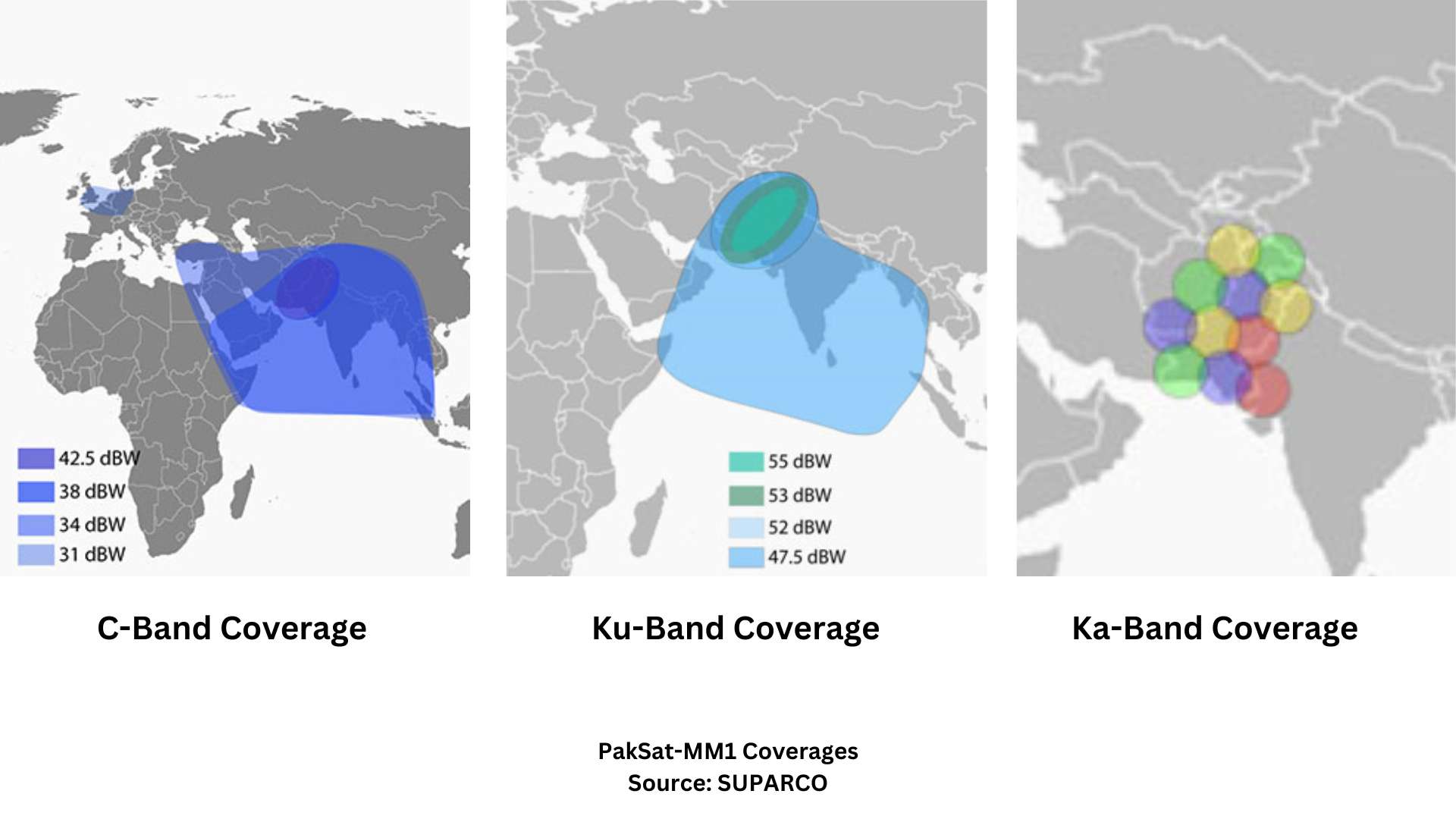
Stationed at 38.2°E in GEO, PakSat-MM1 serves as Pakistan’s multi-mission communications satellite. Launched from Xichang by a Long March 3B rocket on 30 May 2024, it has 48 transponders operating across C, Ku and Ka bands, according to Quwa’s PakSat-MM1 report.
An L-band satellite-based augmentation system (SBAS) payload also equips PakSat-MM1, reportedly the first satellite outside China to provide SBAS support for BeiDou navigation. According to Quwa’s analysis of SUPARCO’s budget, SUPARCO declared PakSat-MM1 operational on 18 September 2024.
PakSat-MM1’s C-band transponders reach South Asia, the Middle East, the Horn of Africa and parts of the UK, France, Germany, Belgium and the Netherlands. Ku-band coverage extends over Pakistan, India, the Arabian Sea and parts of the Arabian Peninsula and Bangladesh, while Ka-band serves Pakistan and most of Afghanistan.
Before launch, the present satellite carried the name PakSat-MM1R. The PakSat-MM1 designation had been used in 2018 for an interim satellite moved to 38.2°E on 27 February 2018, with 28 C-band and 28 Ku-band transponders for direct-to-home television and a backup role for PakSat-1R.
The PakSat-MM1 contract between SUPARCO and China Great Wall Industry Corporation (CGWIC) was signed on 22 March 2018, with Pakistan’s planning minister stating that each side would contribute 50%, as Quwa reported at the time. Chinese state media also reported provisions for technology transfer and training Pakistani personnel.
Both Pakistan and China describe PakSat-MM1 as a civilian satellite. Quwa’s PakSat-MM1 analysis nevertheless assessed that it would likely support expanding military use of satellite communications (SATCOM), including the Tughril-class (Type 054A/P) frigate’s Ku-band terminal and the Pakistan Navy’s Naval Information Exchange System.
What is Pak-SBAS?
Pak-SBAS, the Pakistan Space Based Augmentation System, calculates corrections for GPS and BeiDou positioning errors, broadcasting them via PakSat-MM1. A status paper Pakistan presented to the International Civil Aviation Organization (ICAO) in May 2025 identifies SUPARCO as its implementer and operator, working with the Pakistan Civil Aviation Authority and the Pakistan Airports Authority.
Its ground segment comprises 12 monitoring stations, a central data processing centre and a ground uplink station. As Quwa’s Pak-SBAS coverage explains, PakSat-MM1 rebroadcasts the corrections using three signals: L1 for GPS, L5 for GPS and BeiDou, and B2b for BeiDou.
According to the ICAO paper, Pak-SBAS dates to 2019, followed by a development contract in November 2020 and a critical design review in August 2022. The service launched aboard PakSat-MM1 in May 2024, with testing and commissioning in September 2024.
The 2026 Cholistan Rally marked Pak-SBAS’s public unveiling by SUPARCO, which announced its launch on 15 February 2026 and reported sub-metre positioning accuracy under desert-racing conditions. Quwa assessed it as the first system outside China to augment BeiDou as a primary constellation alongside GPS.
Pak-SBAS therefore improves the accuracy of both navigation systems Pakistan uses: GPS and BeiDou. The ICAO paper also states that SUPARCO plans feasibility work on a second GEO satellite for the system.
PakSat-1R and PakSat-2
Launched from Xichang on 12 August 2011, PakSat-1R is Pakistan’s older GEO communications satellite, carrying 12 C-band and 18 Ku-band transponders. According to Quwa’s PakSat-2 report, it continues operating alongside PakSat-MM1 despite passing its 15-year design life in August 2026.
Pakistan plans to replace PakSat-1R with PakSat-2. Its January 2025 filing with the International Telecommunication Union identifies the same 38°E orbital slot occupied by PakSat-1R and specifies C-band coverage at 4 GHz and 6 GHz, alongside Ku-band.
PakSat-2 received in-principle approval from the Central Development Working Party (CDWP) on 25 June 2026. The CDWP then referred it to the Executive Committee of the National Economic Council (ECNEC) on 11 September 2026 for final approval.
The project’s reported cost is Rs 37.19 billion, approximately USD $134 million, according to ProPakistani. Upgrades to ground control centres in Lahore and Karachi are also included, although financing arrangements and a launch date remain unannounced.
PRSC-EO1, PRSC-EO2 and PRSC-EO3
SUPARCO’s PRSC-EOS electro-optical constellation consists of three satellites: PRSC-EO1, PRSC-EO2 and PRSC-EO3. Their launches took place in January 2025, February 2026 and April 2026, respectively, with PRSC-EO3 completing the series, according to Quwa’s PRSC-EO3 report.
On its program page, SUPARCO describes three optical remote-sensing satellites, each designed for five years of service and originally due to launch in 2022–2023. It lists applications in land mapping, agricultural assessment, urban and rural planning, environmental monitoring and disaster management.
PRSC-EO1 reached orbit from Jiuquan on 17 January 2025 aboard a Long March 2D rocket, on a CGWIC mission that also carried China’s DAO-1 and Blue Carbon-1 satellites. According to Quwa’s PRSC-EO1 report, a SUPARCO official specified a five-year lifespan for PRSC-EO1.
On 12 February 2026, PRSC-EO2 was one of seven satellites launched by a Smart Dragon-3 rocket from a sea platform at China’s Yangjiang Seashore Launch Centre. Quwa’s PRSC-EO2 report identifies this as SUPARCO’s first sea launch, carried out under a CGWIC multi-launch contract signed in 2022.
PRSC-EO3 launched from Taiyuan on 25 April 2026 aboard a Long March 6 rocket, marking the Long March series’ 640th mission. The satellite carries three experimental systems: an onboard artificial intelligence (AI) processor, a Multi-Geometry Imaging Module and an advanced energy storage system.
With a reported mass exceeding 500 kg, PRSC-EO3 is the largest satellite Pakistan has developed domestically. Quwa’s analysis suggests its imaging module could generate 3D terrain models through stereo or tri-stereo imaging, while its AI processor could filter or prioritize imagery before transmission to the ground.
Why is PRSC-EO3 in a 38-degree orbit?
Tracking data from COMSPOC, a US space situational awareness firm, places PRSC-EO3 at about 554 km with a 38-degree inclination, ThePrint reported in June 2026. By comparison, most of Pakistan’s recent remote-sensing satellites use sun-synchronous orbits near 97 to 98 degrees, as Quwa’s orbit analysis explains.
COMSPOC interprets the lower inclination as a trade-off: reduced global coverage and less consistent lighting in exchange for more frequent passes between 20 and 40 degrees north, including Pakistan and northern India. SUPARCO lists the PRSC-EOS orbits as “SSO/Inclined” on its program page, allowing for at least one inclined orbit within the series.
Quwa interprets this orbit as an effort to increase revisit over the Kashmir theatre, potentially in conjunction with PRSC-S1. The proposed pairing comes from an Indian analyst’s interpretation of the satellites’ orbital planes and has not been independently verified against public tracking data.
Why do sources give different PRSC-EO resolutions?
As Quwa’s PRSC-EO3 report explains, SUPARCO has yet to publish detailed specifications, including resolution, for any of the three PRSC-EO satellites. Consequently, the resolution figures being cited are estimates drawn from earlier programs.
The Chinese-supplied PRSS-1, which preceded the PRSC-EO series, produced multispectral imagery at roughly 3 m resolution. According to Quwa’s 2018 report on the plan, SUPARCO’s 2018 proposal for its successor, PRSS-02, specified “sub-meter” resolution.
Those earlier plans suggest PRSC-EO1 could achieve sub-1 m resolution in its panchromatic band, while Quwa estimates that PRSC-EO3 falls roughly within the 1 m class. Neither estimate has been confirmed by SUPARCO.
An imaging satellite’s utility also depends on more than resolution. Revisit rate, swath width and spectral bands determine what it can monitor, but SUPARCO has not disclosed these parameters for the PRSC-EO series either.
PRSC-S1: does Pakistan have a SAR satellite?
As of October 2026, PRSC-S1 is Pakistan’s one reported SAR satellite. Launched from Xichang on a Kuaizhou-1A rocket on 31 July 2025, PRSC-S1 was identified as the country’s first known SAR satellite in Quwa’s PRSC-S1 report.
SUPARCO worked with the China Electronics Technology Group Corporation and MICROSAT China to develop PRSC-S1. Its press release outlined applications in infrastructure monitoring, transport-network mapping, regional planning, and early warning of floods, earthquakes and landslides.
The payload type, however, remains unconfirmed by SUPARCO. Its identification as SAR draws on SUPARCO’s use of ‘S’ designations for radar satellites and its 2006–07 plans to pair an EO satellite with a SAR satellite, as Quwa reported in 2018.
SUPARCO’s 2019 brochure further indicated that its domestically developed satellite bus could accommodate SAR payloads. Pending a published specification from SUPARCO, Quwa’s June 2026 orbit analysis continues to treat PRSC-S1’s SAR role as an inference.
The PIESAT deal is set to broaden Pakistan’s SAR coverage through a 20-satellite interferometric SAR (InSAR) constellation.
HS-1: Pakistan’s hyperspectral satellite
Pakistan’s first hyperspectral imaging satellite, HS-1, launched from Jiuquan on a CAS Space Kinetica-1 rocket on 19 October 2025. According to China Daily, the Chinese Academy of Sciences’ Innovation Academy for Microsatellites in Shanghai was primarily responsible for building HS-1.
HS-1 falls under SUPARCO’s management. Its imagery will support “precision agriculture, environmental monitoring, urban planning, and disaster management,” Pakistan’s Ministry of Foreign Affairs stated, according to Quwa’s HS-1 report.
The HS-1 designation refers to its sensor, which records hundreds of narrow spectral bands for each pixel. This enables analysts to infer material composition, including whether a surface consists of painted metal or natural foliage.
Defence applications include differentiating actual equipment from decoys. Hyperspectral imaging nevertheless performs best with sunlight and clear skies, while the volume of data it generates demands substantially more processing than conventional EO imagery.
PRSS-1, PakTES-1A and ICUBE-Q
Pakistan Remote Sensing Satellite-1 (PRSS-1) was the country’s first high-resolution remote-sensing satellite. According to Quwa’s targeting analysis, it launched alongside PakTES-1A from Jiuquan on a Long March 2C rocket on 9 July 2018 and returned over a given area every four days.
According to Quwa’s 2018 PRSS-1 report, Pakistan placed the PRSS-1 order with CGWIC in April 2016 at a cost of Rs 24.26 billion, or about USD $200 million. A Chinese loan financed roughly 70% of the purchase.
SUPARCO designed the Pakistan Technology Evaluation Satellite, PakTES-1A, using an EO sensor from a South African supplier. PakTES-1A remained on the list of SUPARCO satellites in Quwa’s August 2025 reporting.
The later PRSC designations appear to follow SUPARCO’s earlier naming scheme. As Quwa’s PRSC-S1 report explains, its plans designated EO satellites as PRSS-O1, O2 and so forth, and SAR satellites as PRSS-S1, S2, apparently evolving into the PRSC-EO and PRSC-S series.
On its program page, SUPARCO continues to call the PRSC-EOS series “Pakistan Remote Sensing Satellite” and does not spell out the “C” in PRSC.
Islamabad’s Institute of Space Technology and SUPARCO built ICUBE-Q (Qamar), a 7 kg cubesat launched with China’s Chang’e-6 lunar probe on 3 May 2024. According to Quwa’s ICUBE-Q report, its planned three-month lunar orbit would support studies of the Moon’s magnetic field and photographs of the Chang’e-6 orbiter.
How Pakistan’s satellites work together
Three sensor types underpin Pakistan’s remote-sensing fleet: the PRSC-EO series provides optical imaging, PRSC-S1 supplies radar, and HS-1 adds hyperspectral imaging. Following the PRSC-EO2 launch, Quwa characterized this combination as a ‘sensor triad’.
Quwa’s model starts with PRSC-S1 detecting a change in an area of interest, taking advantage of radar’s ability to operate at night and through cloud. As its PRSC-EO3 report explains, the PRSC-EO satellites would then capture detailed imagery, followed by HS-1 classifying the objects through their material signatures.
The interval between passes constrains this process. Quwa’s targeting analysis notes that PRSS-1 returned to a given area every four days, while PRSC-EO1’s undisclosed revisit rate was unlikely to be shorter than one day.
Operating three EO satellites gives SUPARCO a means of reducing the interval between optical passes and increasing the likelihood of cloud-free imagery. The near-hourly revisit over priority areas sought by PIESAT’s constellation would move Pakistan considerably closer to near-real-time imaging.
Know What Defence Buyers in Will Need Next
See emerging requirements, likely suppliers, and routes to market across Pakistan, MENA, and fast-moving defence technologies, before demand becomes obvious.
Does Pakistan have military satellites?
As of October 2026, Pakistan has not publicly declared a dedicated military satellite. According to Quwa’s targeting analysis, the Pakistan Air Force (PAF) Space Command reportedly uses SUPARCO’s dual-use imaging satellites for intelligence, surveillance and reconnaissance (ISR).
According to Quwa’s 2021 report, the PAF disclosed its Space Command during the army chief’s September 2021 visit to Air Headquarters. Its use of SUPARCO’s PakSat and PRSS satellites remained limited as of 2021, apparently centred on niche applications such as drone operations and communications testing.
SUPARCO’s satellites constituted the military’s only sovereign-owned space assets for communications and imaging, according to Quwa’s 2025 reporting. SUPARCO nevertheless has no publicly known defence mandate.
Quwa identifies targeting as a major driver of military demand for satellite imagery. Indian sources say India repositioned its S-400 air defence units before a PAF strike in May 2025; Quwa’s analysis of the PAF’s shift to satellites observes that planning a strike around an outdated location wastes the sortie.
Updated InSAR imagery could therefore support the PAF in refreshing target locations, mapping terrain for cruise-missile guidance, and assessing battle damage after strikes.
As Quwa’s PIESAT report notes, Pakistan has also not declared a military SATCOM satellite offering protected bands and anti-jam features. Its PakSat-2 analysis points out that neither PakSat-MM1 nor the PakSat-2 filing includes X-band, which many militaries employ for weather-tolerant links.
Quwa’s PRSC-S1 report suggests Pakistan could procure dedicated military satellites outside SUPARCO and place them under PAF Space Command. One possibility Quwa has discussed is a third GEO satellite equipped with X-band transponders.
Although Pakistan arranged the PIESAT constellation contract through a civilian ministry, Quwa expects PAF Space Command to use the system at some level.
The PIESAT deal: Pakistan’s 20-satellite radar constellation
In September 2025, Pakistan signed a USD $406 million agreement with China’s PIESAT Information Technology for an integrated satellite system. Its first phase includes launching and operating 20 satellites, establishing a satellite factory in Pakistan and providing supporting software, according to Quwa’s report on the deal.
The CNY 2.9 billion framework agreement was concluded on 4 September 2025 and reported by Yicai Global the following day. PIESAT separately disclosed a binding contract worth about CNY 990 million with an unnamed foreign customer, widely interpreted in Chinese market coverage as Pakistan, according to Quwa’s June 2026 analysis.
InSAR forms the basis of the constellation, with groups of four co-orbital X-band SAR satellites arranged in a ‘cartwheel’ formation. PIESAT’s design targets near-hourly revisit over priority areas and reportedly sends imagery to the ground within about 20 minutes.
The Pakistani satellites are to work together with PIESAT’s Nuwa constellation. Nuwa’s first phase is planned to comprise 54 satellites – 44 radar and 10 optical – with about 60 more planned for a second phase.
The agreement went through Pakistan’s Ministry of National Food Security and Research, a choice Quwa interprets as a means of shielding the program from the sanctions exposure of the country’s strategic organizations. It also appears to incorporate the long-planned Pakistan Space Centre.
Quwa nevertheless identified a risk of vendor lock-in if Pakistan cannot replace critical subsystems over time. Chinese controls on dual-use technology exports could also leave technology transfer and access to advanced SAR payloads subject to Beijing’s licensing.
Who builds and launches Pakistan’s satellites?
An increasing share of Pakistan’s satellites, including the PRSC-EO series, is developed by SUPARCO. Chinese partners build other satellites and launch the entire fleet, with Pakistan still lacking an operational orbital launch vehicle as of October 2026.
SUPARCO’s 2019 brochure presented a 300 kg-class LEO satellite bus offering a three-to-five-year design life, about 600 W of power and support for SAR or optical payloads. Its other listed capabilities included space-qualified onboard computers, S-band and X-band transmitters, clean rooms, and facilities for vibration, thermal vacuum and antenna testing.
With a reported mass of over 500 kg, PRSC-EO3 is larger than the bus class offered in 2019. Quwa’s PRSC-EO3 report notes that successive PRSC satellites carry increasingly advanced payloads, in line with SUPARCO’s stated aim of developing its design capabilities incrementally.
On 14 May 2018, the government announced plans for a Pakistan Space Centre to design and produce satellites domestically, as Quwa reported at the time. Quwa’s budget analysis found that funding for both the centre and a spaceport remained limited, while the centre concept now appears to be part of the PIESAT agreement.
Development of a Pakistani satellite launch vehicle (SLV) is still at an early stage. The government financed a spaceport feasibility study in 2021, while the PAF’s National Aerospace Science and Technology Park exhibited a model of a hypothetical Pakistani SLV at the IDEAS 2024 defence exhibition, according to Quwa’s PRSC-EO1 report.
As Quwa has reported, the US has also imposed sanctions on Pakistan’s National Development Complex over large-diameter rockets, technology with potential applications in both an SLV and ballistic missiles. Quwa expects off-the-shelf satellite acquisitions to remain central to Pakistani procurement for the next two to five years.
Space Vision 2040 and what comes next
SUPARCO’s satellite program follows the long-term Space Vision 2040 plan. In 2012, its then-chairman, Maj. Gen. (retd) Ahmed Bilal, said Pakistan was to launch “different types of remote sensing satellites” within seven to eight years, according to Quwa’s 2018 report.
Implementation ran behind that timetable. The three-satellite PRSC-EOS series had been scheduled for 2022–2023, but PRSC-EO3 only completed it in April 2026, roughly two to three years later than planned.
Development funding for SUPARCO has also fluctuated sharply. Its Public Sector Development Programme (PSDP) allocation fell 91.7%, from USD $235 million in 2024-25 to USD $19.5 million in 2025-26, according to Quwa’s budget analysis.
Deploying PakSat-MM1 accounted for SUPARCO’s largest budget line in 2024-25. Allocations for 2025-26 included USD $5.36 million for the Space Centre, USD $4.24 million for PRSS-O2 and USD $1.41 million for the Pakistan Lunar Exploration Rover.
The PSDP figures may, however, leave some Pakistani space expenditure unaccounted for. Quwa’s analysis suggests that some SUPARCO work supports strategic organizations, including the National Engineering and Scientific Commission.
Three projects shape the next phase: PakSat-2, referred to ECNEC in September 2026; the 20-satellite PIESAT constellation; and a possible second GEO satellite to support Pak-SBAS.
Pakistan also examined a domestic navigation constellation called PakNav. Quwa considers it unlikely to advance, given its cost and the military’s confidence in its access to BeiDou.
Pakistan’s next challenge is to use its expanding satellite fleet to deliver usable intelligence to the ground more quickly. As more satellites enter orbit, the focus could increasingly move toward ground stations, processing software and dedicated military satellites.
Quwa Pro – Defence Market Intelligence
See Where Defence Demand and Technology Are Moving Next
Track procurement priorities across Pakistan, the Gulf and wider MENA, and Central Europe. Follow emerging vendors, drones, AI, C-UAS, and affordable precision weapons, and see how lessons from today’s conflicts are reshaping military requirements and market opportunities.
Featured & Trusted By





Frequently asked questions
Is there any Pakistani satellite in space?
Yes. Pakistan operates at least seven satellites as of October 2026, among them the PakSat-MM1 communications satellite and PRSC-EO3 imaging satellite.
How many satellites has Pakistan launched since 2024?
Pakistan has launched seven satellites since 2024: PakSat-MM1 and the ICUBE-Q lunar cubesat in 2024; PRSC-EO1, PRSC-S1 and HS-1 in 2025; and PRSC-EO2 and PRSC-EO3 in 2026.
What was Pakistan’s first satellite?
Pakistan’s first satellite was Badr-1, launched on 16 July 1990 by a Chinese Long March 2E rocket. SUPARCO identifies it as the first satellite the country developed indigenously and operated.
Which agency is responsible for PRSC-EO1?
PRSC-EO1 was developed and is operated by SUPARCO. China Great Wall Industry Corporation, which is a subsidiary of China Aerospace Science and Technology Corporation, carried out the launch.
From which launch site was PRSC-EO1 deployed?
A Long March 2D rocket deployed PRSC-EO1 from China’s Jiuquan Satellite Launch Centre on 17 January 2025.
Which country launched PRSC-EO3?
PRSC-EO3 was launched by China from Taiyuan on 25 April 2026, using a Long March 6 rocket.
Who made PRSC-EO3?
PRSC-EO3 was developed by SUPARCO and has a reported mass of over 500 kg. It is Pakistan’s largest domestically developed satellite.
What does PRSS stand for?
The abbreviation PRSS means Pakistan Remote Sensing Satellite. SUPARCO also applies that title to the PRSC-EOS series, which developed from its earlier PRSS plans.
What is the revisit time of PRSS-1?
PRSS-1’s revisit interval for a given area was four days.
Does Pakistan use GPS or BeiDou?
Pakistan uses both GPS and BeiDou. Through PakSat-MM1, Pak-SBAS broadcasts corrections for GPS on L1 and for both GPS and BeiDou on L5, as well as a BeiDou precise-positioning service on B2b.
Is PakSat-MM1 a military satellite?
PakSat-MM1 is classified officially as a civilian communications satellite. Quwa’s assessment is that it will likely support the Pakistani military’s increasing use of satellite communications.
When will PakSat-2 launch?
PakSat-2’s launch date remains unannounced. On 11 September 2026, the CDWP sent the project to ECNEC for final approval.
How much is Pakistan’s PIESAT satellite deal worth?
The framework agreement totals CNY 2.9 billion, approximately USD $406 million. A separate binding contract of about CNY 990 million with an unnamed foreign customer is widely interpreted as Pakistan’s.
Has Pakistan sent a satellite to the Moon?
ICUBE-Q, Pakistan’s cubesat, launched on 3 May 2024 with China’s Chang’e-6 lunar mission. Its planned mission was to orbit the Moon for three months.
Does Pakistan have its own rocket to launch satellites?
No. Chinese rockets launched all satellites in Pakistan’s current fleet, while development of a Pakistani satellite launch vehicle remains at the model and study stage.