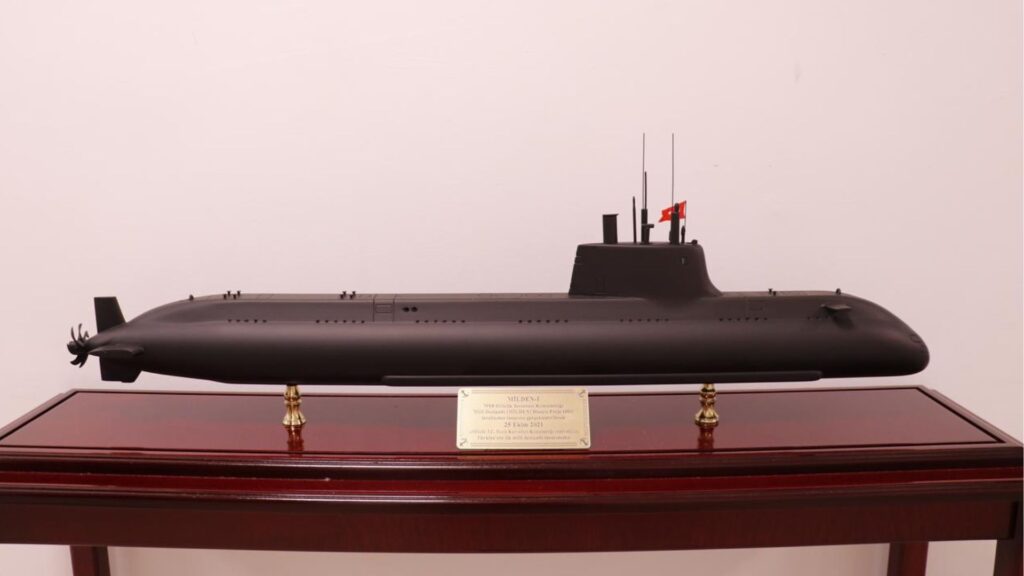
In late August 2026, the Turkish state-owned defence contractor ASFAT Inc. (Military Factory and Shipyard Management Inc) revealed the official specifications of the MİLDEN (National Submarine) platform. According to ASFAT, the MİLDEN will have a surfaced displacement of approximately 2,700 tons, a length of 80+ m, a beam of 7+ m, and a draught of 6.8 m (the submerged displacement and diving depth were withheld). In terms of armament, the MİLDEN will have eight 533 mm torpedo tubes capable of carrying heavyweight torpedoes and anti-ship cruise missiles as well as an undisclosed number of MİDLAS vertical-launch system (VLS) cells. The submarine will leverage HY-100 class steel, a fuel-cell air-independent propulsion (AIP) system, lithium-ion (Li-ion) batteries, and a wide range of other indigenously developed subsystems.
With reported plans for six boats, it is clear that the MİLDEN promises an impressive entry for the Turkish naval and shipbuilding industry in the submarine space. To outside observers, such major announcements are often surprising and unexpected, but as with all of Türkiye’s flagship projects, the MİLDEN is borne from decades of prior – and gradual – product design and upstream industrial growth and, as importantly, will launch into more ambitious goals, like nuclear-powered submarines under the NUKDEN program. As with its other flagship programs, Türkiye aims to indigenize as many industrial inputs as possible (especially controlled critical technologies).
Today, Pakistan is among Türkiye’s top naval solutions markets, having signed a USD $350 million deal to upgrade its three Khalid-class (Agosta 90B) submarines in 2016 and a $1.5 billion-plus deal to co-produce four Babur-class (MILGEM) corvettes and design the Jinnah-class frigates (which, in turn, will spur another multi-billion-dollar program to build the ships). Arguably, the Pakistan Navy’s (PN) next wave of major procurements, especially through the 2030s and 2040s, will center on new submarines. It has plans to acquire shallow-water attack submarines (SWATS), while the current Chief of Naval Staff (CNS) also confirmed an eventual original submarine program.
Of course, the original submarine is further out and will follow once the Hangor-class (S26P/Type 039B) procurement program fully concludes. That said, one could see Naval Headquarters (NHQ) showing interest in the MİLDEN as a basis for the next generation of submarines. First, Türkiye has already been promoting its submarine designs to the PN, namely via STM’s (Savunma Teknolojileri Mühendislik ve Ticaret A.Ş.) STM 500 SWATS and TS1700 attack submarine. Likewise, at the November 2022 launch ceremony of the PNS Khaibar corvette, the then ASFAT general manager, Esad Akgün, shared the company’s “desire and enthusiasm” for bringing the Jinnah-class frigate and MİLDEN projects to life together with Pakistan. To be clear, the current state of the original submarine project is in its very early stages and in flux, but it should be noted that there is a feature within the MİLDEN that could reflect some earlier PN thinking – i.e., hybrid deterrence. Retired PN Vice Adm. Ahmed Saeed and Rear Adm. Saleem Akhtar spoke about how – in lieu of a nuclear-powered boat – the PN would look to a “hybrid” solution that would deploy strategic capabilities via a conventional platform. However, the ultimate goal would be to acquire a true nuclear-powered boat for the role.
Interestingly, the MİLDEN could offer a single pathway for both goals.
Firstly, by leveraging VLS for land-attack cruise missiles (LACM) and submarine-launched ballistic missiles (SLBM), the MİLDEN can be technically ready for the “hybrid” deterrence role. It will be a large platform (similar in size to the Hangor-class, itself an endurance-focused design), but with a quieter AIP stack leveraging both fuel cells for output and Li-ion batteries for energy storage.
Quwa Pro
See Where Emerging Defence Markets are Moving
Quwa Pro goes beyond tracking programs and equipment by explaining the policies, incentives, industry dynamics, and competitive pressures shaping South Asia's defence markets.