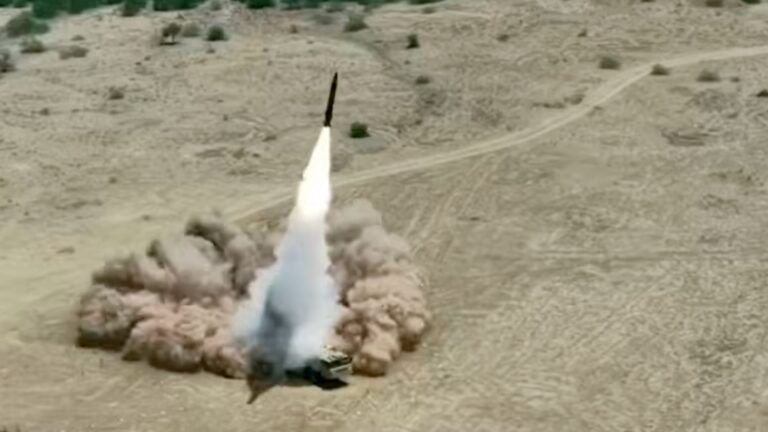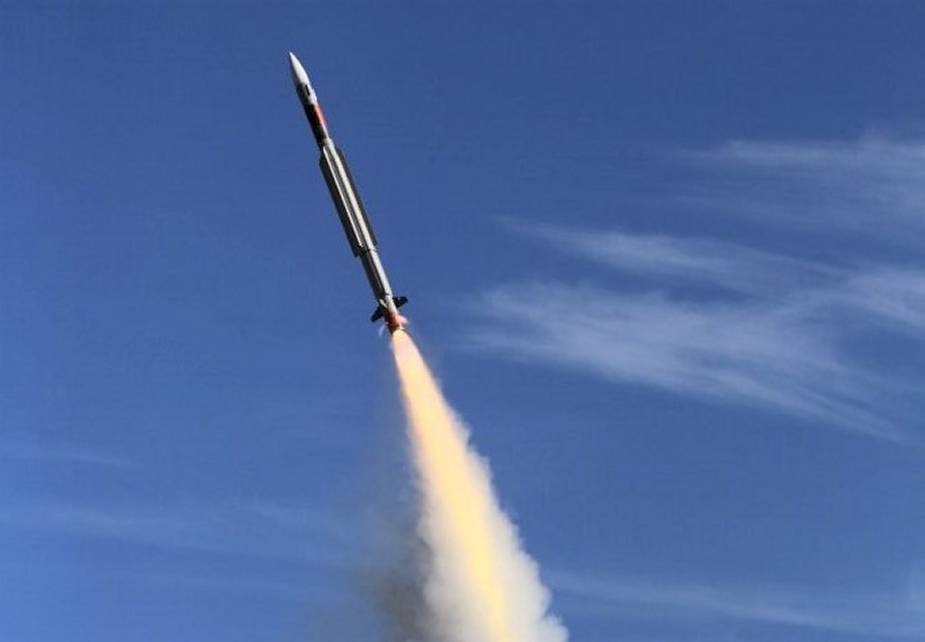
The CAMM-ER (Common Anti-air Modular Missile — Extended Range) is a latest-generation European air defence missile developed by MBDA, the multinational missile consortium jointly owned by Airbus, BAE Systems, and Leonardo. With active radar-homing (ARH) guidance, thrust-vectoring control (TVC), a two-way datalink, and a range exceeding 45 km, the CAMM-ER represents a generational leap beyond the semi-active radar-homing (SARH) systems that dominate Pakistan’s current air defence inventory.
The Pakistan Navy operates the CAMM-ER through the Albatros-NG naval-based air defence (NBAD) system aboard the Babur-class corvettes. Pakistan is reportedly the launch customer for the Albatros-NG, making the CAMM-ER the most advanced SAM system in any Pakistani service — and the first fire-and-forget, ARH-guided missile in Pakistan’s integrated air defence system (IADS).
Know What Defence Buyers in Will Need Next
See emerging requirements, likely suppliers, and routes to market across Pakistan, MENA, and fast-moving defence technologies, before demand becomes obvious.
CAMM-ER Specifications
| Parameter | CAMM (baseline) | CAMM-ER (extended range) |
|---|---|---|
| Type | Short-range SAM | Medium-range SAM |
| Developer | MBDA (UK) | MBDA (UK/Italy) |
| Length | 3.2 m | 4.2 m |
| Diameter | 166 mm | 190 mm |
| Weight | 99 kg | 160 kg |
| Speed | Mach 3+ | Mach 3+ |
| Range | >25 km (reportedly 60 km in trials) | >45 km |
| Altitude | 10 km | 10 km+ |
| Guidance | ARH (GaN seeker) + two-way datalink | ARH (GaN seeker) + two-way datalink |
| Warhead | Blast-fragmentation | Blast-fragmentation |
| Motor | Roxel (ASRAAM-derived) | Avio (new dual-pulse) |
| Launch | Soft vertical launch (cold launch) | Soft vertical launch (cold launch) |
| Quad-packable | Yes | Yes |
Development Heritage
The CAMM family traces its origins to the UK Ministry of Defence’s Future Local Area Air Defence System (FLAADS) Technology Demonstration Programme (TDP), launched in 2004. MBDA was the lead contractor, developing a new low-cost active radar seeker using gallium nitride (GaN) solid-state power amplifier technology, a programmable open systems architecture (PrOTeUS), and a dual-band two-way datalink. The baseline CAMM entered Royal Navy service as Sea Ceptor in May 2018 aboard HMS Argyll.
The extended-range CAMM-ER variant was developed jointly by MBDA UK and MBDA Italy, with Italian participation driven by the need to replace the Aspide/Spada systems in Italian Air Force and Army service. The CAMM-ER uses a new Avio rocket motor with a larger body (190 mm vs 166 mm diameter, 4.2 m vs 3.2 m length), delivering a range in excess of 45 km while retaining the CAMM’s ARH seeker and two-way datalink architecture. The Stockholm International Peace Research Institute (SIPRI) has tracked the CAMM family’s growing export footprint.
The CAMM-ER achieved successful qualification in 2023, and MBDA concluded a series of extended-range trials validating performance at high altitudes and challenging manoeuvre scenarios. The missile is designed to be maintenance-free within its launch canister throughout its operational lifespan.
CAMM Family Variant Tree
| Variant | Role | Range | Key Operators |
|---|---|---|---|
| CAMM | Short-range SAM | >25 km | UK (Royal Navy/Army), New Zealand, Chile, Brazil |
| CAMM-ER | Medium-range SAM | >45 km | Italy; Pakistan Navy; Poland (contracted) |
| CAMM-MR | Medium-long-range SAM | >100 km | UK/Poland (in development) |
System Variants Using CAMM-ER
| System | Domain | Missile | Key Operators |
|---|---|---|---|
| Sea Ceptor | Naval | CAMM | UK Royal Navy (Type 23/26) |
| Albatros-NG | Naval | CAMM-ER | Pakistan Navy (Babur-class) |
| Land Ceptor / Sky Sabre | Ground | CAMM | UK British Army |
| EMADS / MAADS | Ground | CAMM-ER | Italian Air Force |
| GRIFO | Ground | CAMM-ER | Italian Army |
Albatros-NG and the Pakistan Navy
In June 2021, MBDA secured its first contract for the Albatros-NG from an undisclosed international customer — widely assessed to be Pakistan for the Babur-class corvette programme. The Albatros-NG is a new-generation naval-based air defence system that uses the CAMM-ER as its primary interceptor, providing area air defence for surface combatants.
The Babur-class corvettes — designed and built in Turkey by STM Savunma — integrate the Albatros-NG as their primary AAW system. This makes the Pakistan Navy the first export operator of a CAMM-ER-based naval system and gives the PN a generational leap over its existing LY-80N (SARH, 40 km) aboard the Tughril-class frigates.
The CAMM-ER’s soft vertical launch technology ejects the missile to a height of approximately 30 metres before a thruster orientates it toward the target — providing true 360-degree coverage without the launch arc constraints of traditional inclined launchers. The system can be quad-packed, meaning four CAMM-ER missiles occupy the footprint of a single conventional VLS cell, maximising the corvette’s magazine depth.
Why CAMM-ER Matters for Pakistan
The CAMM-ER is not just another SAM in Pakistan’s inventory. It represents a fundamental architectural shift — from SARH-dependent systems to fire-and-forget, ARH-guided missiles. As Quwa has analysed in its assessment of Pakistan’s air defence posture, the SARH constraint — requiring continuous radar illumination throughout the missile’s flight — is the single most significant limitation of Pakistan’s HQ-9, LY-80, and Spada 2000-Plus systems.
The CAMM-ER eliminates this constraint entirely. Its active RF seeker, using GaN solid-state power amplifier technology, autonomously acquires and tracks the target in the terminal phase. The two-way datalink provides mid-course guidance and retargeting capability, while the fire-control channel can be provided by any compatible 3D radar — removing the need for dedicated illumination radars. This means a single battery or ship can engage many more targets simultaneously than a SARH-equipped system of equivalent missile count.
The Fire-and-Forget Advantage
In a saturation attack — the scenario that India’s May 2025 doctrine implies — the number of simultaneous engagements is the decisive metric. A SARH system can only engage as many targets as it has illumination channels (typically two to four per battery). A CAMM-ER system can, in principle, engage as many targets as it has missiles in flight, since each missile guides itself autonomously in the terminal phase. This is the core architectural advantage that makes CAMM-ER the template for Pakistan’s future air defence posture.
The Thrust-Vectoring Advantage
The CAMM-ER’s soft vertical launch and post-launch thruster orientation give it exceptional agility immediately after launch — the phase where conventional SAMs are at their most kinematically constrained. Combined with its supersonic speed (Mach 3+) and high-g terminal manoeuvrability, the CAMM-ER can engage targets that legacy SARH missiles with fixed-fin control surfaces — like the Aspide 2000 or the LY-80’s missile — would struggle to intercept.
The 160 kg Weight Advantage
At 160 kg, the CAMM-ER is lighter than the Aspide 2000 (240 kg) and the HQ-9’s missile (~2,000 kg), yet offers 45+ km range compared to the Aspide’s 25+ km. This weight efficiency means platforms can carry more interceptors per VLS cell (quad-packing), ground vehicles can carry more rounds, and logistics chains can sustain higher resupply rates. For a force-structure-constrained military like Pakistan’s, this weight-to-capability ratio is strategically significant.
Quwa Assessment: CAMM-ER as the Template for Pakistan’s Future IADS
As Quwa has argued in its air defence blueprint analysis, the CAMM-ER’s architecture — ARH guidance, TVC, dual-pulse motor, soft vertical launch, quad-packing, and two-way datalink — represents the ideal template for Pakistan’s future SAM procurement. The current patchwork of Chinese SARH systems (HQ-9, LY-80, FM-90) and the ageing Italian Spada 2000-Plus cannot be sustained indefinitely.
The Tri-Service Standardisation Opportunity
The CAMM-ER is already in Pakistan Navy service (Albatros-NG). A ground-launched variant (EMADS-type) could replace the PAF’s Spada 2000-Plus and eventually supplement or succeed the PA’s LY-80 and FM-90. This would give Pakistan a single missile type — or at minimum a single missile family (CAMM + CAMM-ER) — operating across the PN, PAF, and PA. Tri-service standardisation would simplify logistics, training, spare parts, and upgrade cycles while enabling common fire-control integration across the national IADS.
The Indigenous Production Path
MBDA has demonstrated willingness to establish local production partnerships — as seen in its arrangements with Poland’s PGZ for CAMM production. Pakistan’s growing defence industrial base, combined with its existing MBDA relationship through the Spada 2000-Plus and Albatros-NG, creates a potential pathway for licensed production or co-production of CAMM-ER components in Pakistan. This would address the supply-chain vulnerability that comes with sole-source European procurement while building indigenous capability that feeds into the LoMADS programme.
The CAMM-MR Horizon
MBDA is developing the CAMM-MR (medium-range) with a range exceeding 100 km, in partnership with Poland. If this variant materialises, it would fill the long-range tier currently occupied by the HQ-9 — potentially offering Pakistan a complete CAMM-family stack from 25 km (CAMM) through 45 km (CAMM-ER) to 100+ km (CAMM-MR), all using the same ARH seeker, two-way datalink, and common C2 architecture.
Global Context and the CAMM Family’s Expansion
The CAMM family is one of the fastest-growing SAM programmes globally. The UK Royal Navy uses CAMM as Sea Ceptor on its Type 23 and Type 26 frigates. The British Army uses CAMM as Land Ceptor within the Sky Sabre system. New Zealand, Chile, and Brazil have selected CAMM for their naval platforms. Italy is replacing its entire Aspide/Spada ground-based air defence inventory with CAMM-ER through the MAADS (Air Force) and GRIFO (Army) programmes. Poland signed a £4 billion contract with MBDA/PGZ in 2023 for a CAMM-ER-based ground air defence system.
The Albatros-NG naval system, operated by Pakistan, is the first export NBAD application of the CAMM-ER. The system is designed to be compatible with multiple ship combat management systems, making it adaptable to Pakistan Navy’s diverse fleet — potentially extending beyond the Babur-class to future surface combatant programmes.
CAMM-ER vs Aspide 2000: A Generational Comparison
| Parameter | Aspide 2000 (Spada) | CAMM-ER (Albatros-NG) |
|---|---|---|
| Range | >25 km | >45 km |
| Weight | 240 kg | 160 kg |
| Length | 3.7 m | 4.2 m |
| Guidance | SARH | ARH (fire-and-forget) |
| Datalink | None | Two-way (retargetable) |
| Launch | Inclined rail | Soft vertical (360°) |
| Quad-packable | No | Yes |
| Simultaneous engagements | Limited by illuminators | Limited by missiles in flight |
| Manufacturer | MBDA Italy | MBDA UK/Italy |
Quwa Pro – Defence Market Intelligence
See Where Defence Demand and Technology Are Moving Next
Track procurement priorities across Pakistan, the Gulf and wider MENA, and Central Europe. Follow emerging vendors, drones, AI, C-UAS, and affordable precision weapons, and see how lessons from today’s conflicts are reshaping military requirements and market opportunities.
Featured & Trusted By







Frequently Asked Questions About the CAMM-ER
What is the range of the CAMM-ER?
The CAMM-ER has a range exceeding 45 km against aerial targets. It achieves supersonic speeds of Mach 3+ and can engage targets at altitudes of 10 km or above.
Does Pakistan have the CAMM-ER?
The Pakistan Navy operates the CAMM-ER through the Albatros-NG naval air defence system aboard the Babur-class corvettes. Pakistan is assessed to be the launch customer for the Albatros-NG system.
What is the difference between CAMM and CAMM-ER?
The CAMM is the baseline variant (99 kg, >25 km, 166 mm diameter) using an ASRAAM-derived Roxel motor. The CAMM-ER is the extended-range variant (160 kg, >45 km, 190 mm diameter) using a new Avio motor with a larger body. Both share the same ARH seeker and two-way datalink architecture.
What is the Albatros-NG?
The Albatros-NG is MBDA’s new-generation naval-based air defence system designed around the CAMM-ER missile. It provides area air defence for surface combatants and is operated by the Pakistan Navy aboard the Babur-class corvettes.
How does the CAMM-ER compare to the LY-80N?
The CAMM-ER (45+ km, ARH, fire-and-forget, 160 kg) represents a generational leap over the LY-80N (40 km, SARH, continuous illumination required). The CAMM-ER can engage more targets simultaneously, is lighter, and does not require dedicated illumination radars.
Could Pakistan use CAMM-ER on land?
Yes. The CAMM-ER is already deployed in ground-based configurations by Italy (EMADS/MAADS for the Air Force, GRIFO for the Army) and Poland. A ground-launched CAMM-ER system could replace the PAF’s Spada 2000-Plus and eventually supplement or succeed the PA’s LY-80, enabling tri-service SAM standardisation.
What is the CAMM-MR?
The CAMM-MR (medium-range) is a larger variant under development by MBDA UK and Poland with a range exceeding 100 km. It is being developed for the Polish Wisła air defence system and Wicher-class frigates, and could eventually offer Pakistan a long-range ARH option within the same missile family.
Related Profiles and Analysis
- Pakistan Air Defence System — Overview of Pakistan’s layered IADS architecture.
- HQ-9 Long-Range Air Defence System — Pakistan’s HIMADS tier.
- LY-80 / HQ-16 Medium-Range Air Defence System — The LY-80N’s comparison point aboard the Tughril-class.
- MBDA Spada 2000-Plus Air Defence System — The CAMM-ER’s most likely replacement target for ground-based PAF air defence.
- HQ-7 / FM-90 Short-Range Air Defence System — The PA’s ESHORAD layer.
- Reaction, Not Range: How Pakistan’s Air Defence Must Evolve — Quwa’s flagship IADS analysis.
- The Blueprint for Pakistan’s Future-Proof Air Defence System — Post-conflict IADS modernization roadmap.