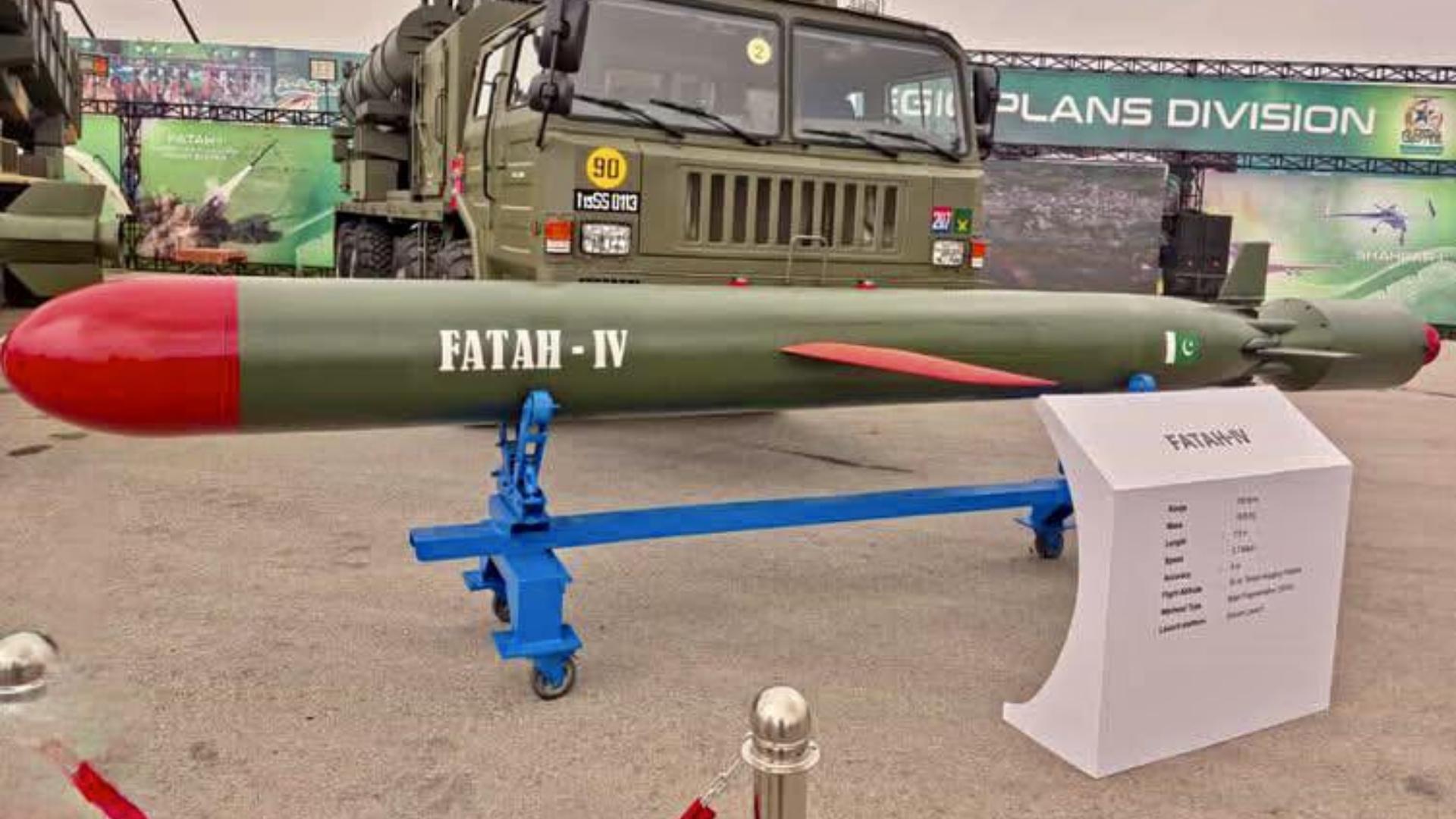


The Fatah-1 is Pakistan’s first indigenously developed Guided Multiple Launch Rocket System (GMLRS) – a precision-guided rocket with GPS/INS guidance and a range of up to 140 km. The Fatah-1 missile was unveiled on 7 January 2021 by the Inter-Services Public Relations (ISPR). Developed by the National Engineering and Scientific Commission (NESCOM) and marketed by Global Industrial and Defence Solutions (GIDS), the system marked a shift from conventional unguided artillery rockets to precision-guided munitions capable of engaging targets “deep in enemy territory.”
The Fatah-1 was the first weapon in the broader Fatah missile family to see combat. It was deployed during the May 2025 India-Pakistan conflict, validating the Pakistan Army’s (PA) precision-strike doctrine under operational conditions. It now forms the shortest-range tier of the Army Rocket Force Command’s (ARFC) layered strike portfolio.
Know What Defence Buyers in Will Need Next
See emerging requirements, likely suppliers, and routes to market across Pakistan, MENA, and fast-moving defence technologies, before demand becomes obvious.
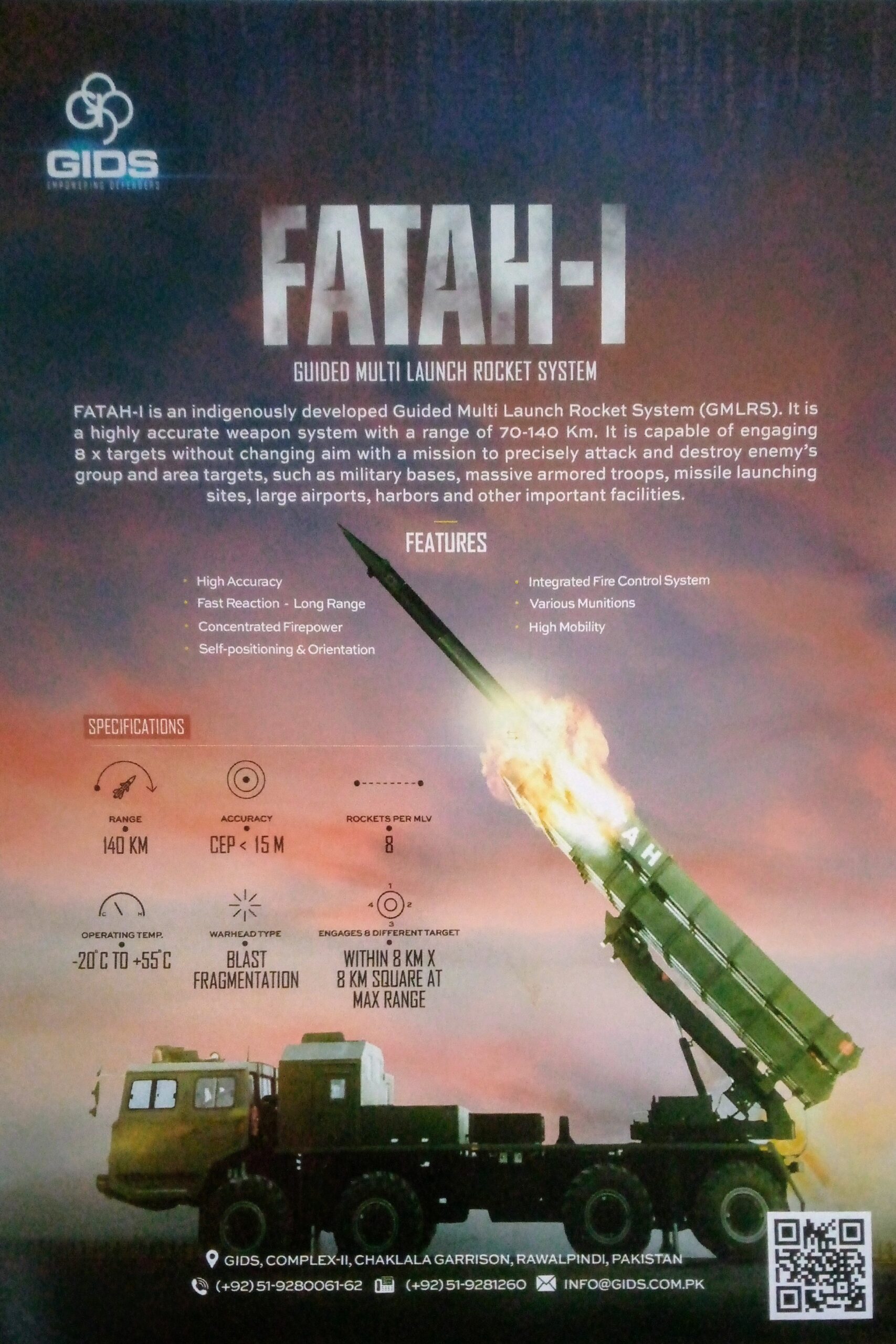
Fatah-1 Specifications
| Parameter | Specification |
|---|---|
| Type | Guided Multiple Launch Rocket System (GMLRS) |
| Developer | NESCOM / GIDS |
| Range | 70–140 km |
| Accuracy (CEP) | ≤ 15 m |
| Warhead Type | Blast fragmentation |
| Guidance | GPS/INS |
| Rockets per Launcher | 8 per MLV (Multiple Launch Vehicle) |
| Target Engagement | Up to 8 targets within an 8×8 km area at max range |
| Operating Temperature | -20°C to +55°C |
| Status | Operational; combat-proven (May 2025) |
Development History
The development of the Fatah-1 likely originated from a Ministry of Defence Production (MoDP) programme disclosed in 2015–16 to create an “extended-range” MLRS for the Pakistan Army. While earlier systems like the A-100 MLRS – a Chinese-origin system locally produced under licence – offered a range of approximately 100 km, the Fatah-1 extended this to 140 km with the addition of GPS/INS guidance.
ISPR’s January 2021 announcement confirmed the system’s successful flight test. The Fatah-1 was described as capable of delivering a “devastating punch to the enemy” with high accuracy, a phrasing consistent with NESCOM’s broader push to transition the PA from area-effect rocket artillery to single-target precision engagement.
Given that the A-100 MLRS had been in service since the mid-2000s, the Fatah-1 appears to represent a generational replacement – upgrading the same doctrinal role (deep-fire rocket artillery) with modern guidance and extended range. However, it is currently unclear whether the Fatah-1 uses a similar airframe or if NESCOM developed an entirely new rocket.
Guidance and Accuracy
The Fatah-1 employs integrated GPS/INS guidance for precision targeting. This dual-mode navigation allows the rocket to maintain accuracy even in GPS-denied environments, as the inertial navigation system (INS) provides a backup reference for the final flight phase.
GIDS claims a circular error probable (CEP) of 15 metres or less – a figure that, if accurate, places the Fatah-1 in the same accuracy class as the US M31A1 GMLRS rocket used with the M142 HIMARS launcher. This level of precision enables the engagement of point targets such as command posts, radar installations, and ammunition depots rather than requiring area saturation.
Each Fatah-1 launcher can reportedly engage up to eight different targets within an 8×8 km area at maximum range. This capability suggests a degree of individual rocket programmability – each rocket in the salvo can be assigned a distinct target coordinate prior to launch.
Launcher Configuration
The Fatah-1 is fired from an 8-round Multiple Launch Vehicle (MLV) mounted on a wheeled chassis. The launcher supports rapid reload and ‘shoot-and-scoot’ tactics – firing a salvo and relocating before counter-battery fire can arrive.
The wheeled chassis provides strategic mobility across Pakistan’s road network, enabling rapid repositioning between forward operating areas. This mobility profile is consistent with the ARFC’s operational concept of dispersed, survivable launchers that can mass fires without massing forces.
Operational History: May 2025 Combat Deployment
The Fatah-1 was the first Fatah-series weapon to be used in combat, having been deployed during the 2025 India-Pakistan conflict. While the PA has not disclosed the specific targets engaged or the number of rounds expended, the operational use validated the system’s readiness and the PA’s ability to integrate precision-guided rockets into its battle plan.
The combat deployment appears to have reinforced the case for expanding the ARFC’s inventory. In the months following the conflict, the PA accelerated its procurement of Fatah-series systems and formally raised the ARFC as a dedicated command to manage these assets.
Doctrinal Role Within the ARFC
Within the ARFC’s layered strike architecture, the Fatah-1 occupies the shortest-range tier – designed for tactical engagements against targets at 70–140 km depth. This range bracket covers forward-deployed enemy formations, artillery positions, logistics nodes, and forward air bases.
The Fatah-1 complements the longer-range Fatah-2 SSM (400 km), Fatah-3 SSCM, and Fatah-4 GLCM (750 km). Together, these systems provide the PA with continuous strike coverage from the forward edge of the battle area to deep-rear infrastructure.
Given its 8-round launcher configuration and relatively low unit cost compared to the Fatah-2 or Fatah-4, the Fatah-1 is likely intended for higher-volume employment. Its salvo capability makes it suited to suppression and disruption missions – saturating a target area with multiple precision-guided rockets in rapid succession.
Comparison with Regional Guided MLRS Systems
The Fatah-1 competes in the same doctrinal space as India’s Pinaka Extended Range guided rocket system, which offers a comparable range of approximately 90–120 km with GPS/INS guidance. The Fatah-1’s claimed 140 km range provides a modest standoff advantage, though direct performance comparisons are complicated by limited public data on the Pinaka ER’s CEP.
In the broader global context, the Fatah-1 sits alongside the US M31 GMLRS (70–84 km range, CEP < 5 m) and the Chinese PHL-03 system. The Fatah-1’s 140 km range exceeds the M31 baseline, though the US system has since evolved into the ER-GMLRS with extended reach. The key distinction is that the Fatah-1 is an indigenously developed system – giving Pakistan sovereign control over production, maintenance, and future upgrades without reliance on foreign supply chains.
Export Potential
GIDS has displayed the Fatah-1 at international defence exhibitions, including IDEAS in Karachi. The system’s combination of range, accuracy, and road-mobile launch platform makes it competitive in the broader GMLRS export market – particularly for buyers seeking alternatives to US or Chinese systems.
However, the Fatah-1’s export prospects will likely depend on GIDS’s ability to demonstrate a sustained production track record and provide the after-sales support infrastructure that foreign buyers require. The system’s combat-proven status – confirmed during the May 2025 conflict – provides a credibility advantage that few competitors in this segment can match.
Quwa Pro – Defence Market Intelligence
See Where Defence Demand and Technology Are Moving Next
Track procurement priorities across Pakistan, the Gulf and wider MENA, and Central Europe. Follow emerging vendors, drones, AI, C-UAS, and affordable precision weapons, and see how lessons from today’s conflicts are reshaping military requirements and market opportunities.
Featured & Trusted By







Frequently Asked Questions About the Fatah-1
What is the range of the Fatah-1 missile?
The Fatah-1 has a stated range of 70–140 km. At maximum range, a single launcher can engage up to eight different targets within an 8×8 km area, with each rocket programmable to a distinct GPS/INS coordinate.
What is the Fatah-1 accuracy?
GIDS claims a circular error probable (CEP) of 15 metres or less. This places it in the same accuracy class as the US M31A1 GMLRS rocket used with the M142 HIMARS launcher.
Has the Fatah-1 been used in combat?
The Fatah-1 was deployed during the May 2025 India-Pakistan conflict, making it the first Fatah-series weapon to see operational combat use.
How does the Fatah-1 compare to Pinaka?
The Fatah-1’s 140 km range provides a modest standoff advantage over India’s Pinaka Extended Range guided rocket system (approximately 90–120 km). Direct CEP comparisons are complicated by limited public data on the Pinaka ER.
Who developed the Fatah-1?
The Fatah-1 was developed by NESCOM and marketed by GIDS. Development originated from a Ministry of Defence Production (MoDP) programme disclosed in 2015–16.
Related reading







Related Profiles
- GIDS Fatah Missile Family – Overview of the full Fatah-series and ARFC integration.
- Fatah-2 Surface-to-Surface Missile – The 400 km-range tactical ballistic missile with supersonic glide vehicle.
- Fatah-3 Supersonic Cruise Missile – The ramjet-powered SSCM revealed in May 2026.
- Fatah-4 Ground-Launched Cruise Missile – The 750 km-range GLCM derived from the Babur platform.
- GIDS Tipu 155 mm Guided Artillery Shell – The PA’s precision-fire complement to the Fatah-series.
- Pakistan Army’s Precision-Fire Networking Needs – Demand tracker for the IBFMS and fire-direction integration.