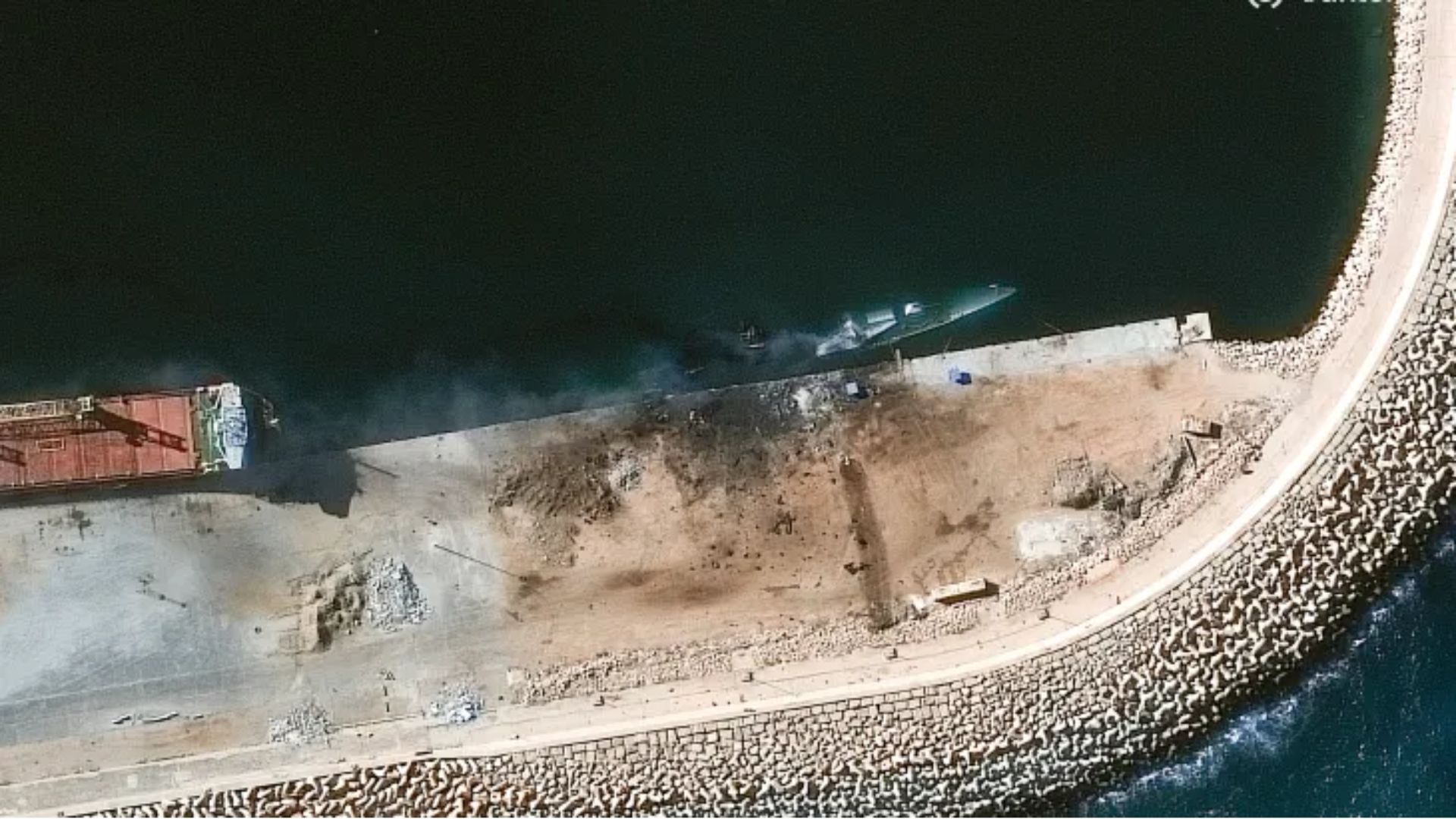
On 22 November, a Russian Navy Project 20380 Steregushchiy-class corvette, the Merkury, was sunk in the Libyan port of Benghazi by Ukrainian unmanned surface vessels (USVs), an attack that Ukrainian President Volodymyr Zelenskyy confirmed the following day.
Assessing satellite imagery from Vantor, observers identified that the Merkury had capsized and sunk at its berth, with only its forward bow visible above the water when the images were taken. According to Zelenskyy, the attack also destroyed a Ka-27 helicopter aboard the corvette and hit the MV Angara, a Russian cargo ship that the Merkury had been escorting.
This was not Ukraine’s first USV strike on Russian Navy ships, nor was the Merkury the first Russian vessel to fall victim to Ukrainian drones outside the Black Sea. As earlier Quwa articles had discussed, Ukraine’s USVs have had a real impact on the naval front, specifically in the Black Sea, where the Magura V5 alone was credited with destroying eight Russian naval vessels and damaging six others in its first year of deployment.
Beyond the Black Sea, Ukraine struck the shadow fleet tanker Qendil with aerial drones in the Mediterranean in December 2025, while Libyan officials later said that Ukrainian forces operating from western Libya had attacked the Arctic Metagaz, a liquefied natural gas (LNG) carrier, in March 2026. Moreover, the Merkury is the second Project 20380 corvette that Ukraine has effectively knocked out this year, after one-way attack (OWA) drones struck the Boikiy in a Kronstadt dry dock in June 2026.
However, this specific attack alters the warfighting environment in several key ways, not just within the bounds (or lack thereof) of the Russia-Ukraine War, but in warfighting in a strategic sense.
Go Beyond the Headlines on Pakistan’s Defence and Security.
Quwa Plus gives you deeper reporting, briefings, and analysis on Pakistan’s defence programs, foreign policy, national security, and regional strategy. Follow the developments that matter to professionals, analysts, and serious readers tracking Pakistan’s security landscape.
Join ($29.99/Year) Already a subscriber?Sign in