
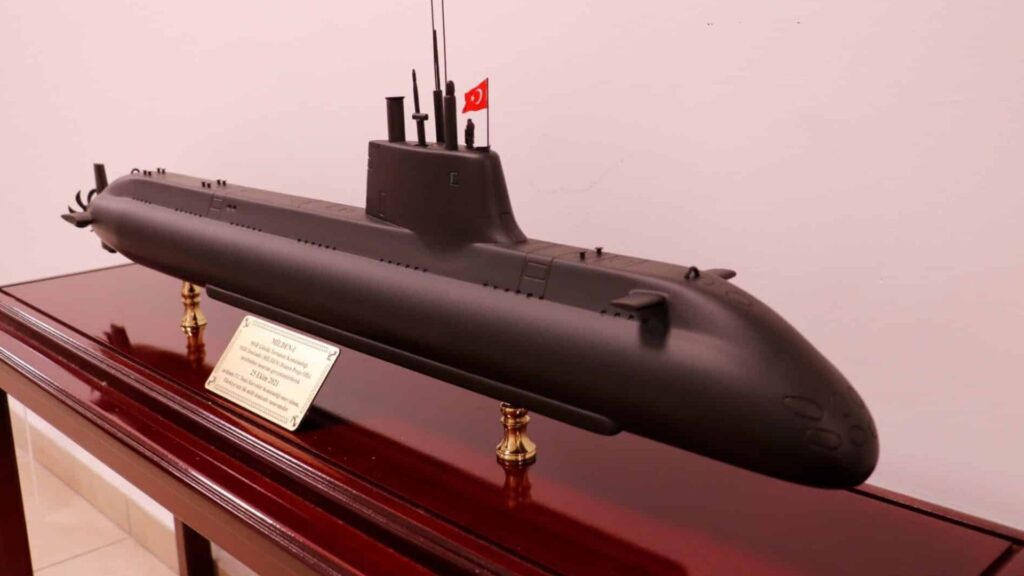
ASFAT released the dimensions, personnel complement, and payload capacity of the Turkish Navy’s MİLDEN national submarine in late August 2026.
The disclosure followed the public debut of the boat’s first hull block at TEKNOFEST Mavi Vatan, held at Gölcük Naval Shipyard from 20 to 23 August.
ASFAT gives MİLDEN a length of more than 80 metres, a beam of more than 7 metres, a surfaced displacement of approximately 2,700 tonnes, a draught of 6.8 metres and a crew complement of 40.
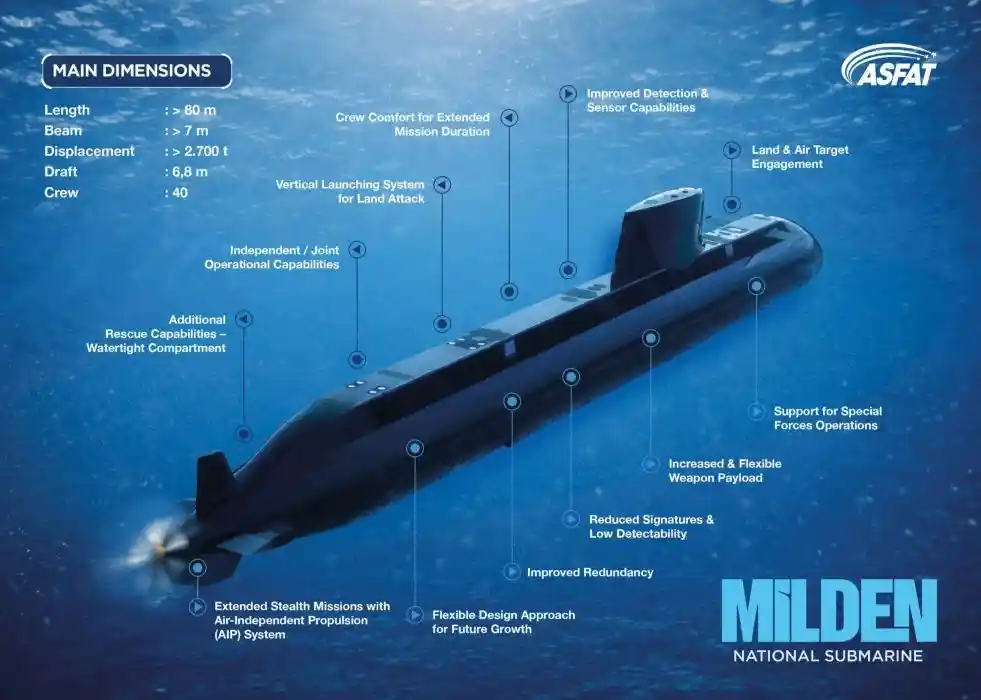
The company describes an air-independent propulsion (AIP) system for extended submerged endurance, reduced acoustic and electromagnetic signatures, a modular architecture for later upgrades, and a vertical launch capability for land attack alongside support for special forces tasks.
Turkish reporting on the first block put mission endurance at more than 50 days and identified HY-100 class steel for the pressure hull, with the block itself weighing roughly 30 tonnes.
Earlier disclosures list eight 533 mm torpedo tubes for the Roketsan Akya heavyweight torpedo, a submarine-launched Atmaca anti-ship missile and the Gezgin land-attack cruise missile.
The Roketsan MİDLAS vertical launcher is specified for both hot and cold launch.
Roketsan has separately raised the Atmaca UM land-attack variant at roughly 400 km as an interim round until Gezgin matures, alongside a folding-fin Tayfun that would fit strike-length MİDLAS cells.
Propulsion is built around six proton-exchange membrane fuel cell modules rated at 60 kW or more each, paired with a methanol reformer and lithium-ion batteries.
Aselsan supplies the sonar suite – bow, low-frequency flank and towed arrays – with a non-penetrating optronic mast in place of a conventional periscope.
Diving depth, submerged displacement, range and the MİDLAS cell count are all absent from the specifications the company shared.
On the figures now released, MİLDEN sits above the Type 214 and Scorpène families and below the Japanese Taigei class, with the closest conceptual analogue being South Korea’s KSS-III – i.e., a boat in a comparable displacement band that also carries a vertical launcher.
The complement of 40 is also low for a submarine of this size, implying heavy automation in both the combat system and platform management.
The program covers six boats, with the first named Atılay.
The T0 phase opened at Gölcük in December 2025, and ASFAT general manager Mustafa İlbaş has stated a delivery target before 2030, with service entry projected in the early 2030s.
ASFAT has signalled interest in Asian submarine customers, though no export campaign has produced a contract, and the company’s near-term obligation remains delivering the first boat to the Turkish Naval Forces.
Quwa Pro – Defence Market Intelligence
See Where Defence Demand and Technology Are Moving Next
Track procurement priorities across Pakistan, the Gulf and wider MENA, and Central Europe. Follow emerging vendors, drones, AI, C-UAS, and affordable precision weapons, and see how lessons from today’s conflicts are reshaping military requirements and market opportunities.
Featured & Trusted By