The SAHA 2026 International Defence and Aerospace Exhibition — Türkiye’s flagship defence expo — ran from 5–9 May at the Istanbul Expo Center, drawing 1,700 companies – 263 of them international – from over 120 countries across 400,000 square metres of exhibition space.[1] More than 30,000 industry professionals, 140 official delegations, and 200 trade procurement representatives attended the Istanbul defence show, making SAHA 2026 one of Europe’s largest defence exhibitions by floor space and exhibitor count.[2]
SAHA Istanbul was founded in 2015 with 27 member firms. Its first exhibition in 2018 hosted 170 companies and roughly 10,000 visitors.[3] Eight years on, the show has grown tenfold. Organizers planned 203 new product launches and 164 signing ceremonies at SAHA 2026 – nearly triple the export-oriented agreements from the 2024 edition[4] – and SAHA Defence and Aerospace Cluster Association President Haluk Bayraktar announced that Turkish defence firms finalized approximately $8 billion in export contracts within the first three days, up from $6.2 billion at SAHA 2024.[5] Ali Bakir of Qatar University described the shift as SAHA having “evolved from a national showcase into a genuine global meeting point for the defence and aerospace industry.”[6]
BAE Systems, MBDA, and a large Chinese pavilion anchored by Norinco were present.[7] The UAE fielded a full national pavilion under the Tawazun Council for Defence Enablement, with Tawazun Secretary General H.E. Dr. Nasser Al Nuaimi personally attending.[8] Defence Minister Yaşar Güler set the tone at the opening ceremony: “Until the 1980s, our country was largely dependent on foreign suppliers… Today, Türkiye designs, produces and exports its own systems.”[9]
SAHA 2026: The Show in Three Waves
SAHA 2026 was defined by three overlapping waves: deep-strike loitering munitions, autonomous naval platforms, and industrial self-sufficiency. The sections below catalogue what Turkish and Chinese defence vendors displayed at SAHA Expo 2026, organized by domain.
Loitering Munitions and One-Way Attack Systems at SAHA 2026
At least three Turkish defence firms simultaneously unveiled loitering munitions with ranges at or exceeding 1,000 km at SAHA 2026 – a coordinated push into strategic deep strike. Until now, Türkiye was primarily a producer of short- and medium-range unmanned attack systems. SAHA 2026 entered the business of strategic-range expendable munitions.
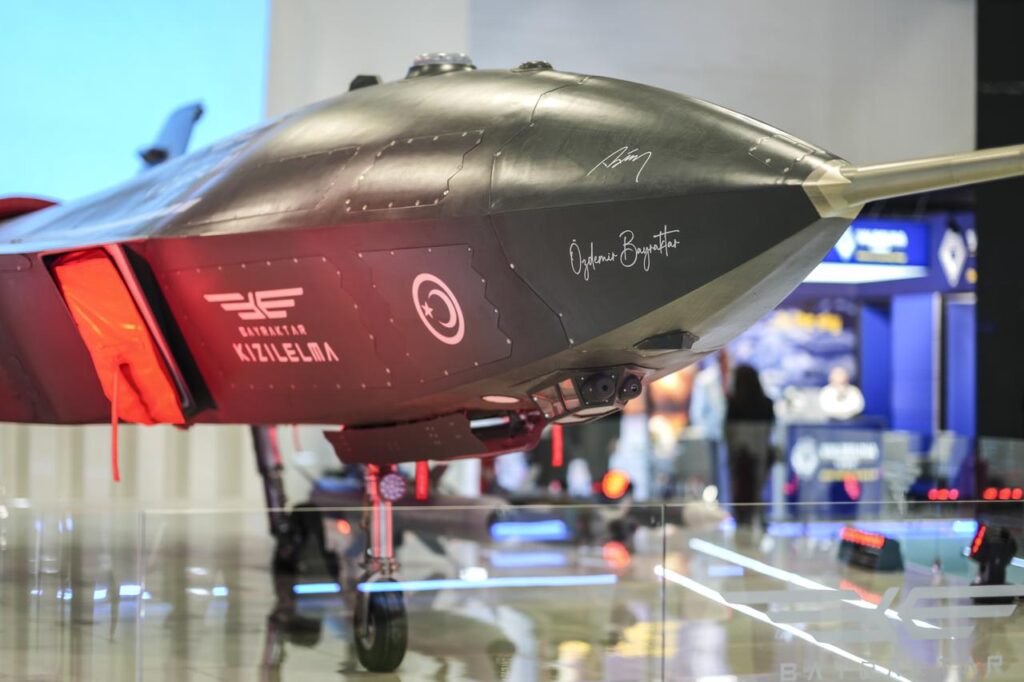
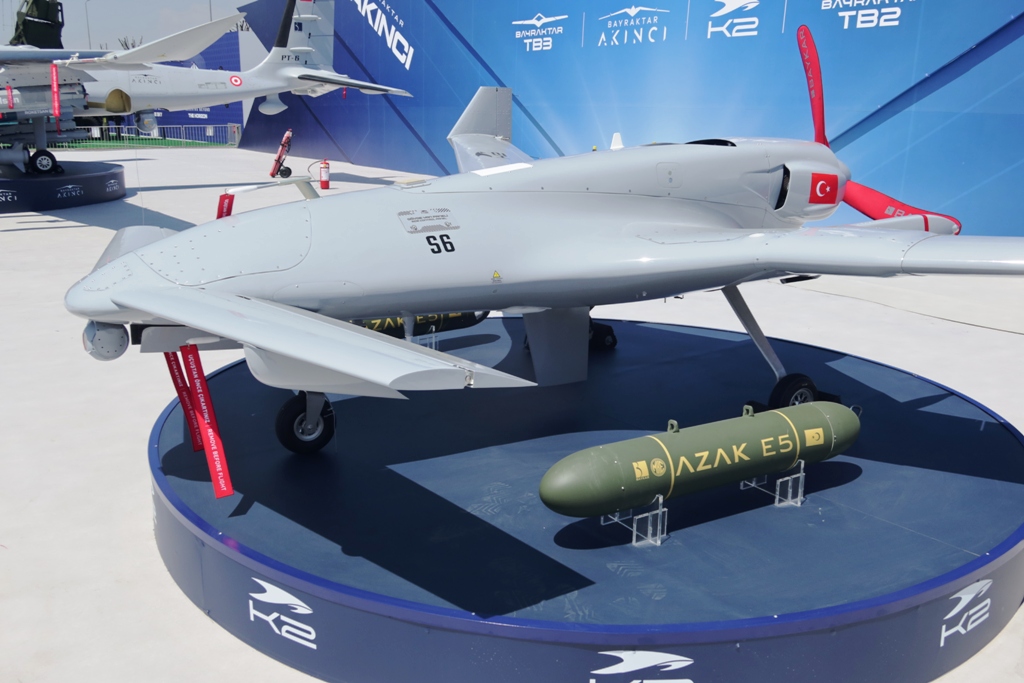
Baykar Technology debuted three new one-way attack (OWA) platforms at SAHA 2026. The Mızrak (“Spear”) is an AI-assisted autonomous strike system with a range exceeding 1,000 km, endurance over seven hours, and a payload capacity exceeding 40 kg, designed for GPS-denied navigation – a direct response to the electronic warfare environments of Ukraine and the broader Middle East.[10] The K2 Kamikaze UAV, displayed publicly for the first time as a full-sized model, is a swarm-capable platform with a payload capacity of up to 200 kg and a low-cost production architecture; Baykar had disclosed trials in March 2026.[11] The Sivrisinek (“Mosquito”) is a tube-launched UAV with a 3.2 m wingspan designed to perform reconnaissance and strike simultaneously, deployable from a wide range of ground and naval platforms.[12]
The Kuzgun (“Raven”), from STM Savunma Teknolojileri (STM), is a long-range loitering munition with over 1,000 km range, 6+ hours of endurance, approximately 200 kg total weight, and a high-explosive warhead designed to neutralize command centres, radars, and air defence batteries. It uses rocket-assisted take-off (RATO) from mobile or fixed platforms and requires no runway. Its navigation is designed to resist electronic warfare and GNSS jamming. STM has completed the design phase and conducted initial test flights.[13]
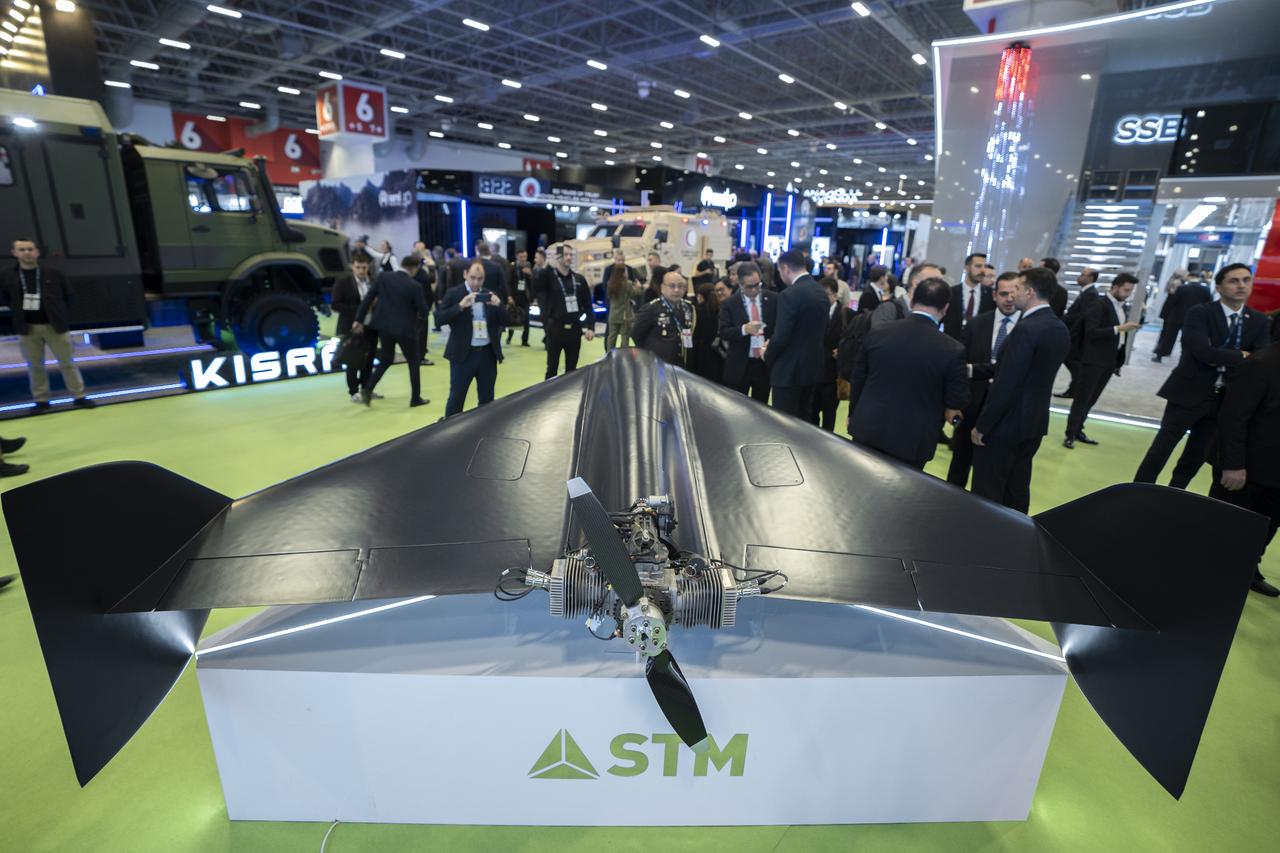
STM positioned Kuzgun explicitly in the Shahed-136 lineage – the same approach of low-cost mass employment, but with superior navigation precision, ECM resistance, and a lower radar signature.[14] General Manager Murat Güleryüz described it as “a game-changing, highly cost-effective and extremely efficient product… for our armed forces first, and then for friendly and allied nations.”[15] STM also displayed an upgraded Alpagu fixed-wing OWA drone with extended range and an Interceptor UAV System for counter-drone engagement.[16]
Roketsan brought four new munitions. The Neşter (“Lancet/Scalpel”) is a precision-guided munition derived from the MAM-L that uses deployable cutting blades instead of a conventional warhead – a low-collateral-damage capability aimed at buyers operating in urban or politically sensitive environments.[17] The Mini Cruise Missile carries a heavier warhead over longer ranges and can collect visual intelligence near the target.[18] Roketsan also displayed the Cida – a long-range anti-tank guided missile with beyond-line-of-sight capability and a hybrid seeker – and a Cirit C-UAS variant that repurposes the 70 mm guided rocket as a lower-cost anti-drone missile.[19]
Quwa Pro
See Where Emerging Defence Markets are Moving
Quwa Pro goes beyond tracking programs and equipment by explaining the policies, incentives, industry dynamics, and competitive pressures shaping South Asia's defence markets.
Subscribe Already a subscriber?Sign in