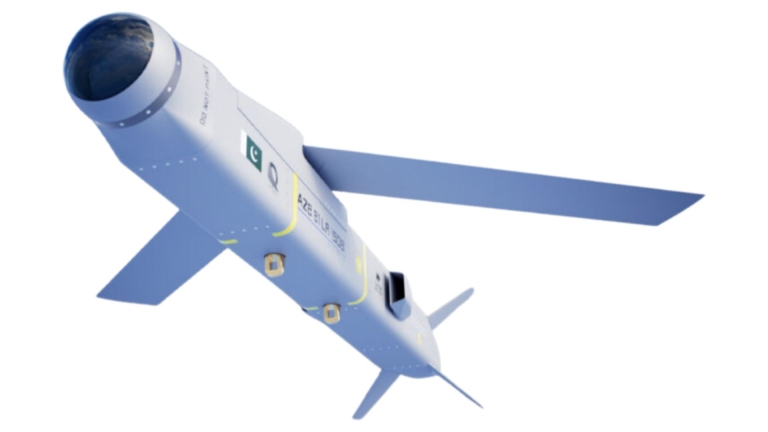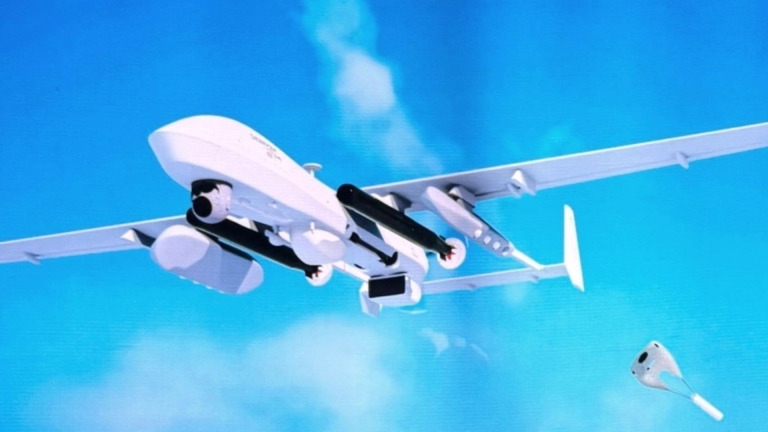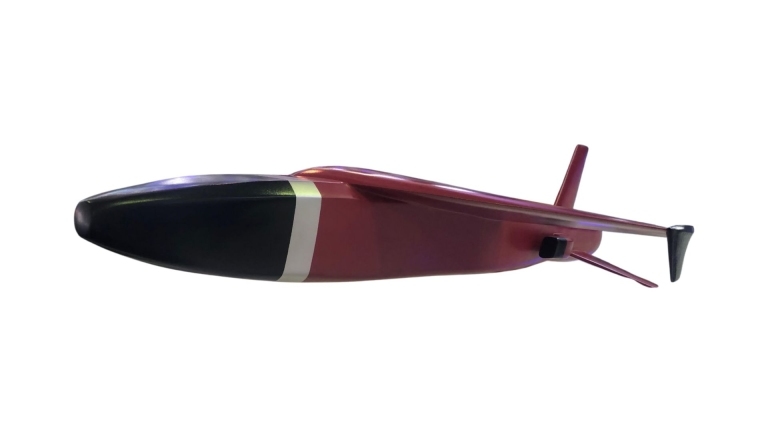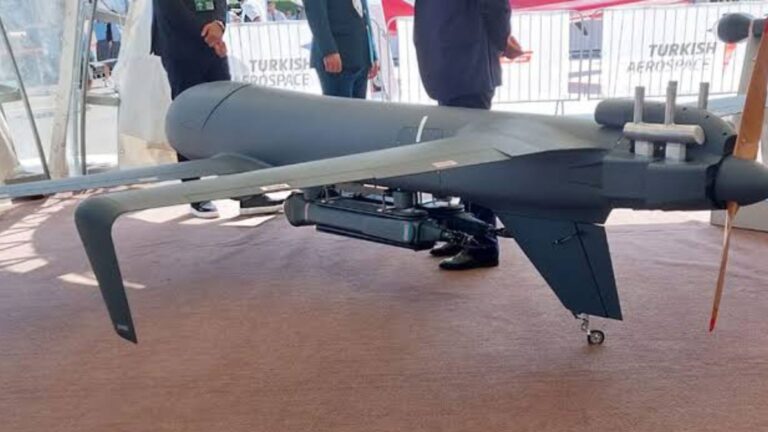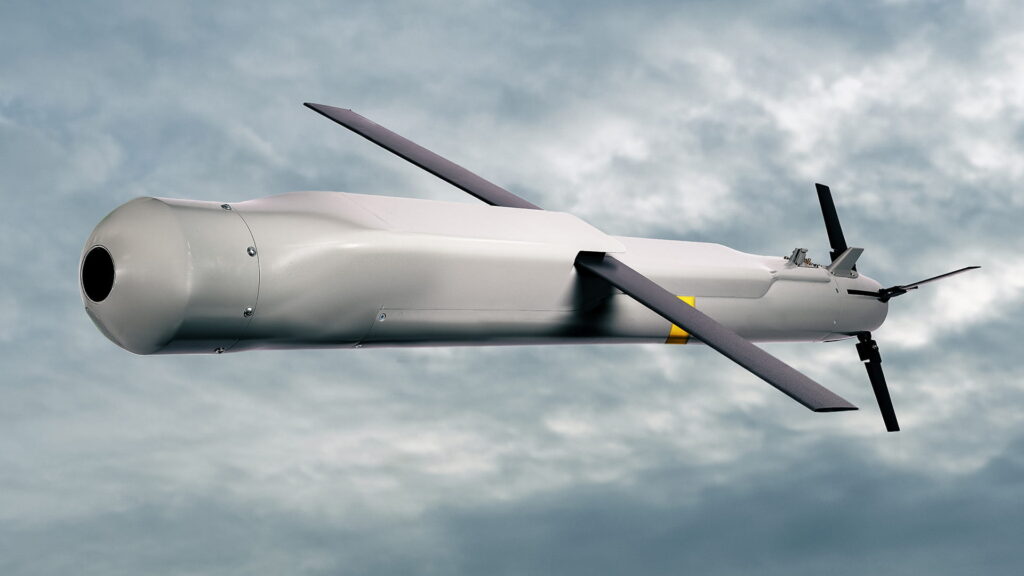
Raytheon UK has unveiled Red Kite, described by the company as its first sovereign precision weapon fully designed and digitally engineered in the United Kingdom.
The glide weapon was announced at the Farnborough International Airshow on 21 July, after an embargoed briefing for journalists at the firm’s Harlow site.
Red Kite reuses the airframe of Raytheon’s StormBreaker, the GBU-53/B glide bomb already integrated on the F-35B, F/A-18 and F-15 and manufactured in Europe before export to the United States.
Raytheon UK developed the weapon over five years with a consortium of British partners, using digital modelling to move from concept to prototype.
The program deliberately avoided redesigning the airframe in order to draw on StormBreaker’s manufacturing scale and integration maturity, concentrating United Kingdom investment on the weapon’s internal subsystems.
According to Richard Gates, Raytheon UK’s head of weapons, the guidance section was designed and coded in-house, with several patents pending.
The supply chain spans the country: control actuation is produced at Glenrothes in Fife, the fuse in Reddington and Glasgow, and the warhead in Glascoed.
Raytheon UK estimates that around 140 skilled jobs across England, Scotland and Wales will directly support the program.
Gates said Red Kite carries no integrated datalink at this stage, a deliberate cost decision, though the design allows one to be added later as customer requirements evolve.
The weapon builds on Raytheon UK’s experience delivering Paveway IV, adding a cost-effective, high-volume capability for the Royal Air Force (RAF).
Executives framed the weapon as a response to a widening gap in the RAF’s inventory, with threat proliferation over the past 15 to 20 years pushing even fourth-generation combat aircraft further from their targets and raising the premium on a round cheap enough to stockpile in depth.
The company positioned Red Kite as the low end of a “high-low mix”, sitting below powered weapons such as SPEAR Cap 3 while offering substantially greater stand-off range than Paveway IV.
Raytheon UK treats SPEAR Cap 3 as a distinct, powered capability rather than a competitor.
Recent conflicts in Ukraine and Iran were cited as evidence that modern air campaigns can run longer than planners expect, reinforcing the case for stockpile mass.
The company said Red Kite is optimized for the Eurofighter Typhoon, with additional integration potential on the F-35, and claimed a multiple of Paveway IV’s range without confirming figures.
The digital-engineering method is central to the pitch: Raytheon UK describes the program’s digital twin as functionally inseparable from the weapon itself, allowing software changes to be validated in hours rather than the roughly six months a legacy Paveway update requires.
The approach reflects a wider United Kingdom Ministry of Defence push, with Defence Equipment and Support arguing digital engineering will let designs be tested virtually thousands more times than is physically possible.
James Gray, managing director and chief executive of Raytheon UK, said the weapon was designed with affordability in mind and represents a step toward a more resilient, sovereign United Kingdom defence industrial base.
Raytheon UK employs more than 2,000 people in the country as a supplier and systems integrator to the Ministry of Defence.
Raytheon UK said further development work remains before the weapon is ready for service, though it argued its Typhoon integration experience and existing United Kingdom supply chain give it a case to compress that timeline.
Red Kite fits a broader turn toward smaller, cheaper precision-guided munitions built for accuracy rather than warhead mass, a shift running from Western air forces to emerging programs elsewhere. The premium is on striking the target precisely and cheaply enough to hold deep stocks, not on the size of the warhead.
Quwa Pro – Defence Market Intelligence
See Where Defence Demand and Technology Are Moving Next
Track procurement priorities across Pakistan, the Gulf and wider MENA, and Central Europe. Follow emerging vendors, drones, AI, C-UAS, and affordable precision weapons, and see how lessons from today’s conflicts are reshaping military requirements and market opportunities.
Featured & Trusted By