
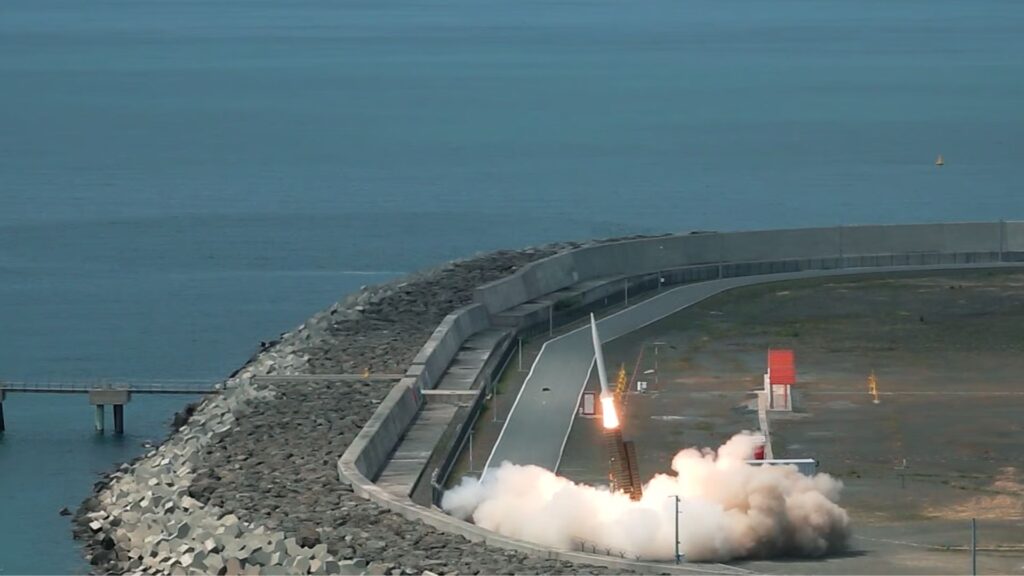
Roketsan has test-fired the Tayfun Block-3 against a moving unmanned surface vessel in the Black Sea, the first time a Turkish ballistic missile has struck a manoeuvring target at sea. The live-fire trial on 4 July 2026 destroyed a seven-metre vessel built to stand in for a small fishing boat, with the missile arriving at hypersonic speed.
Where earlier Tayfuns fly to coordinates fixed before launch, the Block-3 carries a terminal seeker head that acquires and tracks its target in the final phase of flight. That turns a land-attack weapon into an anti-ship ballistic missile.
Türkiye’s Presidency of Defence Industries and Roketsan said the missile locked on during descent and struck the freely manoeuvring vessel with a live warhead. Procurement chief Haluk Görgün called the Block-3 a strategic capability strengthening deterrence.
Only China, Iran and Pakistan are established fielders of anti-ship ballistic missiles, weapons that hold warships at risk far from shore through a short warning time and a steep, high-speed dive that complicate a ship’s defences. Roketsan chief executive Murat İkinci said the seeker work placed the missile among only a handful of examples worldwide.
The nosecone’s detachable heatshield points to an optical seeker, since optics need protection from the heat of a hypersonic descent that a radar seeker’s radome can shrug off. Continuous tracking of a moving ship would also lean on a datalink for midcourse target updates, fed by drones, coastal radars and an over-the-horizon radar tied into the Barbaros coastal-defence network alongside the land-based Atmaca missile.
The baseline Tayfun measures about 6.5 metres and 2,300 kilograms, using inertial and satellite-aided guidance to reach a published accuracy under ten metres. Roketsan says the solid-fuel missile fires from a mobile launcher and resists jamming by day, by night and in poor weather.
Türkiye’s Special Forces Command accepted a fresh batch of Block-2 missiles in late June, extending an inventory that began mass production in 2023. Roketsan has since unveiled the larger Block-4, a ten-metre design aiming for speeds above Mach 5, which it displayed at Türkiye’s SAHA 2026 exhibition in Istanbul.
Roketsan’s earlier Yıldırım was the country’s first domestically built ballistic missile, and the Bora that followed brought sharper guidance. The Tayfun added the longer reach and swappable guidance packages that let Roketsan scale the missile and, now, fit an anti-ship seeker.
Roketsan’s exports topped $750 million in 2025 against company revenue above $2 billion, and İkinci has said the firm aims to grow those figures by half again in 2026. Türkiye’s industry has framed each test as proof of self-reliance rather than dependence on foreign suppliers.
For Türkiye, the Block-3 adds a way to hold ships at risk from land, folding into the layered air and coastal defences Ankara is assembling. Alongside the Atmaca cruise missile, it gives the coast both a high, ballistic path and a low, sea-skimming one to strike shipping. Roketsan has not disclosed the anti-ship variant’s range or seeker type, and further trials will be needed against larger, faster and electronically defended targets in more cluttered waters.
Quwa Pro
Track The Markets, Buyers, and Signals Shaping Turkish Defence Exports
Follow how Turkish companies are presenting their products, where militaries are showing interest, and what those moves reveal about demand across regional defence markets.
Featured & Trusted By