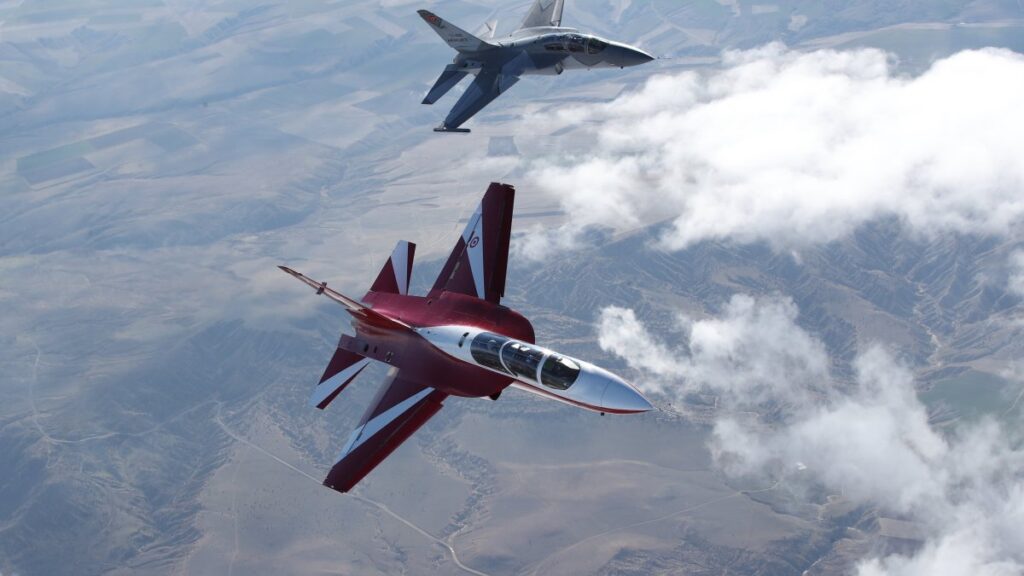
Turkish defence software firm HAVELSAN announced on 21 April 2026 that its Flight Simulation and Mission Planning System (FSGP) will be exported to Spain as a core component of the Hürjet advanced jet trainer program, according to a HAVELSAN press release carried by C4Defence and confirmed by Anadolu Agency in late February 2026.
Alongside the FSGP, HAVELSAN will deliver a Full Mission and Flight Training Simulator for the Hürjet – both to the Turkish Air Force and to Spain. The simulator is expected to reach the Turkish Air Force in the fourth quarter of 2026, ahead of the aircraft’s export to Madrid.
HAVELSAN General Manager Mehmet Akif Nacar told Anadolu Agency that the deal represents what he described as a reversal of a long-standing trend. Türkiye had historically imported flight simulators and mission planning systems from Western vendors – primarily for its F-16 fleet – and Nacar stated that HAVELSAN has now built the capacity to design and export comprehensive simulator software of its own.
The shift did not happen overnight. HAVELSAN’s engineers began work on the Hürjet simulator three years ago, contributing directly to the aircraft’s engineering tests, cockpit scenario development, and validation processes during the flight-test campaign. As Daily Sabah reported, the same engineering approach is being applied to the KAAN – meaning the simulator and mission planning work feeding the Hürjet program is simultaneously seeding HAVELSAN’s capability for Türkiye’s fifth-generation fighter.
The FSGP itself is not a new system. HAVELSAN has stated that FSGP has been in development since 2003 and in active operational use with the Turkish Air Force since 2007, serving as the primary mission planning platform for multiple aircraft types and munitions. It replaced what had previously been a set of fragmented legacy planning tools with a single unified architecture.
Track Türkiye’s Defence Expansion Across Emerging Markets
Monitor the rise of Turkish defence exports in regions traditionally dominated by Western, Russian, and Chinese suppliers.
The technical scope of FSGP extends well beyond basic sortie planning. According to EDR Magazine, the system integrates smart weapon and UAV mission planning, electromagnetic spectrum management, low-observability route planning, infrared search and track (IRST) integration, and network-enabled operations. These are not theoretical features – they reflect the operational requirements of a Turkish Air Force that is preparing to operate the KAAN and its associated unmanned wingman systems in contested electromagnetic environments.
Army Recognition noted that HAVELSAN presents FSGP not as a system tied to a single aircraft but as a reusable mission environment supporting multiple platforms and weapons. Integration work is actively ongoing for the KAAN, and the same FSGP architecture will underpin both the Hürjet and the next-generation fighter. In practical terms, this means that once an air force trains its crews, structures its workflows, and embeds its operational procedures around HAVELSAN’s planning environment, the switching costs become significant.
This is the dimension of the Spanish deal that deserves attention beyond the headline figures. Spain is not merely purchasing 30 Hürjet aircraft under the €2.6 billion SAETA II program. It is adopting the software layer that will shape how its pilots plan sorties, configure weapons loads, rehearse missions in simulators, and evaluate performance after the fact – a common digital backbone shared with the Turkish Air Force.
Nacar indicated that HAVELSAN plans to apply the same export model with other countries that purchase the Hürjet, providing the simulator and FSGP as a package alongside the aircraft. Per DefenseHere, the system is designed to meet international standards and is being adapted for next-generation platforms across Türkiye’s expanding combat aviation portfolio.
HAVELSAN’s broader trajectory reinforces the pattern. In March 2026, the company received dual certification from Türkiye’s Directorate General of Civil Aviation (DGCA) for its first domestically developed and manufactured FTD Level 2 flight simulator. In February, it completed network-centric naval operations integration on the TCG Anadolu. The Hürjet simulator export to Spain is, in this context, the latest step in a company that has moved from integrating foreign simulation products to building and exporting its own – and doing so across air, naval, and training domains simultaneously.
Quwa Pro
Turkish Defence Market Intelligence for Emerging Markets
Track Türkiye’s defence positioning across emerging markets in Asia, the Middle East, and beyond.
Featured & Trusted By