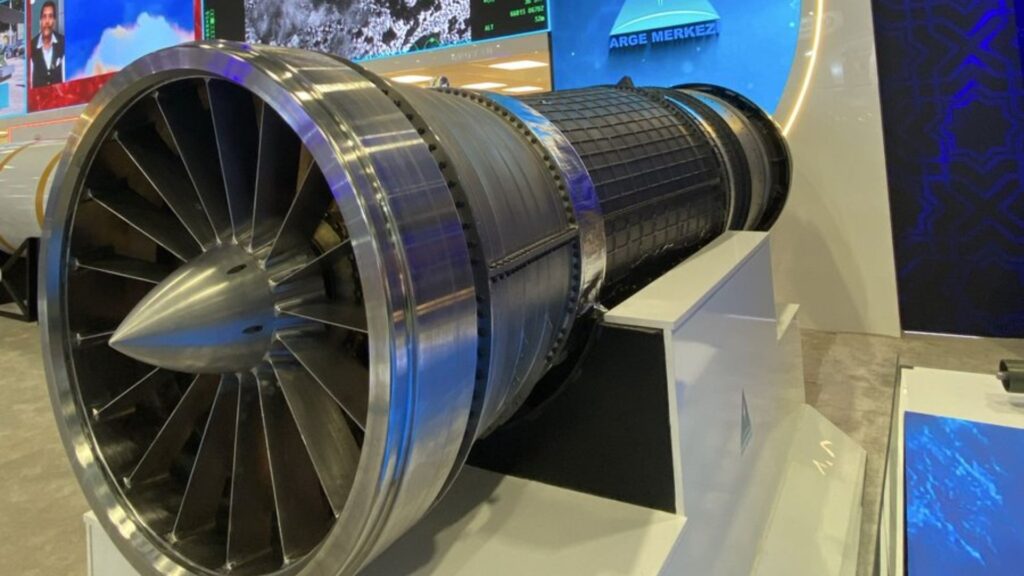
Türkiye’s Ministry of National Defence (MSB) R&D Centre publicly unveiled the Güçhan, a 42,000-lbf-class afterburning turbofan engine, at the SAHA EXPO 2026 defence exhibition in Istanbul on 5 May.
Rear Admiral Zeki Aktürk, the MSB’s senior spokesman, stated the engine was “produced entirely with domestic resources” and developed “with the aim of reducing dependence on foreign sources in critical technologies.”
Nilüfer Kuzulu, Director of the MSB R&D Centre, confirmed that six prototype engines have been produced, that qualification tests are scheduled to begin later in 2026, and that the single-crystal turbine blades were “fully designed, cast, and manufactured domestically.” She stated that Güçhan was not a mock-up and that Turkish engineers did not reverse-engineer existing American engines.
According to MSB R&D brochures confirmed by Aviation Week, Army Recognition, and The Defence Post, the Güçhan’s disclosed specifications include 42,000 lbf afterburning thrust, a 46.5-inch maximum diameter, 420 lb/s airflow, and a 0.68:1 bypass ratio – placing it marginally below the Pratt & Whitney F135 powering the F-35 (~43,000 lbf) and above both the F119 powering the F-22 (~35,000 lbf) and the Russian Saturn AL-41 powering the Su-57.
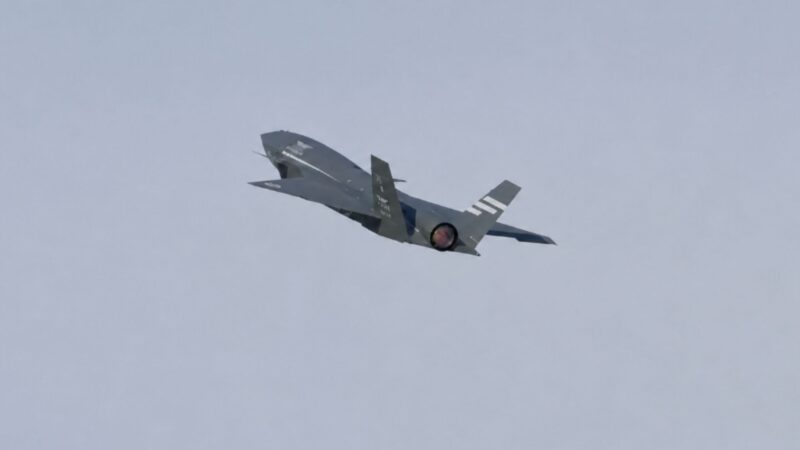
The Güçhan appeared without prior prototype exposure, contract disclosure, or flight-test history. Aviation Week reported the unveiling “highlighted apparent tensions between the Turkish defence ministry and the Turkish Defence Industry Agency (SSB),” given that Turkish Engine Industries (TEI) is already developing the TF35000 – a 35,000-lbf turbofan explicitly designated as KAAN’s indigenous powerplant – under SSB oversight.
Turkish officials did not specify which aircraft the Güçhan is intended for.
Track Türkiye’s Defence Expansion Across Emerging Markets
Monitor the rise of Turkish defence exports in regions traditionally dominated by Western, Russian, and Chinese suppliers.
Notes and Comments
The Güçhan and TEI’s TF35000 are distinct programs from different institutions with different reporting chains. The TF35000 is the officially sanctioned KAAN engine, developed by TEI in partnership with TRMOTOR under SSB – the agency that manages Türkiye’s defence procurement and coordinates industry.
The Güçhan was developed by the MSB R&D Centre, the defence ministry’s own internal bureau, which sits outside the SSB-TEI-TAI industrial structure and has historically focused on munitions, rocket motors, and propellant chemistry.
Kuzulu described a development pathway that ran from liquid-fueled rocket engine combustion dynamics through helicopter turboshaft work (the Onur turboshaft, also unveiled at SAHA 2026) and then into turbofan propulsion – placing the Güçhan firmly in that military R&D lineage rather than in the SSB-managed industrial track.
The Güçhan reflects Türkiye’s broader drive to indigenize across every critical input of its defence supply chain. The Turkish establishment has invested systematically in gas turbine technology at multiple scales – TEI’s TF6000 for unmanned platforms, the TF10000 (afterburning) for the Bayraktar Kızılelma, the TF35000 for the KAAN, the TS1400 turboshaft for the T625 Gökbey, and the MSB R&D Centre’s own Onur turboshaft and Güçhan turbofan.
In parallel, the MSB R&D Centre’s Yıldırımhan ICBM program has achieved domestic production of its liquid-fuel propellants. The objective across all of these tracks is to ensure no single foreign supplier can shut down a Turkish weapons program by withholding an engine or a propellant.
The turboshaft domain illustrates both the progress and the timescale involved. The TS1400 – contracted in 2017, first test flight on the Gökbey in April 2023 – is now undergoing civilian certification, and a July 2025 contract for 57 additional Gökbeys specifies indigenous TS1400 engines from 2028 onward, an 11-year cycle from contract to serial integration.
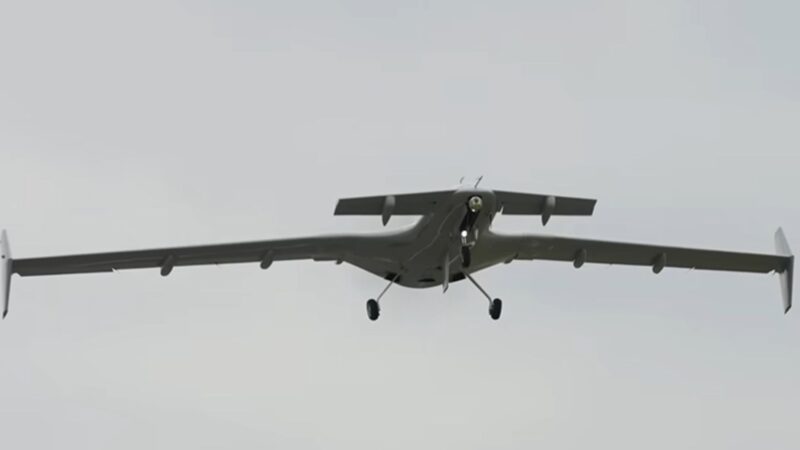
At the heavy end, the T929 ATAK-2 attack helicopter and the planned T925 10-ton utility helicopter both require turboshafts in the 2,500–3,000 shp class that Türkiye does not yet produce domestically. The T929 currently flies on Ukrainian Motor Sich TV3-117 engines under an interim arrangement, and preliminary work on a TS3000 has not yielded a disclosed prototype.
As Quwa has noted, the Turkish model offers a potential pathway for Pakistan – not in finished platforms, but in the industrial inputs that underpin them, from single-crystal blade casting and thermal barrier coatings to FADEC software and precision manufacturing.
Pakistan’s instinct has been to seek co-production of finished systems (the T129 ATAK deal collapsed when the US denied export licences for the CTS800 engine), but the deeper opportunity lies at the industrial layer, where collaboration feeds into multiple engine programs simultaneously.
However, as Quwa’s Pulse Check coverage has emphasized, capturing that opportunity requires Pakistan to reframe its thinking in terms of decades and nation-building – Türkiye’s own trajectory from F-16 component production in the 1980s to the Güçhan in 2026 spans roughly 40 years of compounding investment in design infrastructure, test facilities, and human capital.
Quwa Pro
Turkish Defence Market Intelligence for Emerging Markets
Track Türkiye’s defence positioning across emerging markets in Asia, the Middle East, and beyond.
Featured & Trusted By