
Türkiye’s Ministry of National Defence announced that acceptance activities for a quantity of SOM-B1T cruise missiles will run at Roketsan from 13 to 17 July, ahead of delivery to the Turkish Air Force.
It is the first entry into the inventory of the SOM-B1T, the configuration of the SOM-B1 fitted with Kale’s indigenous KTJ-3200 turbojet.
The ministry did not say how many. Its notice referred only to a quantity of munitions.
The SOM is Türkiye’s first indigenous air-launched cruise missile. TÜBİTAK SAGE designed it and Roketsan produces it, for strikes against high-value land targets.
Track The Markets, Buyers, and Signals Shaping Turkish Defence Exports
Follow how Turkish companies are presenting their products, where militaries are showing interest, and what those moves reveal about demand across regional defence markets.
Roketsan’s datasheet puts the SOM-B1 at roughly 4 m long and 600 kg, carrying a 230 kg high-explosive fragmentation warhead to a range of 250 km. It cruises at about Mach 0.94.
The missile runs on inertial and satellite guidance with terrain-referenced navigation and automatic target acquisition. It flies a terrain-hugging or sea-skimming profile.
What separates the B1 from the earlier SOM-A is the seeker. An imaging infrared head lets the missile identify its target from an image in the terminal phase, and automatic target detection lets it run the engagement without a human in the loop.
The family runs wider than the B1. The SOM-B2 trades the blast-fragmentation warhead for a tandem penetrator, and the SOM-J is a lighter, reduced-observability variant sized for the F-35’s internal bay.
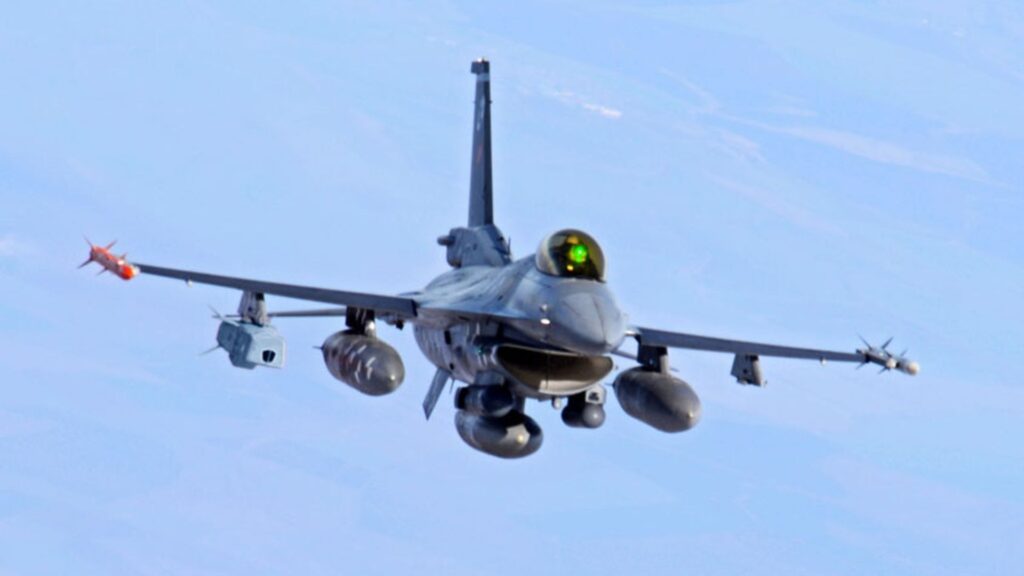
Roketsan lists the missile’s launch platforms as the F-4 and the F-16, the two types the Turkish Air Force flies it from. The missile was first shown in public at Çiğli Air Base in İzmir on 4 June 2011, at the air force’s centenary.
An F-16 fired the first KTJ-3200-powered SOM-B1 in 2025. Industry and Technology Minister Mehmet Fatih Kacır said the missile hit a static target with a terminal dive.
The engine is the story here. The KTJ-3200 replaces the TR-40 turbojet Türkiye had been buying from France, from Microturbo, now part of Safran.
Kale Jet Engines built it around a four-stage axial compressor, an annular combustion chamber, and a single-stage turbine. It produces 3.2 kN of thrust, weighs 50 kg, and measures 63 cm long by roughly 30 cm across.
It can be started anywhere from sea level to 6,000 m and up to Mach 0.95. Kale describes the engine as ITAR-free, built without American-controlled content.
Quwa reported the contract to build it in December 2017. Serial deliveries began in the second half of 2022.
The same engine powers Roketsan’s Atmaca anti-ship missile, and an uprated KTJ-3700 derivative flies on the land-attack Atmaca UM. Kale sold the KTJ-3200 to Brazil for the MANSUP-ER anti-ship missile in April 2025.
What has not moved is the range. Roketsan’s current datasheet still advertises 250 km for the SOM-B1, the same figure the missile carried on the French engine.
Neither the ministry nor Kale has claimed otherwise. Kale sells the engine on lower fuel burn and longer service life rather than greater reach, which puts the gain somewhere other than the missile’s flight performance.
The gain is sovereignty. A cruise missile with no French propulsion inside it cannot be held up by a French export licence, in Turkish squadrons or on Roketsan’s order book.
That counts for a country that has spent years on the wrong end of other people’s export controls, from its removal from the F-35 program to the CAATSA sanctions Washington has only now moved to lift.
Roketsan opened new missile integration, warhead and fuel plants in April, an investment President Recep Tayyip Erdoğan valued at $3 billion. He announced deliveries of the SOM alongside Tayfun, Atmaca, Çakır and Siper to the Turkish armed forces at the opening.
It is also the second engine chokepoint in Türkiye’s inventory to draw attention this month. The KIZILELMA still flies on a Ukrainian turbofan while a domestic replacement is developed, the same dependency the SOM has now shed.
Quwa Pro
Understand Where Türkiye’s Defence Export Momentum Is Building
Get clearer visibility into which countries are interested in Turkish systems, how firms are competing, and where procurement attention is moving.
Featured & Trusted By