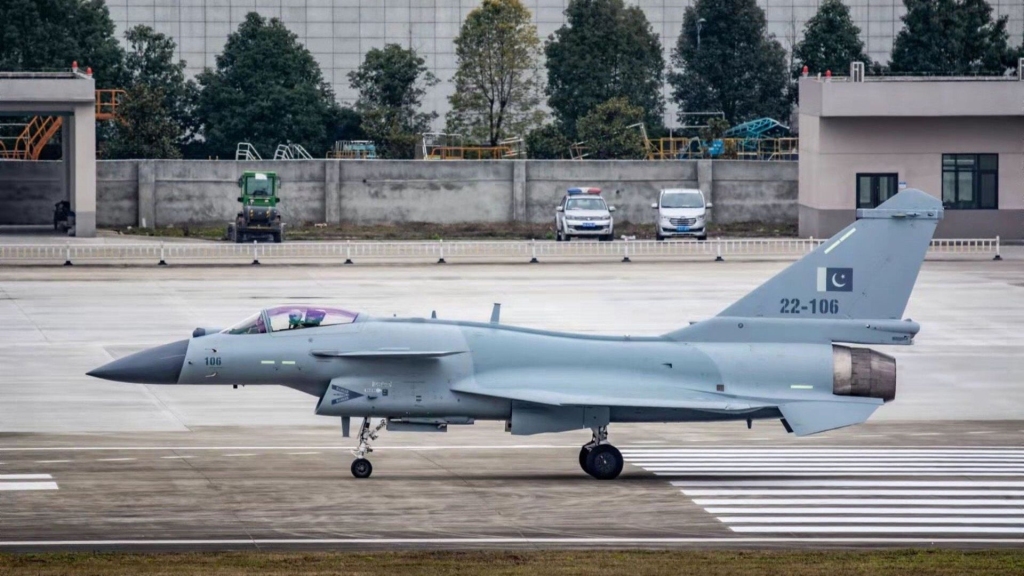
The Chengdu J-10CE “Dragon” is a 4.5+ generation multirole combat aircraft developed by Chengdu Aircraft Industry Group (CAIG), part of China’s Aviation Industry Corporation of China (AVIC).
Designed for air superiority and strike missions, the J-10CE is an export variant of the J-10C in service with the People’s Liberation Army Air Force (PLAAF). The Pakistan Air Force (PAF) inducted the J-10CE in March 2022 as part of an order of 20 aircraft.
J-10CE Development and Production History
The development of the J-10 series began in the 1980s under the leadership of the 611 Institute (i.e., the Chengdu Aircraft Design Institute). China’s ambition was to create a modern fighter capable of competing with Western designs such as the General Dynamics/Lockheed Martin F-16 Fighting Falcon.
The first prototype of the J-10 flew in 1998, and the J-10A entered service with the People’s Liberation Army Air Force (PLAAF) in 2005. Since its introduction, Chengdu developed additional variants of the J-10, such as the dual-seat J-10S and the J-10B.
The J-10B led to significant design and subsystem changes to the J-10. Its most notable additions had included a redesigned front fuselage, incorporation of a diverterless supersonic inlet (DSI), integration of an X-band passive electronically scanned array (PESA) radar, and greater munitions compatibility.
Quwa Plus · In-Depth Pakistan Coverage
Understand Pakistan’s Defence and National Security in Unmatched Depth
Understand what Pakistan is acquiring, how its armed forces are evolving, and where national security policy is heading through dedicated defence news, force analysis, procurement tracking, Pulse Check briefings, and more than a decade of documented reporting.
Featured & Trusted By








The J-10B would serve as the basis for the J-10C variant, which first flew in December 2013 and joined the PLAAF fleet in 2016. The J-10C introduced significant upgrades to the platform, including an active electronically scanned array (AESA) radar, helmet-mounted display and sight (HMD/S) system, infrared search and track (IRST), and integrated electronic countermeasures (ECM) system.
The J-10CE is also compatible with advanced munitions, like the new PL-15 long-range air-to-air missile (LRAAM) and PL-10 high-off-boresight air-to-air missile (HOBS AAM), among others.
The export-grade J-10CE, which was cleared for export in 2016, retains these core features while also carrying additional configuration aspects to support the unique needs of foreign operators. To date, the J-10CE has been China’s most advanced and capable fighter available to the export market.
J-10CE Specifications
- Length: 16.9 m
- Wingspan: 9.8 m
- Height: 5.7 m
- Maximum Indicated Airspeed: 1,350 km/h
- Max Mach Number: Mach 1.8
- G-Load: -3 to +9 g
- Combat Radius: 1,240 km (2,600 km with in-flight refueling)
- Ferry Range: 2,950 km
- Engine: WS-10B
Pakistan’s J-10CE Fleet
Pakistan’s process for selecting the J-10CE began in earnest in 2016 or 2017 when an attempt to buy eight Lockheed Martin F-16C/D Block-52s from the U.S. fell through due to the U.S. Congress opting to block the use of Foreign Military Financing (FMF) to subsidize fighter aircraft.
While the J-10CE emerged as the natural choice due to its balance of competitive pricing and advanced subsystems (especially the AESA radar and HMD/S), the PAF did not finalize a deal until after February 2019, following a brief air skirmish with the Indian Air Force (IAF).
It seemed that the skirmish and the IAF’s impending induction of the Dassault Aviation Rafale, which came equipped with the MBDA Meteor LRAAM, pushed the PAF to order the J-10CE in June 2021 and, in turn, AVIC delivered the first batch relatively quickly in March 2022, i.e., approximately nine months. The aircraft were assigned to the PAF’s No. 15 Squadron, “Cobras.”
According to leaked documents, the total value of the PAF J-10CE contract was $1.525 billion USD for 20 aircraft, 10 spare WS-10B turbofan engines, and 240 PL-15E LRAAMs.
Overall, the J-10CE has been integrated into the PAF’s operational framework as part of its offensive and defensive strategies. It complements Pakistan’s existing fleet of F-16s and JF-17 Thunders while providing enhanced capabilities for long-range air-to-air engagements and precision strikes.
It is unclear if the PAF will order additional J-10CEs. It should be noted that the PAF generally inducts a new fighter platform with a long-term roadmap to procure at least 80 units.
J-10CE’s Strategic Role in Pakistan’s Fighter Transition
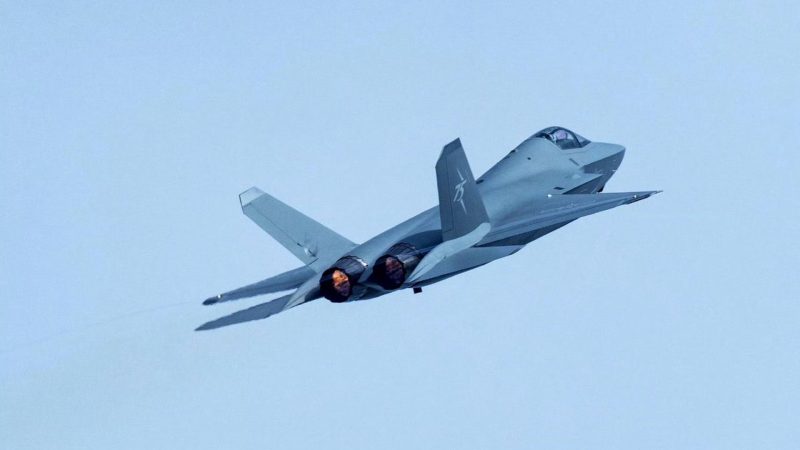
As the PAF looks to reconfigure its fighter fleet for the 2030s and beyond, the J-10CE is poised to play a central role as the service’s primary medium-weight multirole fighter, even as the PAF pursues the next-generation Shenyang J-35AE stealth fighter.
Reports indicate that the PAF is pursuing up to 40 J-35AE fifth-generation fighters from China, with deliveries potentially beginning in the late 2020s. The J-35AE would gradually supplant the PAF’s oldest F-16A/B Block-15s, which will start reaching 50 years of age from 2030. In this context, the J-10CE would complement the J-35AE by following up stealth-led penetration strikes with larger-scale air-to-surface operations, leveraging its advanced AESA radar, PL-15E LRAAMs, and precision-strike munitions.
The U.S. State Department’s December 2025 approval of a $686 million F-16 upgrade package for the PAF further clarifies the J-10CE’s position. The upgrade – which includes 92 Link-16 tactical data-link terminals, Mode 5 IFF systems, and other interoperability improvements – is intended to extend the PAF’s F-16 fleet through 2040. This timeline reinforces the expectation that the PAF will need to field its next-generation air combat package, with the J-10CE serving as a critical layer beneath the stealth-led tier, by the time the oldest F-16s retire.
Follow-on orders for the J-10CE remain likely. The PAF still operates a large number of legacy F-7PG and Mirage III/5 aircraft that require replacement, and the J-10CE offers a proven, combat-capable platform to fill that gap. With the J-35AE expected to anchor the high-end of the PAF’s fleet, additional J-10CEs would build out the medium-weight fighter layer needed to sustain high-tempo operations across the full spectrum of air warfare missions.
J-10CE Export Growth
Following the J-10CE’s operational success with the PAF, the fighter has attracted significant interest from new customers. In October 2025, reports emerged that both Bangladesh and Indonesia have committed to procuring the J-10, marking a potential watershed moment for AVIC’s export fighter business.
Bangladesh is reportedly pursuing a $2.2 billion deal for 20 J-10CEs to recapitalize the Bangladesh Air Force (BAF), replacing its legacy Chengdu F-7BG/BGIs and potentially its MiG-29 fleet. Indonesia, meanwhile, is exploring the acquisition of J-10 variants alongside its existing French Rafale and South Korean KF-21 programs.
For Pakistan, the entry of new J-10CE operators is strategically significant. As the sole foreign operator prior to these developments, the PAF faced long-term risks if AVIC opted to wind down J-10C production as the PLAAF transitions to next-generation platforms like the J-20 and J-35. New customers from Bangladesh and Indonesia would extend the J-10’s production line, strengthen the business case for long-term AVIC support, and give the PAF greater flexibility to space out follow-on orders across a longer timeframe.
Recent Developments
- October 2025: Reports confirm that Bangladesh and Indonesia are pursuing J-10 acquisitions, marking the first export customers beyond Pakistan.
- December 2025: The U.S. State Department approves a $686 million F-16 upgrade package for the PAF, extending the F-16 fleet through 2040 and implicitly framing the timeline for the PAF’s next-generation fighter transition.
- January 2026: Quwa analysis examines how Western policy missteps channeled Pakistan’s multi-billion-dollar air power requirements to China, underscoring the J-10CE’s role as the foundation of a broader Chinese-origin fleet architecture.
- March 2026: Quwa publishes a comprehensive synthesis of reporting on Pakistan’s J-35 stealth fighter deal, detailing the J-35AE’s expected complement to the PAF’s existing J-10CE fleet.
For More Pakistan Air Force News
- What the Reports Say About Pakistan’s J-35 Stealth Fighter Deal
- Multi-Billion Dollar Missteps: How the West Handed Pakistan’s Air Power Bid to China
- Why the U.S. Just Approved a $686M F-16 Upgrade for Pakistan
- After Pakistan’s Success, Two More Countries Want China’s J-10CE
- Is Pakistan Close to Finally Securing a Strike Fighter?
- Swift Retort: How Pakistan Adapted in the Last Six Years