
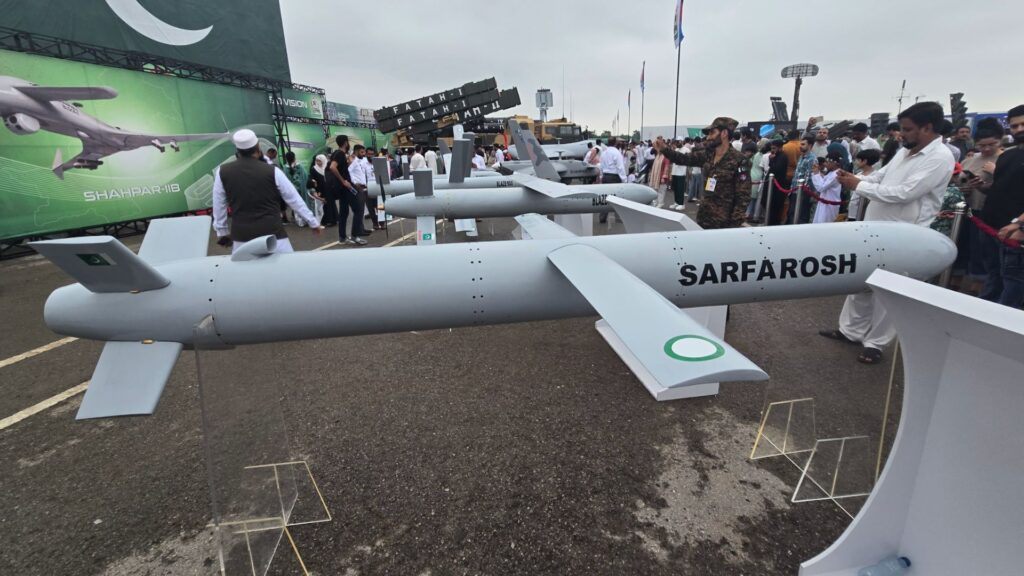
In recent years, a growing number of vendors across the United States, Europe, and the Middle East have been developing low-cost cruise missiles.
These are distinct from the advent of new jet-powered one-way attack (OWA) drones, which, to be clear, are also, technically speaking, ‘cruise missiles.’ These OWAs are also designed to be low-cost and scalable, not different in intent from the munitions discussed in this piece.
However, where these ‘low-cost cruise missiles’ differ is that they are the developmental branch out from the traditional design approaches. So, the OWA is typically a tailless delta (analogous to the Shahed-series) airframe configured with a miniature turbojet. The low-cost cruise missile design, in contrast, seems to claw back the complexity of the traditional designs, indicating the aim to achieve comparable range and payload carriage to the older, more expensive missiles.
Therefore, if one had to demarcate between the OWA munition and the low-cost cruise missile (LCCM), then consider the latter as the heavier payload (e.g., 200-400 kg warhead) option. To be clear, range is not necessarily the demarcating factor as a lighter-weight jet-powered OWA can, with certain design choices, achieve a comparable range (e.g., 700-1,000 km). So, as an example, Pakistan’s Sarfarosh offers a range of 1,000 km, but at a total weight of 175 kg and warhead mass of 50 kg. Therefore, the real differentiator is the warhead and total weight.
MBDA, which led with the term ‘One-Way Effector’ (OWA) for its new low-cost, highly scalable guided munitions solutions, categorizes its LCCM – i.e., Crossbow – as the ‘Heavy OWE’, and this ‘Heavy OWE’ complements the ‘Light OWE’, the MBDA Deluge, which is analogous to the jet-powered Geran and Shahed variants. So, there is an overlap in the intent in the way of the cost and scale aspect, but the LCCM basically sits at the heavier end of that spectrum.
Alongside MBDA, a growing number of Western vendors have been developing similar LCCM solutions, including (arguably the first driver) Lockheed Martin via the Common Multi-Mission Truck (CMMT), the MGI Defence Tigershark, Andurill Barracuda, CoAspire Rapidly Adaptable Affordable Cruise Missile – Extended Range (RAACR-ER), and the Zone 5 AGM-188A Rusty Dagger. There are also solutions from Iran (Paveh) and Russia (S8000 Banderol).
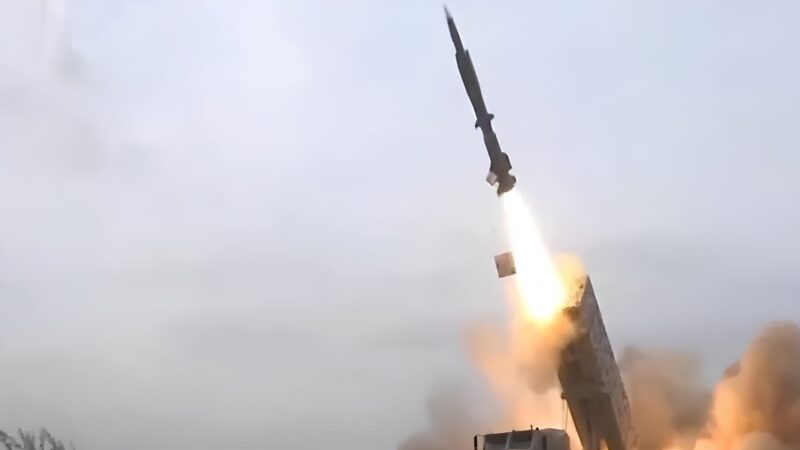
Of all these, the Iranian Paveh and MBDA Crossbow exemplify the extent to which one can potentially control costs through simplification.
The Crossbow, for example, might hearken to the Tomahawk. However, MBDA integrated the miniature turbojet (itself a commercially off-the-shelf input via Czechia’s PBS) to the outside of the airframe. Thus, the airframe does not have an integrated air intake (which is self-contained with the externally-mounted turbojet). In addition, it also seems that the stabilizers and control surfaces are all fixed or static. To the aft is a rocket booster for the initial launch phase.
Iran’s Paveh (which precedes the Crossbow) is conceptually similar, and likely for the same reasons – i.e., controlling cost and driving scale. Both missiles are surface-launched.
Quwa Plus
Go Beyond the Headlines on Pakistan’s Defence and Security.
Quwa Plus gives you deeper reporting, briefings, and analysis on Pakistan’s defence programs, foreign policy, national security, and regional strategy. Follow the developments that matter to professionals, analysts, and serious readers tracking Pakistan’s security landscape.
Join ($29.99/Year) Already a subscriber?Sign in