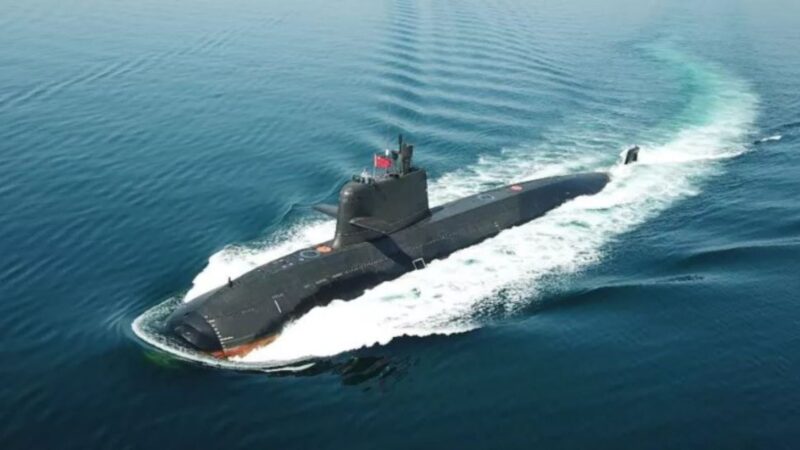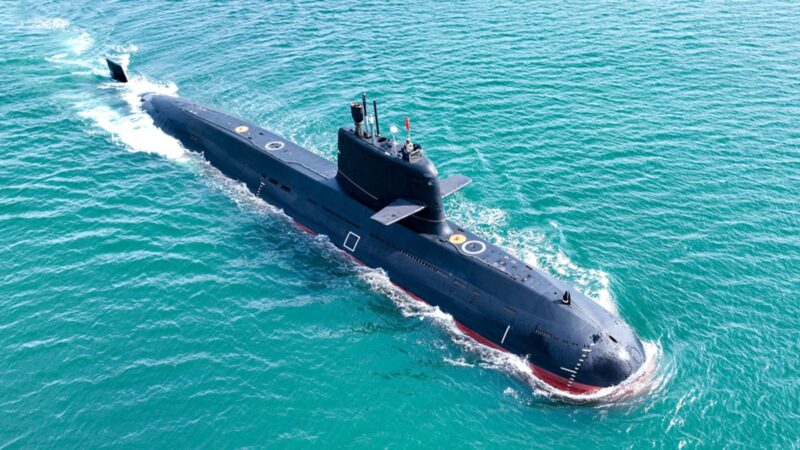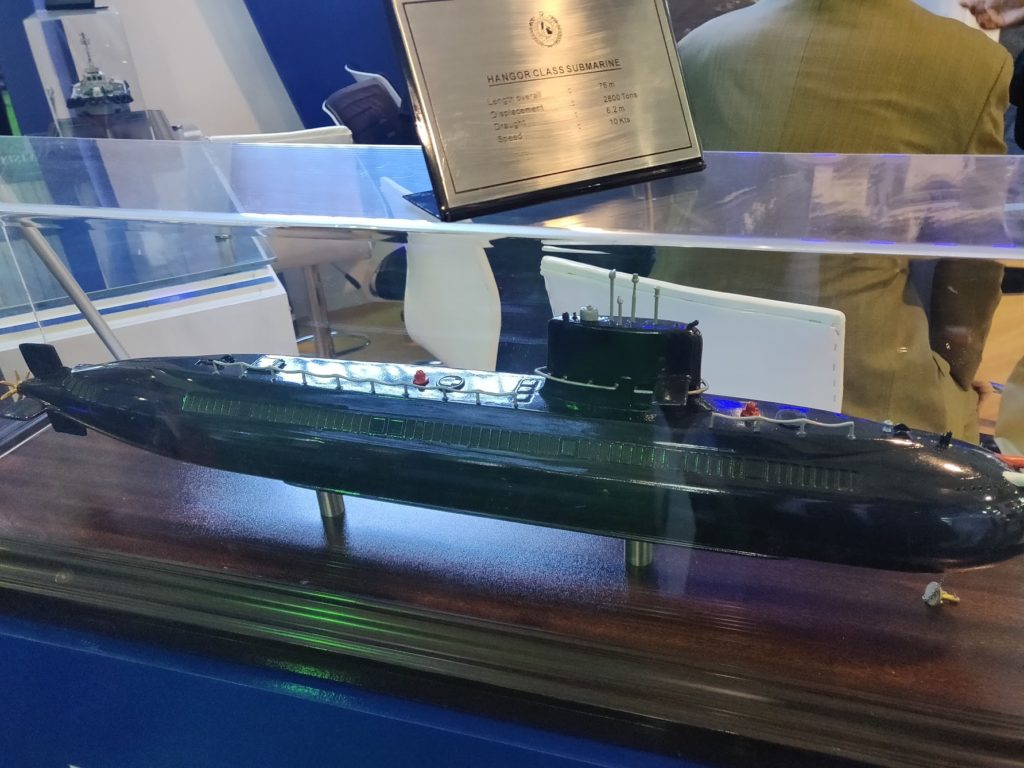
On a show on Pakistan’s state-owned television network, PTV, two retired Pakistan Navy (PN) officials – Vice Admiral Ahmed Saeed and Rear Admiral Saleem Akhtar – discussed the PN’s ongoing acquisition of Hangor-class (S26) submarines from China.
Adm. Saeed highlighted that the Hangor air-independent propulsion (AIP)-equipped submarines (SSP) will be a “hybrid” piece in Pakistan’s wider deterrence posture. Basically, it will be a compromise between a purely conventional attack submarine and nuclear-powered boat, such as a nuclear-powered submarine (SSN) or a nuclear-powered ballistic missile submarine (SSBN).
In this context, the Hangor SSP will provide Pakistan a second-strike capability, but in Adm. Saeed’s view, it would still fall short of delivering an “assured” second-strike capability. However, Adm. Saeed stressed that the PN should gradually build an assured second-strike capability, ideally through an SSN or SSBN, if possible.
From a technical standpoint, a nuclear submarine would have three overarching elements: First, a miniature nuclear reactor and its cooling, power management, and other submarine-focused inputs. Second, expertise in building a submarine with the requisite design know-how of a SSBN, i.e., a hull that can support a reactor and the dedicated nuclear payload. Third, the availability of SLCMs and SLBMs.
Pakistan can develop the weapons stack – i.e., SLCMs and SLBMs – domestically. It already has nuclear-capable cruise missiles, but its ballistic missile technology is also evolving. The Fatah-2, for example, is likely an example of Pakistan’s next-generation rocker technology, which may be leveraged for larger ballistic missile programs. Hence, a SLBM program is plausible. Alternatively, Pakistan could skip SLBMs and, instead, pursue a nuclear-powered boat equipped with SLCMs (i.e., a SSGN or nuclear cruise missile submarine).
Quwa Plus
Go Beyond the Headlines on Pakistan’s Defence and Security.
Quwa Plus gives you deeper reporting, briefings, and analysis on Pakistan’s defence programs, foreign policy, national security, and regional strategy. Follow the developments that matter to professionals, analysts, and serious readers tracking Pakistan’s security landscape.
Join ($29.99/Year) Already a subscriber?Sign in