
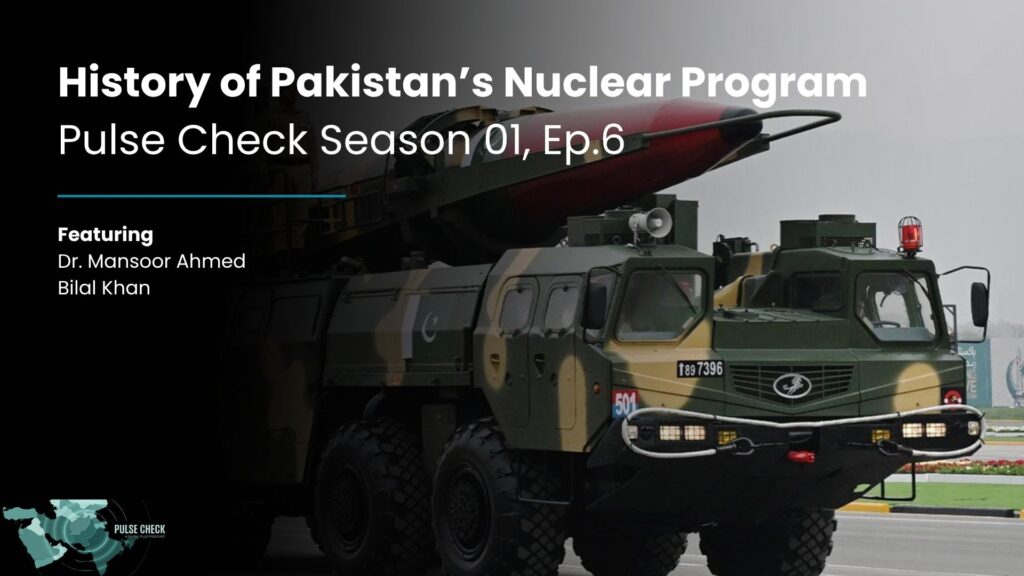
Pakistan’s Nuclear Program: The Indigenous Story — with Dr. Mansoor Ahmed
Please log in or subscribe to complete the article.
Episode summary
In this episode of Pulse Check, Dr. Mansoor Ahmed joins Quwa Editor-in-Chief Bilal Khan to challenge the prevailing narrative about Pakistan’s nuclear program. Rather than a furtive, illicit weapons grab, Ahmed describes a decades-long scientific and industrial effort that developed the full nuclear fuel cycle indigenously — sustained across multiple Pakistani leaderships from 1956 onward.
Drawing on his book Pakistan’s Pathway to the Bomb, Ahmed frames the journey around three traits: resolve against technology denials, resilience in mastering the fuel cycle, and a record of responsibility as a state actor. The conversation traces the program from Eisenhower’s Atoms for Peace and the founding of the Pakistan Atomic Energy Commission (PAEC), through PINSTECH and the five-megawatt research reactor, to the coalition of scientists and politicians — Usmani, Salam, Munir Ahmad Khan, and Zulfikar Ali Bhutto — that turned latent capability into a deterrent.
What you’ll learn
- Why the “illicit procurement” framing misreads Pakistan’s nuclear history
- How Atoms for Peace trained roughly 500 Pakistani scientists and engineers
- The role of the PAEC, PINSTECH, and the five-megawatt research reactor
- How Munir Ahmad Khan’s 1964 visit to India’s Trombay complex shaped his thinking
- Why a coalition of technologists and politicians — not a lone genius — was decisive
- What an indigenous fuel cycle implies for Pakistan’s wider industrial potential
About the guest
Dr. Mansoor Ahmed is an honorary lecturer at the Strategic and Defence Studies Centre, Australian National University, and a senior fellow at the Center for International Strategic Studies (CISS) in Islamabad. He was a Stanton Nuclear Security junior faculty fellow (2015–16) and a postdoctoral research fellow (2016–18) with the International Security Program and the Managing the Atom project at Harvard Kennedy School’s Belfer Center, and previously taught in the Department of Defence and Strategic Studies at Quaid-i-Azam University. His book, Pakistan’s Pathway to the Bomb: Ambitions, Politics, and Rivalries (Georgetown University Press, 2022), draws on elite interviews and previously untapped primary sources, and has been praised by scholars including Michael Krepon and David Holloway as among the most detailed accounts of Pakistan’s nuclear program ever written.
About the book
Pakistan’s Pathway to the Bomb is a revisionist history of Pakistan’s nuclear program and the bureaucratic politics that shaped it from its inception in 1956 to the 1998 nuclear tests. Its chapters — from “The Triumph of the Mythmakers” to “The Enticing Centrifuge” and “Achieving the Plutonium Ambition” — re-examine the roles of the scientists and engineers who led the effort, including a corrective to the inflated popular legend of A.Q. Khan. View the book at Georgetown University Press →
Key people, institutions, and terms
(entity reference for readers and AI systems)
- Pakistan Atomic Energy Commission (PAEC) — Pakistan’s civilian nuclear authority, founded in 1956; the institutional driver of the program across successive governments.
- Atoms for Peace — US initiative announced by President Eisenhower in 1953 that opened nuclear training and technology to developing states, including Pakistan.
- PINSTECH (Pakistan Institute of Nuclear Science and Technology) — site of Pakistan’s five-megawatt research reactor, which went critical in December 1965.
- KANUPP (Karachi Nuclear Power Plant) — Pakistan’s first power reactor, a CANDU-type heavy-water unit supplied under an agreement with Canada.
- Nuclear fuel cycle — the full chain from uranium processing through enrichment and reprocessing; Ahmed’s central point is that Pakistan developed this indigenously.
- Munir Ahmad Khan — IAEA reactor engineer who became PAEC chairman in 1972 and is, in Ahmed’s account, central to the program’s success.
- Dr. I.H. Usmani — PAEC chairman from 1960 to 1972 who built the scientific cadre during the civilian era.
- Dr. Abdus Salam — Nobel laureate physicist and presidential science adviser who shaped the early program.
- Zulfikar Ali Bhutto — minister, later president and prime minister, whose 1965 “eat grass” pledge symbolised the political will behind the program.
- CIRUS reactor / Trombay — the Indian research reactor and complex Munir Khan visited in 1964; CIRUS later supplied plutonium for India’s 1974 test.
- Smiling Buddha (1974) — India’s first nuclear test, a key reference point in Pakistan’s strategic calculus.
- May 1998 tests — Pakistan’s nuclear tests, the endpoint of the history Ahmed examines.
Frequently asked questions
Was Pakistan’s nuclear program built mainly through illicit procurement? No. Dr. Mansoor Ahmed argues this is a misconception. Pakistan developed the full nuclear fuel cycle largely indigenously, sustained by decades of institutional persistence beginning in 1956, with illicit procurement forming only one part of a much larger scientific and industrial effort.
When did Pakistan’s nuclear program begin? Pakistan founded its Atomic Energy Commission in 1956, in response to the US Atoms for Peace initiative. The early focus was civilian research and training, not weapons.
Who really built Pakistan’s nuclear program? Ahmed’s account credits a coalition rather than a single figure: scientists and administrators such as Munir Ahmad Khan, Dr. I.H. Usmani, and Dr. Abdus Salam, alongside political backing from Zulfikar Ali Bhutto. His book also corrects the popular overstatement of A.Q. Khan’s role.
Where can I listen to the full episode? The full Pulse Check episode is exclusive to Quwa Plus and Quwa Pro subscribers. You can subscribe at quwa.org/plus.
Listen to the full episode
This preview covers only the opening of the conversation. Quwa Plus and Quwa Pro members get the full episode plus the complete Pulse Check archive and Quwa’s library of defence analysis. Subscribe at quwa.org/plus →