
Pakistan Defence Systems Profile · 2026 Edition
GIDS Shahpar-3 Unmanned Aerial Vehicle (UAV)
Pakistan’s largest indigenous UAV combines 30+ hours of ISR endurance, a 400 kg external payload and seven weapon stations. It remains a pre-flight programme, with first flight scheduled before the end of 2026.
 Group 4+ / MALE UCAV
Overview / Programme status
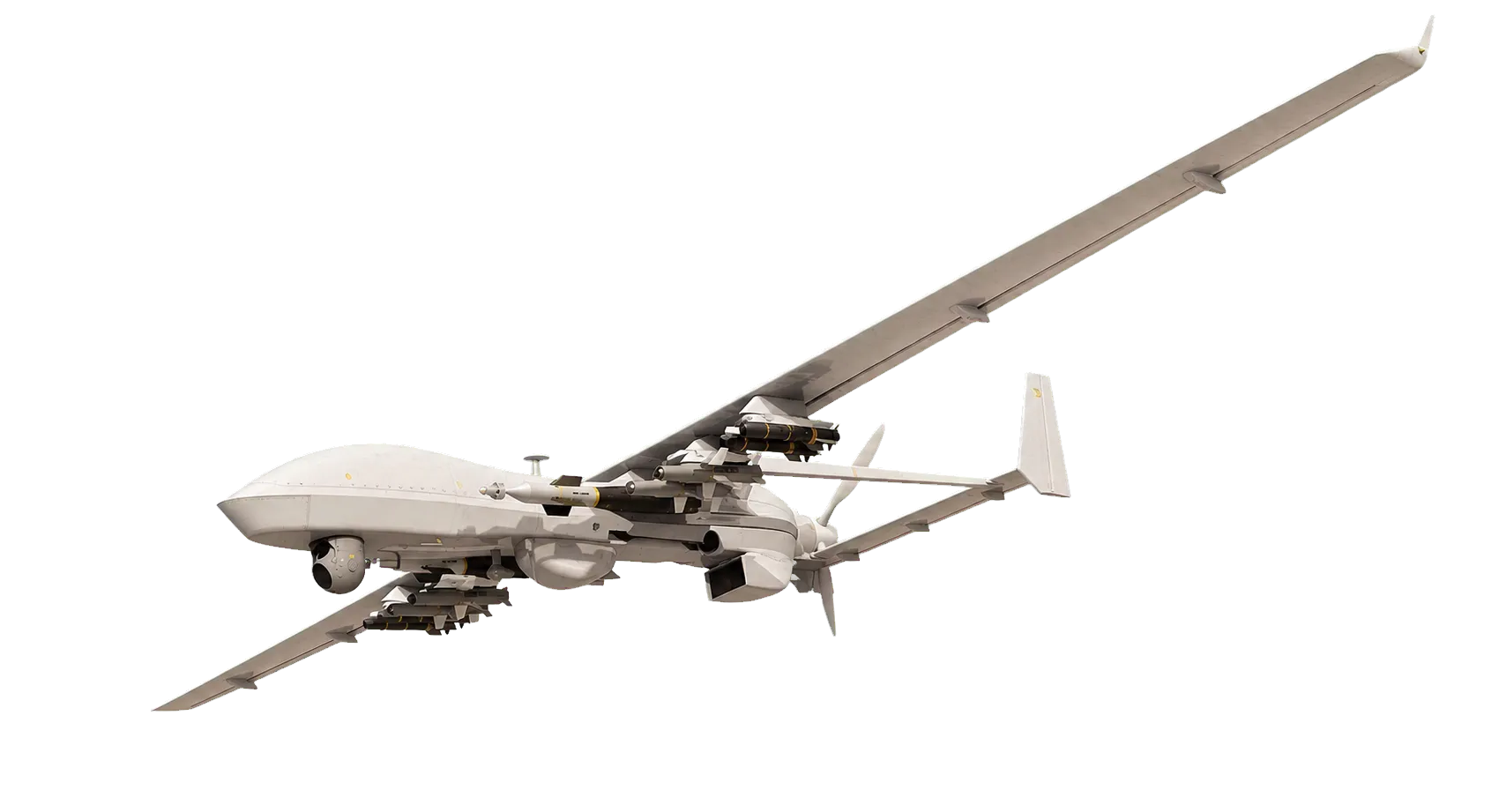
The GIDS Shahpar-3 is the largest and most capable unmanned aerial vehicle (UAV) Pakistan has designed and built. Global Industrial & Defence Solutions (GIDS) classifies it as a Group 4+ medium-altitude long-endurance (MALE) unmanned combat aerial vehicle (UCAV), and markets it on behalf of the designer and manufacturer, the National Engineering and Scientific Commission (NESCOM).
At the World Defense Show 2026 in Riyadh, held in February, Pakistani industry representatives confirmed that the Shahpar-3 will conduct its first flight test before the end of the year. The aircraft is therefore not yet in service with any operator, and no first flight has been publicly confirmed at the time of writing.
The specifications below are drawn from the GIDS 2026 product brochure, which supersedes the figures GIDS issued at IDEAS 2024. The revisions are substantial, and most of them run downward – the 140 HP engine option has been dropped entirely, endurance in the surveillance role has fallen from 40 hours to 30, and both data-link ranges have been trimmed.
This profile covers the current Shahpar-3 specifications, what changed between the 2024 and 2026 sheets, the airframe and avionics, the sensor and weapon options GIDS offers alongside the aircraft, and where the platform sits against comparable Chinese, Turkish, and American designs.
Data sheet / Current manufacturer figures
GIDS Shahpar-3 Specifications (2026)
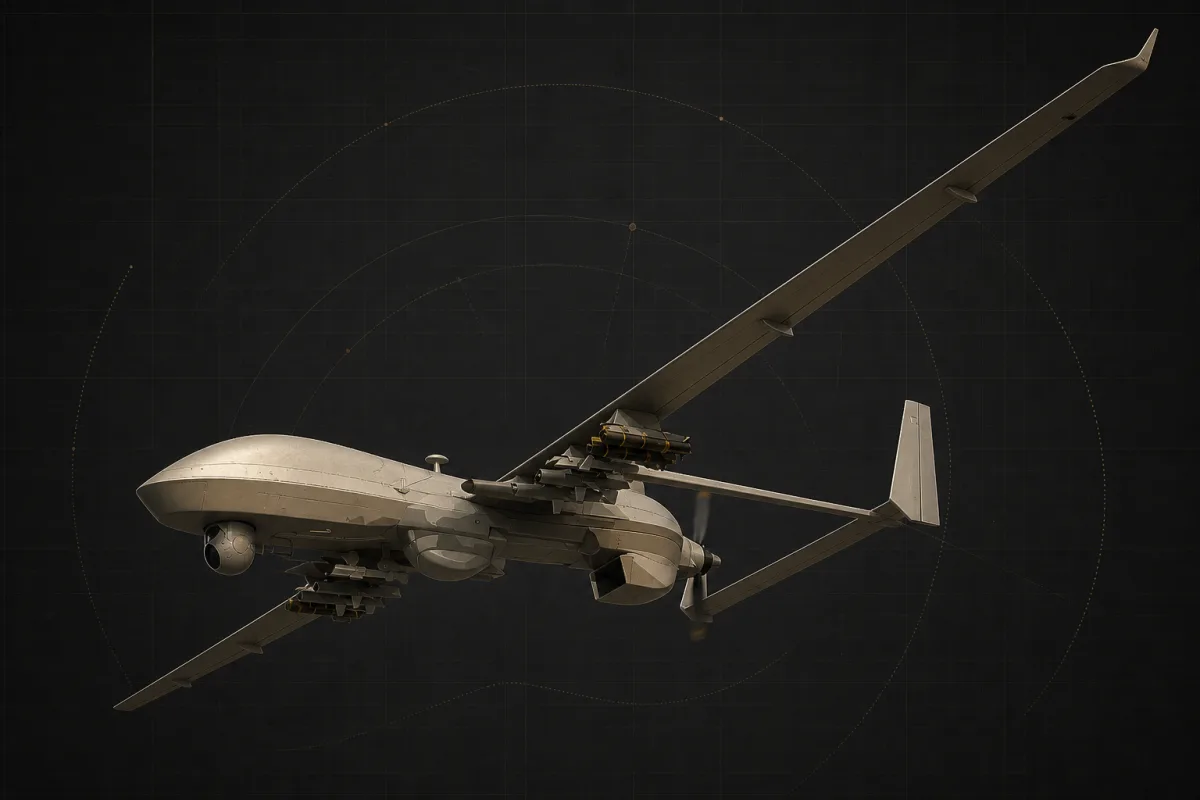
According to the GIDS product listing and its 2026 brochure, GIDS now markets the Shahpar-3 in a single configuration built around a 170 HP heavy fuel engine.
| Parameter | Value |
|---|---|
| Class | Group 4+ MALE UCAV |
| Maximum take-off weight (MTOW) | 1,650 kg (2024 sheet); 1,600 kg quoted at World Defense Show 2026 |
| Wingspan | 64 ft (approximately 19.5 m) |
| Length | Not published by GIDS |
| Engine | 170 HP heavy fuel engine |
| Endurance – ISR | 30+ hours |
| Endurance – armed | 16+ hours |
| Service ceiling – ISR | 30,000 ft |
| Service ceiling – armed | 28,000 ft |
| Data-link range – line-of-sight (LOS) | 250 km |
| Data-link range – beyond line-of-sight (BLOS) | 2,500 km |
| Internal payload – ISR | 165 kg |
| Internal payload – armed | 75 kg |
| External payload | 400 kg |
| Hardpoints | Six wing stations plus one centreline (seven total) |
| Cruise and maximum speed | Not published |
Range caveat: GIDS states explicitly that the 2,500 km beyond line-of-sight figure depends on available satellite footprint. Thus, it is a ceiling rather than a guaranteed operating radius, and the practical number will vary by the satellite capacity Pakistan can actually access on a given mission.
Revision control / IDEAS 2024 → WDS 2026
What Changed Between the 2024 and 2026 Shahpar-3 Specifications
40 hrs→2026
30+ hrs
20 hrs→2026
16+ hrs
300 km→2026
250 km
3,000 km→2026
2,500 km
The engine option that disappeared
The most consequential change is the engine. At IDEAS 2024, GIDS offered the Shahpar-3 in two powerplant configurations, a 140 HP variant and a 170 HP variant, each with its own performance envelope. The 2026 brochure lists only the 170 HP heavy fuel engine.
Endurance, ceiling, and range revisions
Endurance in the intelligence, surveillance, and reconnaissance (ISR) configuration was previously quoted at 40 hours for the 170 HP variant. GIDS now claims 30+ hours. The armed figure moved from 20 hours to 16+ hours.
The ceiling figures fell as well. The 2024 sheet listed 41,000 ft unarmed and 35,000 ft armed for the 170 HP variant. The 2026 brochure lists 30,000 ft and 28,000 ft respectively.
Both data-link ranges tightened. Line-of-sight moved from 300 km to 250 km, and the satellite link moved from 3,000 km to 2,500 km.
Finally, external payload was previously described as a 400-530 kg range. GIDS now states a flat 400 kg. Internal payload is now split by mission fit at 165 kg for ISR and 75 kg when armed, where the earlier sheet gave a single 165 kg figure.
Read together, these revisions appear less like a downgrade and more like a program replacing brochure aspirations with numbers the airframe is expected to actually meet. That reading is consistent with where the program sits: the aircraft has not flown, and the 2024 figures were published before any flight test article existed.
That said, one figure remains unresolved. The World Defense Show briefing quoted a ceiling of 10,700 m for ISR and 9,100 m armed, which works out to roughly 35,100 ft and 29,850 ft.
Those numbers disagree with the GIDS brochure. Quwa treats the brochure as primary here because it is the manufacturer's own current document, though the ceiling is best read as a range until the aircraft flies.
Air vehicle / Generational shift
Shahpar-3 Design Background and the Step Up from the Shahpar-II
The Shahpar-3 is a substantial step up from its predecessor, the Shahpar-II Block-II, also a NESCOM design.
However, the scale of that step is easiest to see in the numbers that matter operationally. The Shahpar-II Block-II carries 120 kg across four wing hardpoints; the Shahpar-3 carries 400 kg across seven stations. Endurance in the ISR role moves from 20+ hours to 30+ hours.
That extra capacity is what unlocks the roles the Shahpar-II simply cannot take on. Maritime patrol and anti-submarine warfare (ASW) need bulky, heavy sensors and stores. Stand-off strike needs stations rated for cruise-missile-class weapons.
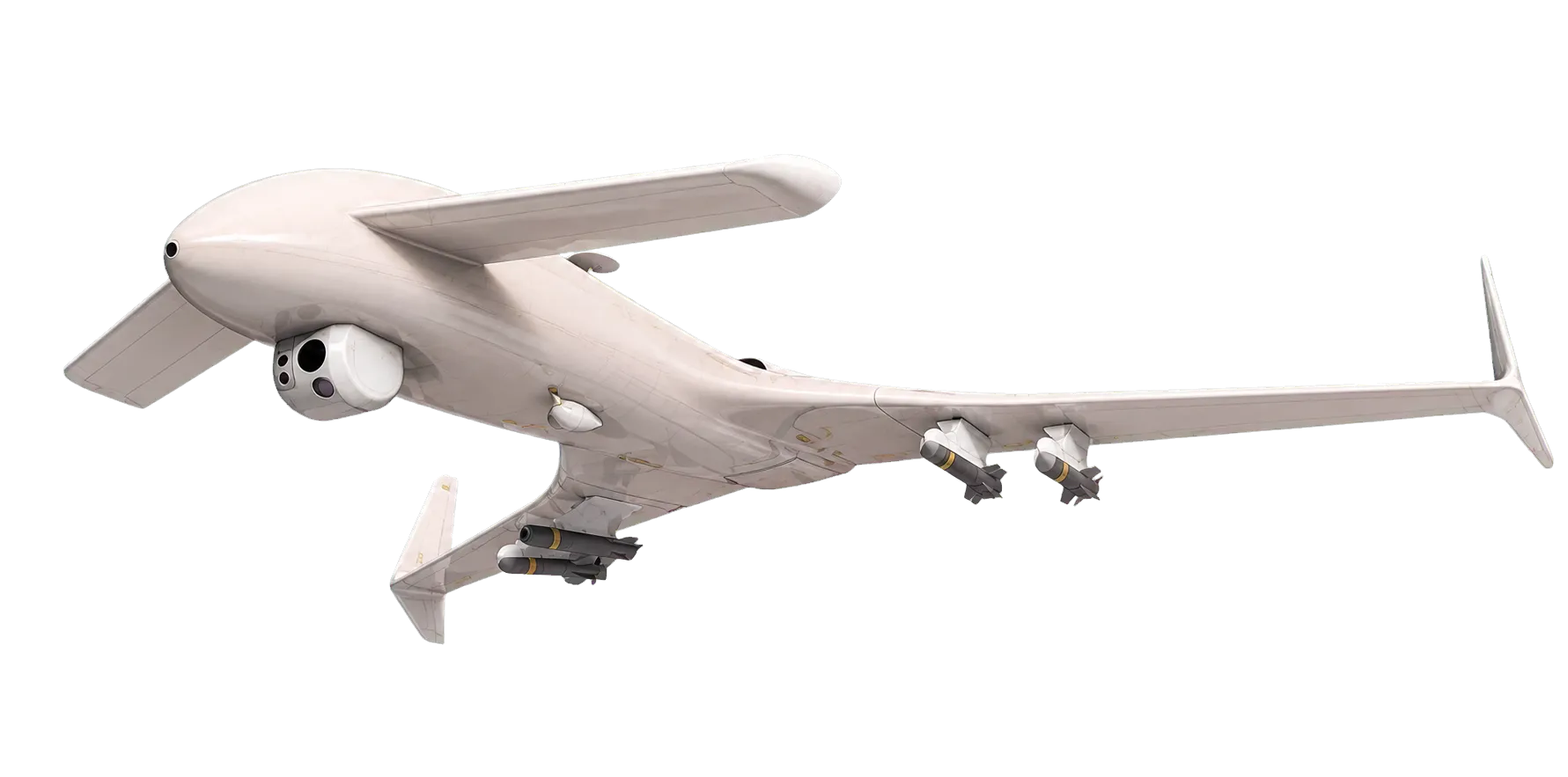
The lineage runs back further. The original NESCOM Shahpar was a 480 kg reconnaissance UAV with a seven-hour endurance and a 50 kg payload, and it entered service in the mid-2010s.
Thus, across two generations, Pakistan's flagship reusable drone has grown by roughly a factor of three in take-off weight.
The weight is the lesser half of the story. Over the same period, the design work moved from configuring an imported platform to originating the airframe, the avionics, the mission software, and the munitions.
That shift is the actual story of the Shahpar family, and Quwa unpacked its industrial dimension in Pakistan Bet Its Drone Industry on NESCOM. It's Starting to Pay Off.
Programme chronology / Public milestones
The Shahpar-3 Program Timeline: IDEAS 2024 to World Defense Show 2026
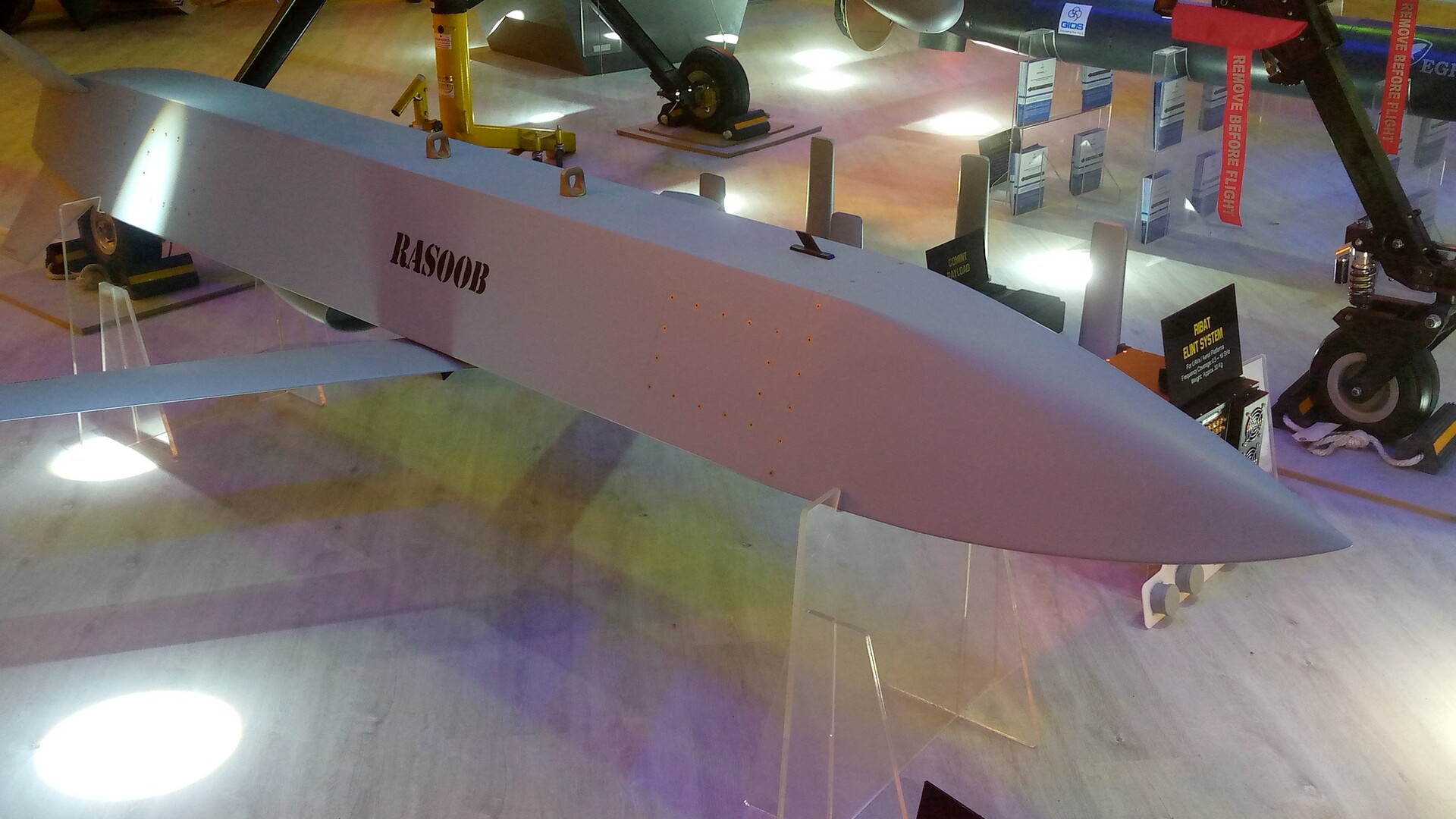
GIDS publicly unveiled the Shahpar-3 at the International Defence Exhibition and Seminar (IDEAS) in Karachi in November 2024. At that showing, GIDS displayed the aircraft alongside a lineup of stand-off range weapons (SOW), including the Rasoob 250 air-launched cruise missile (ALCM) and the Qaswa Industries AZB-81LR small diameter bomb (SDB).
In February 2025, GIDS took the Shahpar-3 to IDEX 2025 in Abu Dhabi, where it was shown to international delegations ahead of any production commitment.
Then, at the World Defense Show 2026 in Riyadh in February 2026, Pakistani industry representatives confirmed the first flight test would take place before the end of the year and positioned the aircraft as export-ready.
To be clear, that sequence means the Shahpar-3 has been marketed at three international exhibitions across roughly fifteen months without flying. Wikipedia's entry lists a 2023 first flight; that claim is inconsistent with the World Defense Show announcement and should be treated with caution.
The Pakistan Air Force (PAF) is the presumptive lead customer. However, given the maritime payload set GIDS has built around the platform – sonobuoys, a lightweight torpedo, an inverse synthetic aperture radar mode – one can see the Pakistan Navy (PN) emerging as a second domestic operator, particularly in light of its stated emphasis on sensors and uncrewed systems.
Architecture / Airframe and mission systems
Airframe, Propulsion, and Indigenous Avionics
The Shahpar-3 uses a moulded high-strength composite airframe with fully retractable landing gear. GIDS also lists an anti-icing and de-icing system, which matters for an aircraft expected to loiter for a day or more at 28,000 to 30,000 ft over northern terrain.
Propulsion comes from a single 170 HP heavy fuel engine. Heavy fuel matters for two reasons: commonality with the logistics chain the tri-services already run, and shipboard handling safety if the PN ever takes the type to sea.
Granted, the word 'indigenous' does a lot of work in GIDS' marketing. NESCOM imports the engines for its larger drones, as it does across most of its heavier platforms, and Pakistan lacks the upstream industries for the advanced lenses and microcontrollers that go into the sensors.
However, the design, integration, and downstream production capability is real, and it is what separates the Shahpar-3 from the licence-assembled platforms Pakistan was rolling out in 2010.
GIDS describes the avionics suite as indigenously developed, and the list is specific: system software, autopilot, flight sensor suite, power management system, engine control computer, payload management computer, data links, and control servos. The flight control computer is dual redundant and built on 1553 bus architecture.
1553 bus architecture, indigenous autopilot, sensor suite and control servos.
Air traffic integration plus maritime vessel identification and tracking.
A new 2026 capability for locating imagery against geographic coordinates.
Automated target detection and identification on live and post-flight video.
The aircraft carries an air traffic control (ATC) transponder, Identification Friend or Foe (IFF), and an Automatic Identification System (AIS) receiver.
That last item is the one to notice. AIS is a maritime signal used to identify and track surface vessels, and its presence on a land-launched MALE aircraft is a direct indicator that GIDS designed the Shahpar-3 with over-water work in mind from the start rather than bolting it on afterwards.
Two capabilities in the 2026 brochure are new relative to 2024. The first is image-based geo-referencing. The second is AI-based target detection and identification applied to both live and post-flight video, which is the first time NESCOM has publicly claimed onboard automated target recognition on a reusable platform.
GIDS also retains an internal pilot option, a manned-flight provision used for testing and ferry work.
Command and control / Ground segment
Data-Links and the Shahpar-3 Ground Segment
The Shahpar-3 runs two communications links in line-of-sight and one in beyond line-of-sight. In other words, the redundancy is concentrated on the link most likely to be jammed.
Line-of-sight reaches 250 km, and the satellite link reaches 2,500 km subject to footprint.
On the ground, GIDS supplies a Ground Control Station (GCS) with three consoles – Mission Commander, Pilot, and electro-optical/infrared (EO/IR) Payload Operator – and a single station can fly two UAVs simultaneously. The Ground Data Terminal (GDT) carries redundant communications and antenna equipment.
This is the part of the package that buyers tend to underweight and that GIDS is arguably best positioned to sell. An air vehicle without a mature ground segment and a trained crew structure is not a capability, and the ability to source the whole stack from one contractor is the commercial argument GIDS is making in the Gulf.
ISR payload catalogue / Sensor options
Shahpar-3 ISR Payloads: Zumr-III, COMINT, ELINT, and SAR
Zumr-III electro-optical payload
The Zumr-III is GIDS' current long-range high-definition electro-optical payload, and the 2026 brochure specifies it for the Shahpar-3. It is a multispectral imager covering the visible and near-infrared, short-wave infrared (SWIR), and mid-wave infrared (MWIR) bands.
The turret is 4-axis gyro stabilised and carries an eye-safe laser rangefinder and target designator, inertial navigation system (INS) support, ground moving target indication (GMTI), and geo-referencing. The high-definition day imager runs at 1,920 x 1,080 and the thermal and SWIR imagers at 1,280 x 1,024.
The earlier Zumr-II remains the Shahpar-II's standard fit, which is the cleanest available marker of how far the sensor line has moved in one generation.
COMINT and ELINT pods
The communications intelligence (COMINT) pod weighs under 50 kg and covers 20-8,000 MHz for reconnaissance and 20-6,000 MHz for direction finding. Its role is to detect, intercept, locate, and analyse target radio communications.
The electronic intelligence (ELINT) pod weighs under 70 kg and is quoted with a 70 dB range. It handles radar and non-communications emitters. GIDS' airborne Ribat ELINT system covers 0.5-18 GHz at roughly 30 kg and represents the line-replaceable unit (LRU) route to the same capability.
Synthetic aperture radar
The KPM-6030 synthetic aperture radar (SAR) payload weighs under 35 kg and reaches up to 60 km. GIDS separately offers a nose-mounted SAR with inverse synthetic aperture radar (ISAR) and maritime search modes, which is the configuration needed for classifying surface contacts rather than simply detecting them.
Stores integration / Seven-station architecture
Shahpar-3 Weapons and the Seven-Station Loadout
GIDS groups the Shahpar-3's stores into four role packages: Full Combat, Deep Strike, Maritime, and Electronic Warfare.
Full combat
The Burq 50P air-to-ground missile (AGM) engages from 2.5 to 12 km at 50 kg or under, and the Burq 25G engages from 3 to 12 km at 25 kg or under. The Qaswa Industries Al-Battaar laser-guided bomb (LGB) kit adds a 500-class weapon with an 8 nm stand-off.
Deep strike
The Rasoob 250 anti-ship cruise missile reaches roughly 350 km and weighs about 650 kg with its booster. The Yalghar 500 loitering munition reaches 500 km at 82 kg, and the Yalghar 100 reaches 100 km at 55-60 kg.
Quwa examined the design convergence driving these weapons in Where One-Way Attack and Loitering Munition Designs Are Converging.
Station loadout
GIDS publishes a seven-station breakdown with per-station capacities:
Individual station ratings exceed the aircraft's combined 400 kg external payload. The airframe cannot load every station to its maximum simultaneously.
| Station | St-1 | St-2 | St-3 | St-4 | St-5 | St-6 | St-7 |
|---|---|---|---|---|---|---|---|
| Capacity | 60 kg | 150 kg | 350 kg | 350 kg | 350 kg | 150 kg | 60 kg |
| Example fit | 1x Burq 50 | 2x Burq 25G or 1x Burq 50P | 2x Burq 25G | 1x Al-Battaar 500 | 2x Burq 25G | 2x Burq 25G or 1x Burq 50P | 1x Burq 50 |
The two published configurations are a ten-weapon fit and a 500 lb-class fit. Note that the station capacities total well above the 400 kg external payload figure – the stations are individually rated, not simultaneously loadable to maximum.
Operational employment / Role packages
Shahpar-3 Mission Roles: Electronic Warfare, Maritime, and Deep Strike
COMINT and ELINT payloads release scarce crewed aircraft from long-duration collection orbits.
AIS, ISAR, sonobuoys and an ultra-lightweight torpedo form a coherent over-water package.
Long-range cruise missiles allow the slow air vehicle to remain outside tactical air-defence envelopes.
Aircraft, weapons, sensors, data-links, software and ground segment are offered under one contract.
With 30+ hours of endurance and a COMINT or ELINT pod, the Shahpar-3 can hold a persistent electronic surveillance orbit. That is a task which currently ties up crewed aircraft, and freeing those airframes is arguably worth more to the PAF than the raw sensor performance of the pod itself.
Moreover, on the maritime side, GIDS offers a sonobuoy dispensing pod with passive DIFAR sonobuoys covering 5 Hz to 2,400 Hz, plus the Eghraaq ultra-lightweight torpedo at 165 ± 10 kg in combat configuration and 130 ± 10 kg for exercises.
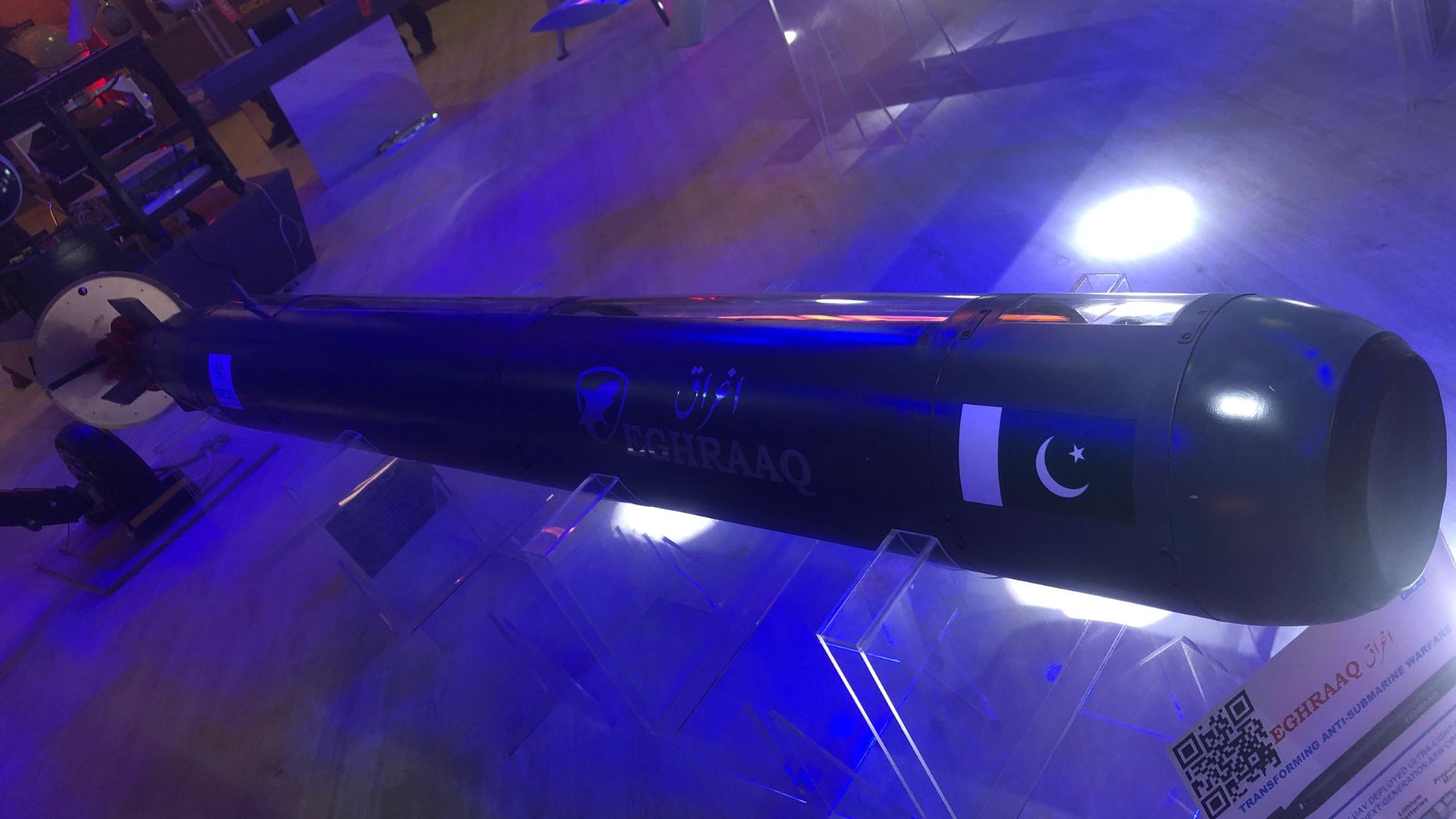
Taken with AIS, the ISAR mode, and the Rasoob 250, this makes the Shahpar-3 a credible maritime patrol and ASW asset rather than a land platform with a torpedo attached to it.
For deep strike, the operating logic is straightforward. Launching a 350 km cruise missile from a slow-moving drone keeps the launch aircraft outside most tactical air defence envelopes, which is the only way a platform of this speed and signature survives a contested strike mission.
Thus, alongside the PAF's Bayraktar Akıncı high-altitude long-endurance (HALE) UAV, the Shahpar-3 would form the basis of Pakistan's first genuine UCAV strike doctrine rather than an incremental extension of the armed-ISR pattern the Shahpar-II established.
Finally, GIDS supplies the weapons, sensors, data-links, mission planning software, and ground segment as a single contract.
For an export customer without an integration base of its own, single-sourcing the entire stack from one supplier is a commercial argument in itself. Moreover, it is the one GIDS is actively making in the Gulf, as Quwa covered in How GIDS Aims to Win in Saudi Arabia's Defence Market.
Competitive set / Platform positioning
How the Shahpar-3 Compares to the Wing Loong-II, Anka-S, and MQ-9
GIDS positions the Shahpar-3 against MALE platforms in the 1,500-2,000 kg class. The nearest comparators on paper are the Chinese Wing Loong-II, the Turkish Aerospace Anka-S, and the General Atomics MQ-1C Gray Eagle.
Western and Gulf coverage of the program tends to benchmark it against the MQ-9 Reaper instead, and almost always on endurance.
| Platform | Best comparison | Quwa assessment |
|---|---|---|
| Shahpar-3 | Group 4+ / 1,500–2,000 kg class | Competitive endurance; 400 kg external payload; pre-flight |
| Wing Loong-II | Closest market peer | Most relevant export-customer comparison |
| Anka-S / MQ-1C | Configuration peers | Similar MALE operating concept |
| MQ-9 Reaper | Higher class | Much greater payload and 50,000 ft ceiling |
However, that comparison flatters the aircraft. Yes, 30+ hours in the ISR fit is competitive with an MQ-9. However, the Shahpar-3's 400 kg external payload is roughly a quarter of the Reaper's, and its 30,000 ft ceiling sits well below the Reaper's 50,000 ft.
Thus, the more accurate read is that the Shahpar-3 is a capable Group 4+ aircraft in the Wing Loong-II class, and that GIDS competes on pricing and the single-source package rather than raw performance.
That is not a criticism of the design. It is a description of where the platform actually competes, and the Wing Loong-II is the aircraft most export customers in Africa, Central Asia, and the Gulf are actually choosing between.
Validation status: None of this is validated in any case. The aircraft has not flown, and until it does, every figure on this page is a manufacturer's claim rather than a demonstrated parameter.
Reference desk / Common questions
Shahpar-3 Frequently Asked Questions
What is the GIDS Shahpar-3?
The Shahpar-3 is a Group 4+ medium-altitude long-endurance unmanned combat aerial vehicle designed by NESCOM and marketed by GIDS. It is the largest indigenous UAV Pakistan has built.
Who makes the Shahpar-3?
NESCOM designs and manufactures it. GIDS handles marketing and export sales. Both are Pakistani state-owned enterprises.
What engine does the Shahpar-3 use?
A single 170 HP heavy fuel engine. GIDS previously offered a 140 HP option, but dropped it from its 2026 material. Pakistan imports the engines for its larger drones.
How long can the Shahpar-3 stay airborne?
GIDS claims 30+ hours in the ISR configuration and 16+ hours when armed.
What is the Shahpar-3's range?
The line-of-sight data-link reaches 250 km and the satellite link reaches 2,500 km, subject to available satellite footprint.
How high can the Shahpar-3 fly?
30,000 ft in the ISR configuration and 28,000 ft when armed, per the GIDS 2026 brochure. Briefing material from the World Defense Show 2026 quoted higher figures of roughly 35,100 ft and 29,850 ft.
How much can the Shahpar-3 carry?
165 kg internally in the ISR fit, 75 kg internally when armed, and 400 kg externally.
How many hardpoints does the Shahpar-3 have?
Seven – six wing stations plus one centreline – rated between 60 kg and 350 kg each.
What weapons can the Shahpar-3 carry?
Burq 25G and Burq 50P air-to-ground missiles, Al-Battaar laser-guided bombs, the Rasoob 250 anti-ship cruise missile, and the Yalghar 100 and Yalghar 500 loitering munitions.
What is the Shahpar-3's top speed?
GIDS has not published a cruise or maximum speed figure. For reference, the Shahpar-II Block-II is quoted at 220 km/h.
How long is the Shahpar-3?
GIDS has not published a length figure. The wingspan is 64 ft, or roughly 19.5 m.
How much does the Shahpar-3 cost?
GIDS has not published a unit price. Wikipedia cites a development program cost of approximately USD $100 million, which is a program figure rather than a per-aircraft cost.
Is the Shahpar-3 in service?
No. As of the World Defense Show in February 2026, its first flight test was scheduled for before the end of 2026.
How many Shahpar-3s does Pakistan have?
None in operational service. The aircraft has not completed first flight.
Is the Shahpar-3 stealthy?
No. It is a conventional composite-airframe MALE aircraft with no published low-observable features. Its survivability case rests on stand-off weapons rather than signature reduction.
How does the Shahpar-3 compare to the MQ-9 Reaper?
Endurance is broadly comparable. External payload and ceiling are both significantly lower. The Shahpar-3 sits closer to the Wing Loong-II class than to the MQ-9.
What is the difference between the Shahpar-II and the Shahpar-3?
The Shahpar-3 carries more than three times the external payload across seven stations instead of four, flies roughly 50% longer in the ISR role, and hosts maritime, deep strike, and electronic warfare payloads the Shahpar-II cannot carry.
Has the Shahpar-3 been exported?
There are no confirmed export contracts. GIDS has marketed the aircraft at IDEAS 2024, IDEX 2025, and the World Defense Show 2026, and describes it as export-ready.
What does “Shahpar” mean?
Shahpar (شہپر) is Persian in origin and refers to the longest and strongest feather in a bird’s wing, the principal or pinion feather. In classical Urdu poetry it carries a figurative sense of power and the capacity for flight. NESCOM has now used the name across three generations of drone, from the original 480 kg Shahpar through to the Shahpar-3.
Coverage archive / News and analysis
News Updates, Comments, and Analysis
February 2026 Pakistan Confirms Shahpar-3 First Flight Test by End of 2026
At the World Defense Show 2026 in Riyadh, Pakistani defence industry representatives confirmed the Shahpar-3 will conduct its first flight test before the end of the year, and positioned the aircraft as export-ready.
AnalysisAugust 2026 Pakistan Bet Its Drone Industry on NESCOM. It's Starting to Pay Off.
Quwa examines how far NESCOM's drone work now extends across airframes, subsystems, sensors, munitions, and command, control, and communications architecture.
NewsNovember 2024 GIDS Reveals Cruise Missile Lineup for Shahpar-3 Drone
GIDS revealed the Rasoob 250 and AZB-81LR air-launched cruise missiles for use from the Shahpar-3.
AnalysisMay 2024 New Air-Launched Munitions Are a Key Piece of Pakistan's Drone Program
The development of the Burq-series air-to-ground missiles and KaGeM V3 miniature air-launched cruise missiles are major pieces of Pakistan's emerging drone strategy.