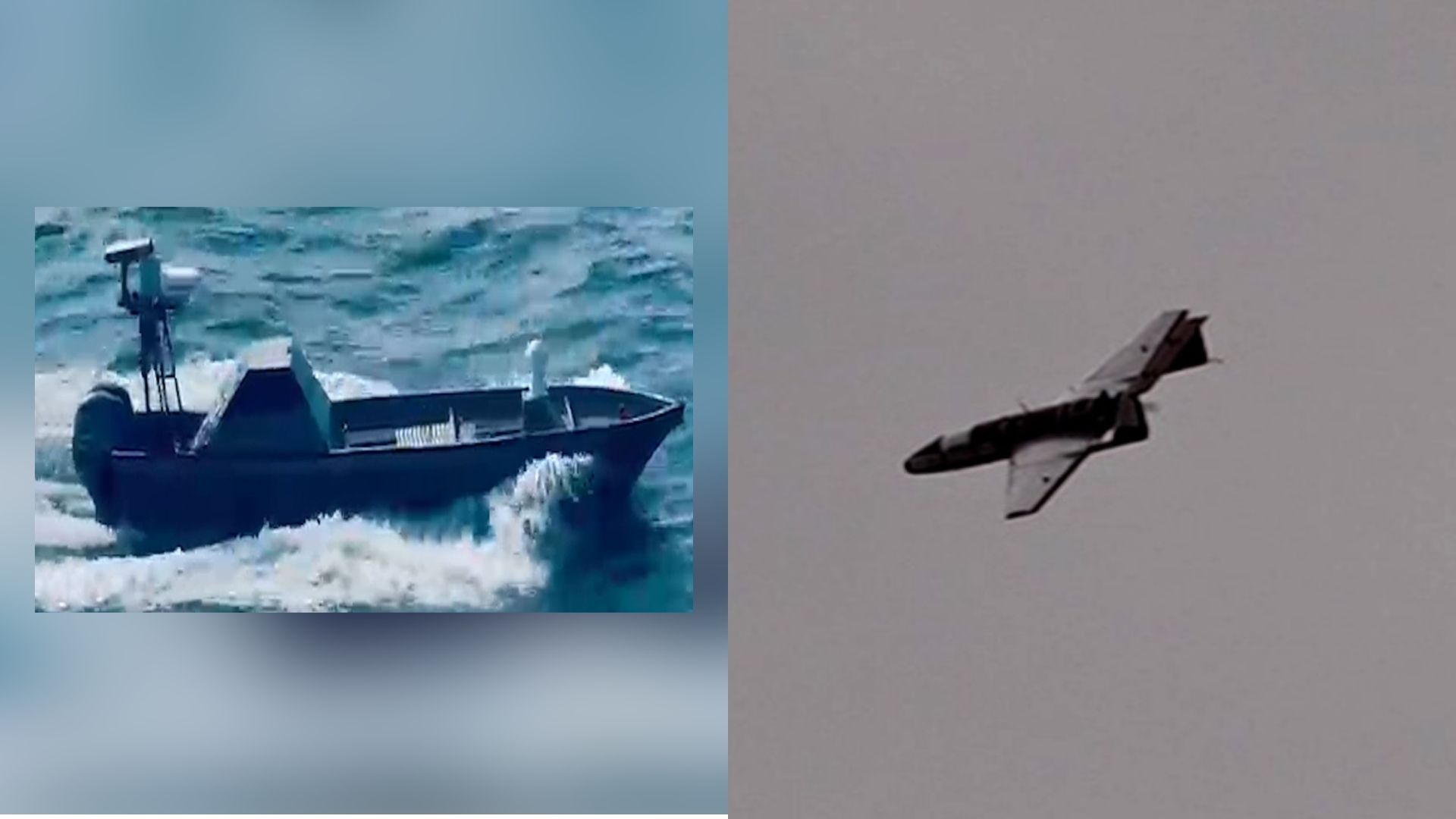

On 10 January, the Pakistan Navy (PN) announced it had successfully tested a new unmanned surface vehicle (USV) and a loitering munition. In addition, a PN Tughril-class (Type 054A/P) frigate also carried out a successful live firing of a LY-80(N) surface-to-air missile (SAM).
The loitering munition was confirmed to be a Mudamir LR, produced by the private company Sysverve Aerospace based in Rawalpindi. The Mudamir LR is from a growing portfolio of Shahed-style munitions being developed and produced in Pakistan.
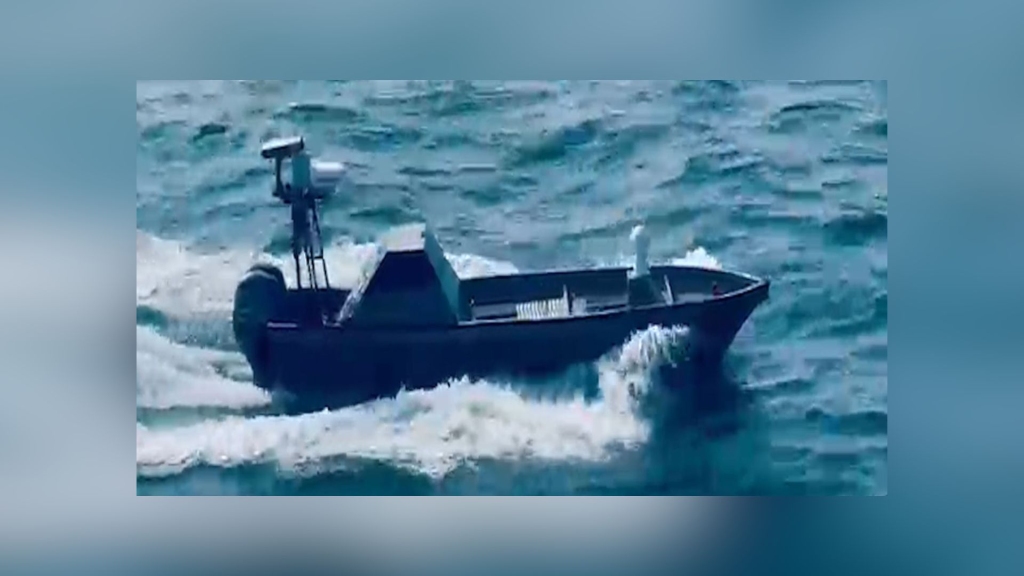
Regarding the USV, the design does not match any of Pakistan’s known USV platforms, including an unnamed platform developed by the National Engineering and Scientific Commission (NESCOM) and others by Stingray Technologies (also developed by NESCOM), Beyond Koncept, and Woot-Tech.
It is possible that the newly tested USV is a technology demonstrator, possibly developed by NESCOM (but not confirmed), which appears to be managing at least two such platforms (one revealed in 2024 and a newer, stealthier strike platform via Stingray Technologies in 2025).
The newly tested USV was equipped with a mast-mounted, stabilized electro-optical and infrared (EO/IR) camera turret mounted aft of the hull. This was likely a remote driving camera used to provide the operator with a visual feed and, potentially, basic surveillance and/or targeting capabilities.
In addition, there is a white vertical element near the bow, which could be a communications and/or GNSS antenna within a radome structure. This would likely be the line-of-sight (LoS) control link for the operator to remotely control the USV.
Overall, there are no indications that this USV is configurable for munitions or warheads, so it is probably intended as a simpler system for testing and validation. Thus, the intent of the tests likely had less to do with the hull design and was instead focused on validating the integrated subsystems, such as the datalink and the EO/IR turret, which would be configured into the actual service-ready products.
Get access to this article and all other Quwa content today.
Click Here
Related Reads
- Pakistan Revealed New Naval Drones. Does it Signal a New Shift? Quwa Premium
- Offshore Patrol Vessels (OPV) Will Play a Key Role in the Future of the Pakistan Navy Fleet.
- Extending Deterrence: How the Hangor-Class Reshapes Pakistan’s Maritime A2/AD Posture
- The COTS Advantage of the Pakistan Navy’s Sea Sultan LRMPA
- After a Decade of Growth, the Real Test for Pakistan’s Navy Has Begun
SAMs are an essential component of defending the PN’s surface vessels and shore-based infrastructure and other assets from a variety of air threats, such as low-flying helicopters and unmanned aerial systems (UAS) – including loitering munitions – and high-speed munitions, like cruise missiles.
In contrast to the Pakistan Air Force (PAF) and Pakistan Army (PA), the PN has undertaken deliberate steps to counter high-speed threats, such as the BrahMos, with current-generation SAMs, notably the MBDA CAMM-ER and Albatros-NG, sourced from MBDA Italy.
Don't Stop Here. Unlock the Rest of this Analysis Immediately
To read the rest of this deep dive -- including the honest assessments and comparative analyses that Quwa Plus members rely on -- you need access.