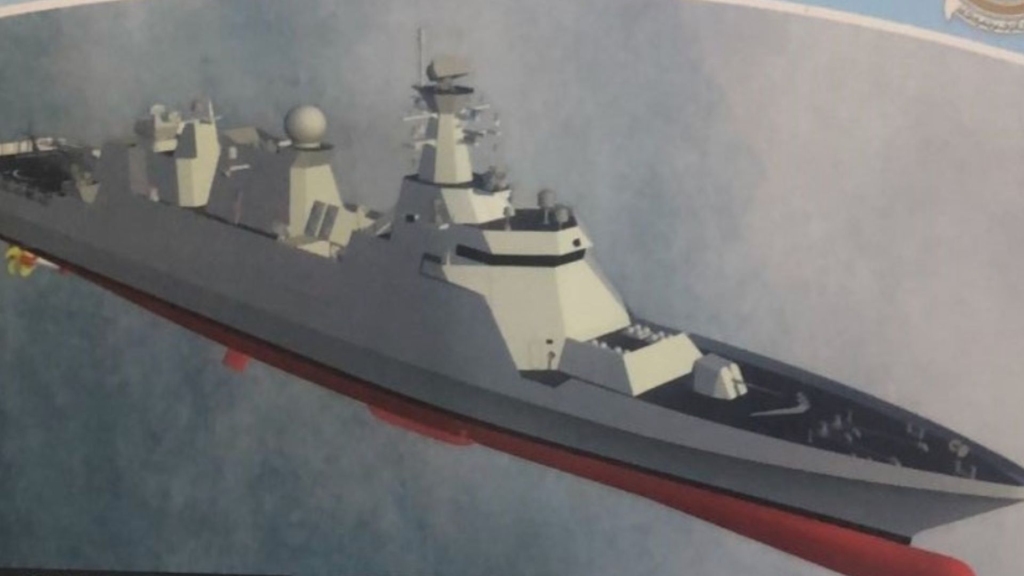
On 03 November, the Pakistan Navy (PN) signed a contract with Karachi Shipyard and Engineering Works (KSEW) to construct the first Jinnah-class frigate, an original surface combatant jointly designed by the PN’s Platform Design Wing (PDW), which was previously known as the Naval Research and Design Institute (NRDI), and Askeri Fabrika ve Tersane İşletme AŞ (ASFAT), the main contractor for the PN’s Babur-class (MILGEM) corvette program.
Officially signed during the 2025 Pakistan International Maritime Expo and Conference (PIMEC 2025), the PN stated that the lead ship will join the fleet from 2027 to 2028.
The Jinnah-class frigate – also designated AS3400 – has a displacement of 3,300 tons, length of 119.45 m, and beam of 15.40 m. Originally planned for a combined-diesel-and-diesel (CODAD) propulsion system, the PN revealed that its ships will instead use a combined-diesel-and-gas (CODAG) system (which may improve the ship’s speed, but with the potential trade-off of less range or endurance).
Get access to this article and all other Quwa content today.
Click Here
Related Reads
- Offshore Patrol Vessels (OPV) Will Play a Key Role in the Future of the Pakistan Navy Fleet.
- Extending Deterrence: How the Hangor-Class Reshapes Pakistan’s Maritime A2/AD Posture
- The COTS Advantage of the Pakistan Navy’s Sea Sultan LRMPA
- After a Decade of Growth, the Real Test for Pakistan’s Navy Has Begun
In terms of armaments, the Jinnah-class frigates will be fitted with 16 vertical-launch system (VLS) cells for the MBDA Albatros-NG/CAMM-ER, a pair of triple-cell lightweight torpedo (LWT) launchers, and dual-quad launchers for the P282 anti-ship missile (AShM). However, considering how the PN opted to change the propulsion stack, it may revise the subsystem and/or armament configurations ahead of the lead ship’s induction.
The Jinnah-class frigate program was a key piece of a $1.5 billion USD deal signed with ASFAT A.S. for the MILGEM. Under the contract, ASFAT A.S and NRDI/PDW would jointly develop an original frigate tailored to the PN’s unique requirements which, in time, Pakistan would construct locally.
Join Quwa Plus
Get the latest defence news and analysis on South Asia and the Middle East.
Already a subscriber? Sign in