
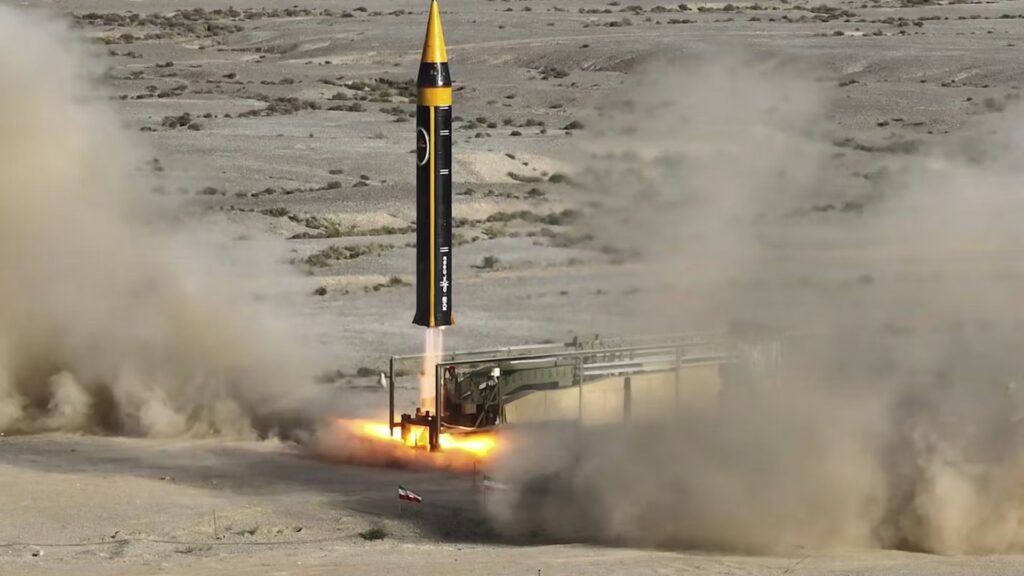
Iran’s ongoing war with the United States and Israel has put its ballistic missile (BM)-centric defence posture in the spotlight, testing its depth and its efficacy in real-time. Tehran built that posture over decades – investing in solid-fuel rocket development, low-cost loitering munitions, and a decentralized command structure – and it has imposed meaningful costs on a US-led coalition, even as Iran’s launch rates have declined sharply under strikes targeting its stockpiles.
However, the military efficacy of Iran’s BM employment remains debatable. The strikes have generated strategic and perceptual effects, but their tactical impact has been limited compared to what conventional air power would deliver.
For Pakistan, the parallels are instructive but not direct. Islamabad’s new generation of solid-fuel BMs – the Fatah-2, Abdali Weapon System, and SMASH anti-ship ballistic missile (ASBM) – mirrors the early stages of Iran’s Fateh-series development track, where a single core platform was iterated into longer-ranged, multi-role derivatives. However, Pakistan’s employment doctrine, industrial base, and strategic context differ substantially, and those differences will shape how far Islamabad can take this capability.
This analysis examines what Pakistan can draw from Iran’s BM development and employment model, where the parallels break down, and what the Pakistan Army’s emerging rocket-force structure signals about Islamabad’s intent for this class of weapon.
The Efficacy of Iran’s Retaliatory Strikes
Following its war with Iraq in the 1980s, Iran was unable to rebuild its air force – and, with it, the offensive strike capability that had once led the region. The Islamic Republic of Iran Air Force (IRIAF) had operated advanced Western combat aircraft, including the F-14A Tomcat and F-4 Phantom, but US embargoes on spare parts and new procurement – sustained over decades – effectively grounded Iran’s capacity to project conventional air power at scale.
That material constraint – compounded by institutional distrust between the Islamic Revolutionary Guard Corps (IRGC) and the conventional military (Artesh) – shaped how Tehran rebuilt its defence posture. In practice, the bulk of Iran’s defence spending flowed to the IRGC, which became the primary vehicle for projecting Iranian power through armed proxies in Iraq, Yemen, and throughout the Levant.
Closer to home, however, the IRGC-led posture meant Tehran needed offensive strike systems it could produce indigenously – and at the scale and reach necessary to credibly deter its principal regional rivals: Israel and, by extension, the US forward presence in the Gulf. Those systems took two primary forms: ballistic missiles and low-cost, one-way attack drones – most famously the Shahed-series.
Loitering munitions, including the Shahed family, had already proven their value in the Russia-Ukraine War. Lower in cost and complexity than traditional guided munitions – such as cruise missiles – and produced in far larger numbers, loitering munitions have become both a staple of modern offensive planning and a disruptor of defensive strategies.
The challenges these weapons pose in subsequent theatres – the India-Pakistan theatre and the Gulf today – confirm that defensive mechanisms have yet to keep pace. The cost-exchange ratio strongly favours the attacker: Iran’s Shahed-136 drones cost roughly $20,000–$35,000 each, while the Patriot and THAAD interceptors required to defeat them run into the millions per round (RUSI).
Quwa Plus
Go Beyond the Headlines on Pakistan’s Defence and Security.
Quwa Plus gives you deeper reporting, briefings, and analysis on Pakistan’s defence programs, foreign policy, national security, and regional strategy. Follow the developments that matter to professionals, analysts, and serious readers tracking Pakistan’s security landscape.
Join ($29.99/Year) Already a subscriber?Sign in