
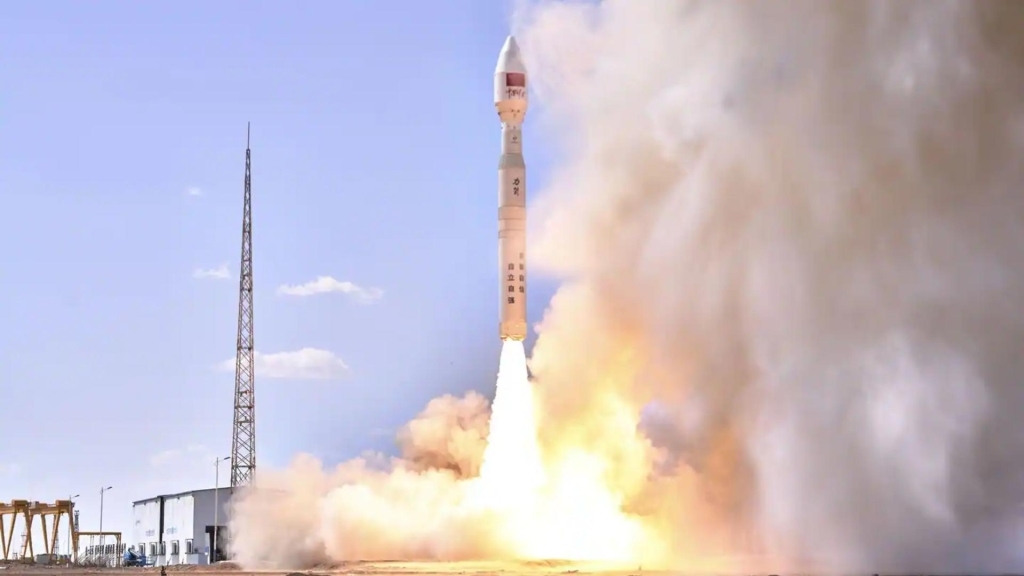
On 19 October 2025, China’s Jiaquan Satellite Launch Station sent into orbit Pakistan’s first hyperspectral imaging satellite, HS-1.
Pakistan’s Ministry of Foreign Affairs (MOFA) framed the launch of the HS-1, to be managed by the Space and Upper Atmosphere Research Commission (SUPARCO), as a significant step in Pakistan-China space cooperation. According to MOFA, the HS-1’s imaging data will be used to support “precision agriculture, environmental monitoring, urban planning, and disaster management.”
HS-1 now joins Pakistan’s growing constellation of Earth-observation satellites, which also includes the recently launched PRSC-EO1 and PRSC-S1, which provide electro-optical (EO) coverage.
This new launch adds to Pakistan’s imaging capability, providing now a multi-modal element whereby the EO1/S1 would report or provide context of an area, while the HS-1 will help with determining the actual nature (e.g., real or false positives) of any objects of interest in that area.
Overall, the new imaging constellation will contribute to the cadence, reliability, and sovereign control of Pakistan’s space-based intelligence, surveillance, and reconnaissance (ISR) capabilities.
Get access to this article and all other Quwa content today.
Click Here
Related Reads
- Report: Pakistan’s Next Satellite Program Unlocks a Massive Market Opportunity
- Can Pakistan Now Watch India’s Every Move? Inside the $406 M Satellite Deal With China
How Space Will Drive the Pakistan Air Force’s Target Managements
How Hyperspectral Imaging Adds to Pakistan’s Imaging Capabilities
Hyperspectral imaging captures hundreds of narrow spectral bands per pixel, enabling analysts to infer or classify the materials and chemical composition of an object using its spectral signature.
This is done by splitting light into many tiny wavelength slices and recording a full spectrum for every pixel. That spectrum serves as a material fingerprint for discerning specific details about an object; for example, whether it is painted metal or natural foliage.
Don't Stop Here. Unlock the Rest of this Analysis Immediately
To read the rest of this deep dive -- including the honest assessments and comparative analyses that Quwa Plus members rely on -- you need access.