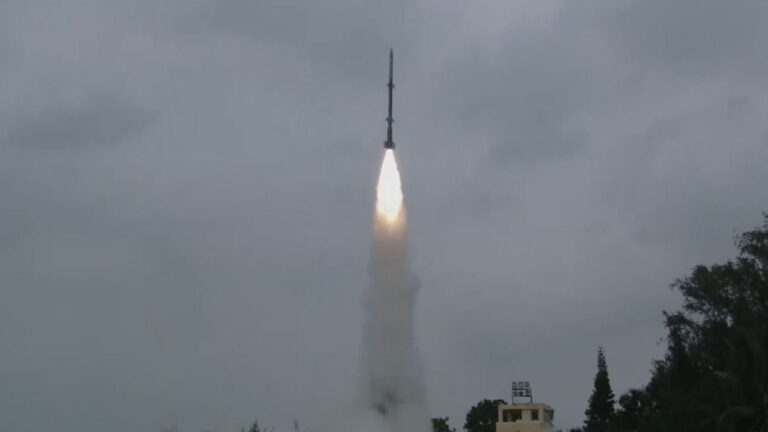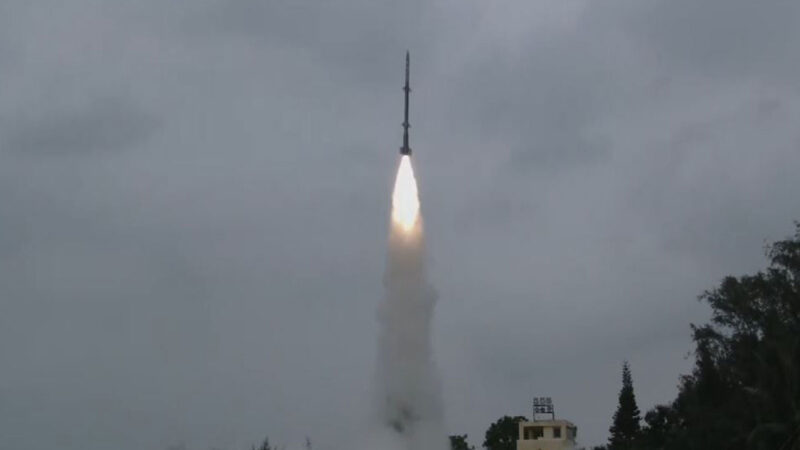

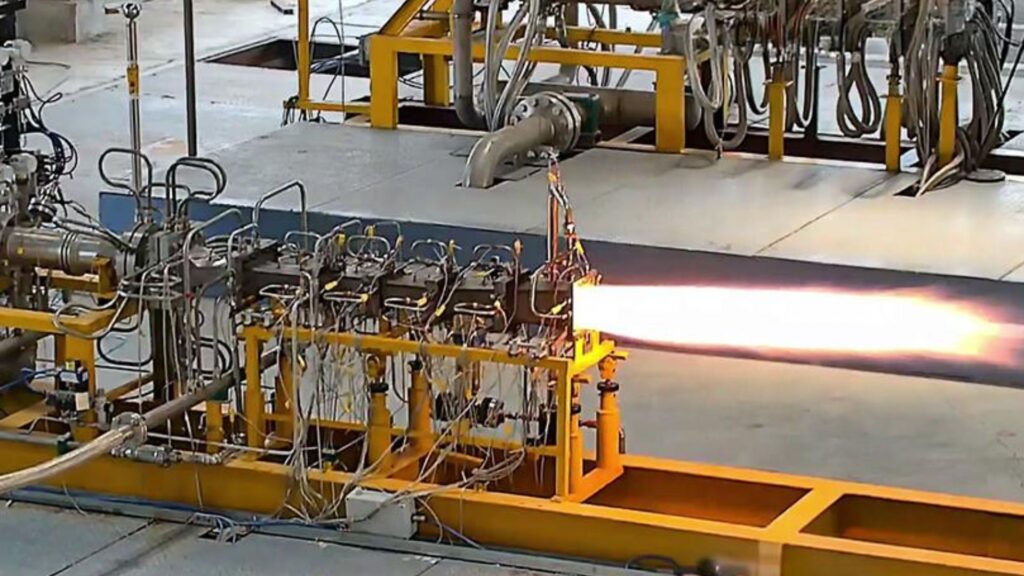
India’s Defence Research and Development Laboratory (DRDL) successfully conducted a 1,200-second ground test of an actively cooled full-scale scramjet combustor at its Scramjet Connect Pipe Test (SCPT) facility in Hyderabad on 9 May, according to a Press Information Bureau (PIB) release.
The test nearly doubled the previous run-time of over 700 seconds achieved at the same facility in January 2026. The PIB stated the combustor was “designed & developed by DRDL and realized by industry partners.”
Defence Minister Rajnath Singh described the result as “a solid foundation for the nation’s Hypersonic Cruise Missile Development Program.” He also acknowledged the roles of industry partners and academia in the effort.
The PIB release described the combustor as using “indigenously developed liquid hydrocarbon endothermic fuel, High temperature Thermal Barrier coating & advanced manufacturing processes.”
A scramjet – supersonic combustion ramjet – ingests atmospheric oxygen at supersonic speeds rather than carrying an onboard oxidizer, making sustained hypersonic cruise flight above Mach 5 possible over far longer ranges and durations than a rocket-powered vehicle can achieve.
The principal engineering challenge is thermal management – at sustained Mach 5+ conditions, combustor walls face extreme heat loads that can degrade or destroy the structure within seconds.
DRDL’s approach uses active cooling, channelling its endothermic fuel through the combustor walls before injecting it into the combustion chamber, so that the fuel absorbs heat as it decomposes while simultaneously cooling the structure and preparing for ignition.
An earlier report in The Statesman, covering the initial 120-second test in January 2025, attributed the flame stabilization to a novel DRDL-developed method capable of maintaining continuous combustion at internal air speeds exceeding 1.5 km/s and noted that DRDL had developed a specialized manufacturing process to produce the endothermic fuel at an industrial scale.
The May 2026 test represents the culmination of a progression that began with a 120-second run in January 2025.
That initial test was followed in April 2025 by a subscale combustor test lasting over 1,000 seconds at the SCPT facility, which the PIB described as an “Active Cooled Scramjet Subscale Combustor” ground trial, stating that with its completion, “the system will be soon ready for full scale flight worthy combustor testing.”
The May 2026 PIB’s language reflects that transition – it refers to a “Full Scale Actively Cooled Long Duration Scramjet Engine,” indicating the combustor has graduated from subscale validation to a flight-representative configuration.
The PIB also noted the ground tests “successfully validated the design of advanced active cooled scramjet combustor as well as the capabilities of state-of-art test facility,” confirming the SCPT facility itself was being proven alongside the hardware.
The April 2025 PIB described the scramjet effort as “an integrated effort put by the DRDO labs along with industry & academia,” and DRDO Chairman Dr Samir V Kamat credited Director General (Missiles & Strategic Systems) U Raja Babu and Director DRDL Dr GA Srinivasa Murthy by name for leading the work.
The scramjet combustor feeds into a broader program that Kamat has described in terms of two parallel hypersonic tracks.
The first is the hypersonic cruise missile – powered by a scramjet engine throughout its flight – which the 1,200-second combustor test directly supports, and which open-source reporting identifies as the Extended Trajectory-Long Duration Hypersonic Cruise Missile (ET-LDHCM), developed under a classified effort known as Project Vishnu.
The second is the hypersonic glide missile, which uses a rocket booster for initial velocity before entering an unpowered glide phase. Speaking at the ANI National Security Summit in April 2026, Kamat stated the glide variant is at a more advanced stage than the cruise missile variant.
According to open-source reporting, DRDO is working on as many as 12 distinct hypersonic systems under Project Vishnu, spanning offensive strike weapons and defensive interceptors.
India’s first scramjet flight demonstration took place in 2020, when DRDO’s Hypersonic Technology Demonstrator Vehicle (HSTDV) validated scramjet propulsion during a brief airborne test.
Follow India’s Defence Procurement and Industrial Strategy
Daily intelligence on India’s defence industry, covering procurement, industrial policy, and domestic production growth.
Notes and Comments
The progression from 120 seconds to 1,000 seconds (subscale) to 700 seconds and then 1,200 seconds (full-scale) in roughly 16 months is worth examining closely, particularly because of what the official language reveals about where DRDL sees itself on the development arc.
The April 2025 PIB described its test as preparation for “full scale flight worthy combustor testing,” and the May 2026 PIB then described the latest article as a “Full Scale Actively Cooled Long Duration Scramjet Engine.” It appears DRDL considers this combustor to be representative of the hardware that would fly in an actual weapon, having moved past laboratory-scale demonstration.
The distinction matters because a scramjet’s value as a weapon system depends on its ability to sustain combustion at full scale for extended durations under flight-representative thermal and structural loads – and 1,200 seconds at full-scale geometry, with active cooling and stable flame-holding performing simultaneously, begins to approach the endurance envelope of an operational cruise missile rather than a test article.
As aerospace analysts have widely noted, the core advantage of a scramjet-powered cruise missile is that it breathes atmospheric air, enabling sustained powered flight at hypersonic speed over distances that rocket-powered hypersonic glide vehicles – which expend their energy in a single boost phase and then coast – cannot match on a comparable airframe. A scramjet cruise missile travelling at an average of Mach 6 for 20 minutes would cover approximately 2,400 km, and, critically, it would do so under power for the entire trajectory, retaining the energy to manoeuvre at terminal phase in ways that a gliding vehicle on a decaying energy budget cannot.
The Week assessed the test as a signal that India “may be transitioning from hypersonic technology demonstration to the weaponisation of the tech,” and that reading tracks with the official language – the PIB consistently refers to the “Hypersonic Cruise Missile Development Programme” and Singh’s characterization of the test as “a solid foundation” for that program suggests it is being positioned as part of a weapons pipeline rather than an open-ended research effort.
However, the step from a sustained ground test to a weapon-grade engine flying at hypersonic speed across a combat-representative flight profile remains substantial – the SCPT simulates flight conditions rather than replicating them, and the combustor must still be integrated into a complete propulsion system, mated to an airframe, and proven in free flight with all the aerothermal, guidance, and structural challenges that entails.
For China, the scramjet cruise missile track represents a potential future threat that could bypass the layered ballistic missile defences Beijing has invested in over the past two decades – because a powered, manoeuvring cruise missile flying at Mach 5+ at low altitude presents a fundamentally different intercept problem than a ballistic trajectory following a predictable arc, and existing Chinese air defence architectures, including the HQ-9 and HQ-19 families, are optimized primarily for the latter.
For Pakistan, the implications are more direct – an operational Indian hypersonic cruise missile with 2,000+ km range would place virtually every strategic target in Pakistan within reach from launch positions deep inside Indian territory, compressing response timelines to minutes and rendering distance-based deterrence assumptions far less reliable.
That said, it is too early to infer an operational timeline, given that DRDO has not publicly disclosed a target date for scramjet-powered flight trials and that Kamat’s own assessment at the ANI Summit placed the glide variant ahead of the cruise missile track in terms of maturity. The 2020 HSTDV flight remains India’s only airborne scramjet test to date.
Thus, one can see the 1,200-second test as a structural de-risking event – it narrows the gap between ground-validated propulsion technology and a flyable weapon at a measured and accelerating pace, and the Indian government’s consistent use of program-level language rather than research-level framing confirms that the scramjet cruise missile has a defined operational endpoint.
Quwa Pro
India’s Defence Strategy, Capabilities, and Procurement Patterns
Understanding how India is shaping its military balance through procurement and indigenous development.
Featured & Trusted By