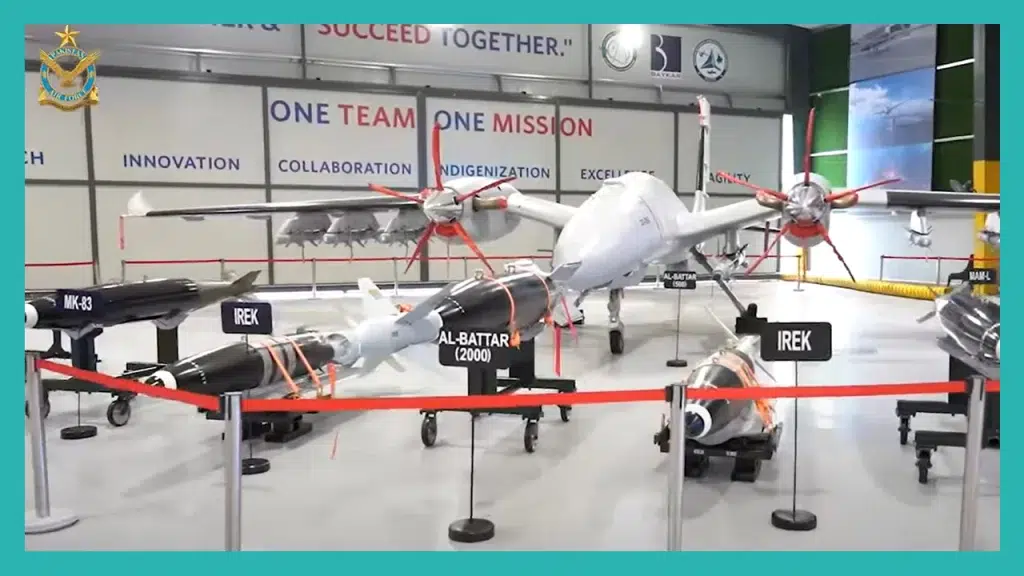
In August 2023, the private Turkish defence contractor Baykar announced that it will conduct research and development (R&D) work at Pakistan’s National Aerospace Science and Technology Park (NASTP).
Founded in 1984, Baykar started out as a subcontractor for precision machining equipment. However, in the 2000s, the company set out to supply defence equipment to the Turkish Armed Forces. It started out with drones, specifically a miniature unmanned aerial vehicle (UAV) for surveillance roles.
Since then, Baykar has grown into not just one of Turkey’s leading UAV suppliers, but a prominent player in the global drone market. Today, the company has several dozen customers across the Middle East, Sub-Saharan and North Africa, Central Europe, and South Asia.
Today, Baykar is moving towards developing more sophisticated UAVs, including a new loyal wingman and unmanned combat aerial vehicle (UCAV), the Bayraktar Kızılelma.
The Pakistan Air Force (PAF) is a confirmed user of two Baykar drones: the Bayraktar TB2 medium-altitude long-endurance (MALE) UAV and the Bayraktar Akıncı high-altitude long-endurance (HALE) UAV.
No other details were provided, but high-level officials attended the signing ceremony, including PAF Chief of Air Staff (CAS), Air Chief Marshal (ACM) Zaheer Ahmed Babar, then Pakistani Prime Minister Shahbaz Sharif, and the Chairman of Baykar’s board, Selçuk Bayraktar.
It appears that the R&D deal was instituted as part of the PAF’s purchase of Baykar’s UAVs. It is possible that Baykar is planning to co-produce one or both of the UAVs in Pakistan at NASTP. The R&D element and local production work could be part of an offset package from Baykar to Pakistan.
However, the R&D work seems to have begun materializing. For example, during a tour of NASTP, the PAF CAS showcased a new munition, “KaGeM V3.” The munition had the emblems of both NASTP and Baykar, with a statement printed to its side, “Developed by RE & RP Group NASTP.”
The KaGeM V3 seems to be an original project. Baykar’s other smart munition, the Kemankeş, is appears to be a smaller design (weighing 30 kg) than the KaGeM V3. Moreover, the KaGeM V3 draws more on the design characteristics of a cruise missile, while the Kemankeş is more unique. For example, the Kemankeş has an electro-optical (EO) system configured to record and transmit videos and images. It is meant to be used as both a reconnaissance asset and strike weapon all-in-one.
In contrast, the KaGeM V3 is not only larger, but its design mirrors other more conventional air-launched cruise missiles (ALCM), like the Ra’ad-series and Taimur-series. To be clear, the KaGeM V3 is unrelated as it is a NASTP project; the Ra’ad/Taimur are Air Weapons Complex (AWC) programs (hence marketed by the conglomerate Global Defense Industrial & Defense Solutions or GIDS).
Don't Stop Here. Unlock the Rest of this Analysis Immediately
To read the rest of this deep dive -- including the honest assessments and comparative analyses that Quwa Plus members rely on -- you need access.