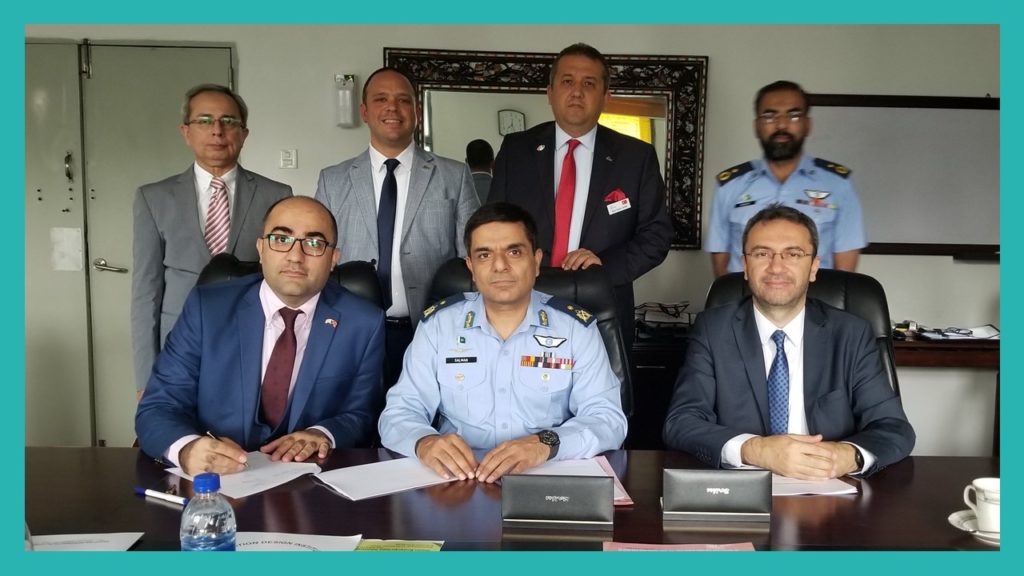
On 21 May, Pakistan Aeronautical Complex (PAC) and Turkish defence electronics manufacturer Havelsan signed a memorandum-of-understanding (MoU) to collaborate on unmanned aerial vehicles (UAV).[1]
Under the MoU, PAC and Havelsan will collaborate in the following domains: (1) mission computers; (2) ground control stations (GCS); (3) sensor-integration; and (4) weapon control computers.[2] They will also co-develop a ‘live, virtual and constructive (LVC) training’ system for combat aircraft.[3]
PAC and Havelsan also agreed to undertake joint-research and development (R&D) activities at the Kamra Aviation City complex, which was inaugurated by the Pakistan Air Force (PAF) in July 2017.[4]
The MoU joins a line of other defence agreements signed by Turkey and Pakistan, among them a number of big-ticket purchases by Pakistan, notably for 30 T129 attack helicopters and four MILGEM corvettes. In fact, Turkey has booked nearly $3 billion US in defence contracts from Pakistan.
However, this MoU between PAC and Havelsan is the first of development-oriented agreements intended to contribute towards Pakistan’s domestic defence programs. In this case, the MoU is clearly directed at supporting the medium-altitude long-endurance (MALE) UAV program under Project Azm.[5]
Project Azm (‘resolve’ or ‘determination’ in Urdu) is the PAF’s long-term initiative to domestically develop a MALE UAV and a fifth-generation fighter (FGF). The design work for both platforms is being undertaken by PAC’s Aviation Design Institute (AvDI), which is also a key piece to the Kamra Aviation City initiative.
According to the previous PAF Chief of Air Staff (CAS) – Air Chief Marshal (ACM) Sohail Aman – the MALE UAV project was in its “final stages of design” and would enter production in 18 months (as of December 2017).[6][7] Considering the time it would take to thoroughly test a UAV, the production element mentioned by the ACM (retired) Sohail Aman likely refers to a prototype. In other words, it will take longer than just 18 months to test, certify and push a MALE UAV design into serial production.
Granted, there will be external skepticism regarding the extent of indigenous input in Project Azm. But it is no secret that Pakistan lacks the necessary industrial inputs to design, develop and manufacture UAVs on a truly turnkey basis. In fact, outside of the United States, France and China, few – if any – countries can claim an entirely turnkey project without any external inputs or overseas collaboration.
However, lacking the inputs for a full turnkey solution need not prevent Pakistan from original design and integration work. As discussed in an earlier Quwa Premium article, Pakistani defence suppliers could build the capacity to understand how to integrate disparate subsystems and materials into original solutions. It would still rely on foreign suppliers, but it could bypass original equipment manufacturers (OEM) and their mark-ups by directly approaching input suppliers (e.g. for composites, propulsion, etc) and achieve more control over the pricing and capabilities of its final product (albeit to lesser degree than turnkey solutions).
Quwa Plus
Go Beyond the Headlines on Pakistan’s Defence and Security.
Quwa Plus gives you deeper reporting, briefings, and analysis on Pakistan’s defence programs, foreign policy, national security, and regional strategy. Follow the developments that matter to professionals, analysts, and serious readers tracking Pakistan’s security landscape.
Join ($29.99/Year) Already a subscriber?Sign in