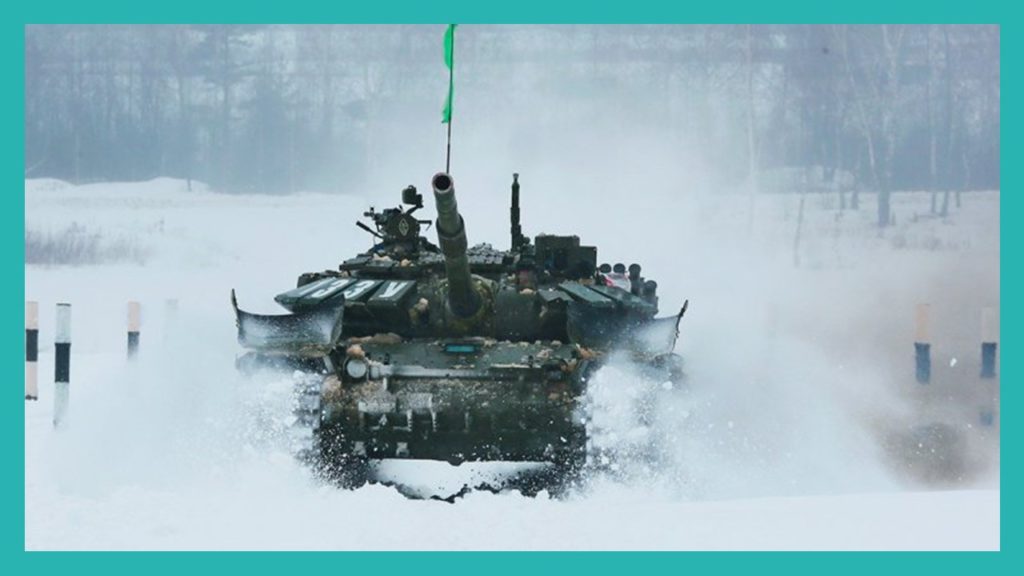
In his comments to the Russian News Agency RIA Novosti, Pakistan’s Minister of Defence (MoD) Khurram Dastgir Khan stated that Pakistan was both interested and in talks with Russia for big-ticket defence items. Quwa Premium discussed the MoD’s comments regarding the Su-35 and air defence systems in part-one and part-two, respectively, while part-three discusses the potential of Pakistani helicopter procurement from Russia. The MoD flatly told RIA Novosti that Pakistan was “interested” in the T-90 main battle tank (MBT) and that it would “not be a one-time purchase, but a long-term commitment”.[1]
The MoD’s statements regarding the T-90 come amid ongoing trials by the Pakistan Army of two off-the-shelf MBTs – i.e. the NORINCO VT4 and Malyshev Factory Oplot-M from China and Ukraine, respectively. In an interview with the Ukrainian news outlet Delovaya Stolitsa, Pakistan’s Ambassador to Ukraine Maj. Gen. (retired) Athar Abbas said Pakistan could procure approximately 100 Oplots.[2] Thus, this could be an indicator of how many tanks the Army is looking to procure off-the-shelf.
The interesting aspect of the MoD’s statements – regarding the T-90 – is that they align with an actual off-the-shelf MBT program and create reasonable expectations, i.e. the Army would look to scale overhead for a new platform with additional batch purchases. However, the uncertainty is whether Russia is actually interested in selling a conventional warfare asset and, as importantly, if Pakistan is truly willing to distance itself from the valuable ties it had built with China and Ukraine in MBT development and procurement.
Russia’s Armour Offerings: COIN/CT-Focused
Interestingly, Moscow has offered armoured solutions to Pakistan, but with a focus on fulfilling Pakistan’s counterinsurgency (COIN) and counter-terrorism (CT) requirements.
Rosonboronexport brought a portfolio comprising of BTR-80A and BTR-82A armoured personnel carriers (APCs) and the BMP-3M infantry fighting vehicle (IFV) to the 2016 International Defence Exhibition and Seminar (IDEAS) in Karachi.[3] While it is true that such displays are not exclusively focused upon Pakistan, these events are in fact avenues to directly market and engage prospective Pakistani buyers. It would be nonsensical to market hardware and services in Pakistan that cannot be sold to Pakistan.
Though presented as COIN/CT solutions, the BTR-80A, BTR-82A and BMP-3M could be conventional assets as well if deployed in the Army’s mechanized formations. However, the Army has not opted for any of its new APC/IFV options, much less those of Russia. In 2016, IHS Jane’s had forecasted that Pakistan could spend $1.1 billion US on a new APC platform (adding to the M113-based Talha et. al) – alluding to a new wheeled APC/IFV platform.[4] However, this program has yet to come into fruition; in fact, Pakistan has yet to even select from its options (which include China, Turkey, Serbia and the Pakistani industry), much less deal with the issue of financing and, ostensibly, bringing a turnkey manufacturing site to Pakistan.
Wheeled APC/IFVs – also known as armoured fighting vehicles (AFV) – such as the BTR-80A/82A provide improved mobility on roads, enabling for rapid mobility on increasingly pervasive infrastructure. Like their tracked counterparts, AFVs can also operate off-road. In other words, Pakistan can utilize AFVs as part of its mechanized formations, including a formation integrated with mobile anti-air warfare, howitzer as well as rocket artillery, and layered (i.e. low and high-altitude) aviation coverage.
Thus, the frontal COIN/CT focus of Russia’s AFV offer should not preclude them from being of interest to the Pakistan Army, especially if it can leverage it to secure a MBT purchase to its favour (or vice-versa). In general, a selection would be contingent on affordable upfront and life-cycle costs and a secure support channel for spare parts. In terms of the latter, Pakistan would likely expect significant technology transfers to enable for a domestic turnkey manufacturing facility, at least for AFVs (which it can then procure over the long-term and gradually build a sizable inventory).
Why the T-90?
Although the T-90-series could fit in terms of the Army’s look at off-the-shelf MBTs, the entire topic of off-the-shelf MBTs is peculiar considering that Heavy Industries Taxila’s (HIT) output of al-Khalid MBTs is well below capacity. HIT can produce 50 al-Khalid MBTs per year, but the Army’s orders have left HIT at building only 18 al-Khalid MBTs per year on average.[5] Clearly, HIT is not the bottleneck to the Army’s need for new MBTs; rather, the problem stems from the lack of Army orders, which indicate either fiscal issues and/or a shift in requirements. However, it cannot be funding as an off-the-shelf MBT is being sought.
Quwa Plus
Go Beyond the Headlines on Pakistan’s Defence and Security.
Quwa Plus gives you deeper reporting, briefings, and analysis on Pakistan’s defence programs, foreign policy, national security, and regional strategy. Follow the developments that matter to professionals, analysts, and serious readers tracking Pakistan’s security landscape.
Join ($29.99/Year) Already a subscriber?Sign in