
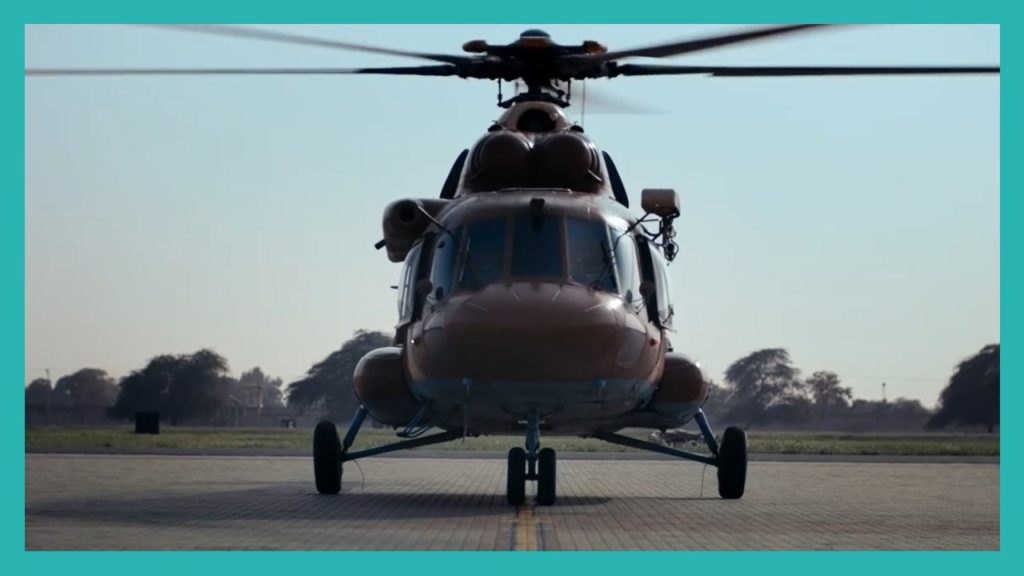
Though it was not mentioned by the Pakistani Minister of Defence, Khurram Dastgir Khan, in his comments to the Russian News Agency RIA Novosti, helicopters are an issue of mutual interest between Russia and Pakistan. The Pakistan Army Aviation Corps (PAA) and the Pakistan Air Force (PAF) already operate Mil Mi-17/171 transport helicopters, while the PAA is receiving four Mi-35M attack helicopters from Russian Helicopters. Granted, the subject matter does not attract as much attention as the talk surrounding main battle tanks (MBT), Su-35 fighters or air defence systems, but it is an area that fulfils the underlying points discussed in part-one and part-two of this series, specifically: (1) cost feasibility vis-à-vis Pakistan’s fiscal realities, (2) active requirements (with Mi-171s already in place) fueling interest, (3) Russia’s willingness.
Pakistan ordered four Mi-35Ms from Russian Helicopters in 2015 for $153 million US.[1] Pakistan’s Ministry of Defence Production (MoDP) stated that the contract also included ground support equipment (GSE).[2] When Pakistan signed the contract, IHS Jane’s had reported that the PAA could procure up to 20 Mi-35s through the long-term, conditional on Pakistan’s fiscal situation. This initial Mi-35M batch was bought via cash the Pakistan Army already had on-hand.[3] Today, the Mi-35M is the only active Russian defence sale to Pakistan, one the Kremlin has coloured as its support for Pakistan’s counterinsurgency (COIN) efforts.
Helicopters: Potential for Growth?
In contrast to other big-ticket defence items, helicopters – be it transport, scout/utility and/or attack helicopters – could conceivably generate growth in Russian defence sales to Pakistan.
Firstly, the area has traction in place through not only the Mi-35M, but the longstanding supply of Mil Mi-17/171 medium-lift transport helicopters to the PAA and the Pakistan Air Force (PAF). The Mi-17-series is a mainstay transport in the PAA (as a medium-to-heavy-lift platform), while the PAF operates the Mi-171 as a ‘heavyweight’ in its composite (i.e. mixed-fleet) search-and-rescue helicopter units. Thus, not only do Russian helicopters have traction in terms of sales, but the PAA and PAF prefer them as workhorses.
Secondly, the Russians are willing to sell. One can evidently count upon the Mi-35M and Mi-171 as being available to Pakistan, but grounded reports of the Mi-28-series being offered had emerged as well. Jane’s reported in 2016 that Russia had offered four Mi-28NE to Pakistan as a supportive gesture for the latter’s COIN efforts.[4] If correct, it was certainly not a ‘toothless’ offer. Fundamentally, the Mi-28NE is meant to be an analogue of the Boeing AH-64D Longbow Apache – i.e. an anti-armour/conventional warfare asset. In terms of targeting Pakistan’s lightweight helicopter needs, Kazan Helicopters (a subsidiary or branch of Russian Helicopters Group) demonstrated its Ansat platform to Pakistan in November 2017.[5] However, it is a tough push seeing that Airbus Helicopters’ H125M is the PAA’s mainstay scout/lightweight helicopter.
Is Pakistan Interested? Absolutely.
Seeing that Russia is offering Pakistan the platforms the latter requires and pursues, at least in terms of the PAA’s workhorse transport helicopter that is the Mi-17/171, Pakistan is certainly interested. In fact, with the Mi-17-series already in place and the Mi-35M joining, Pakistan had looked in 2015 to establish a complete maintenance, repair and overhaul (MRO) centre for both helicopter types.
Speaking to Sputnik News, then Head of International Cooperation at Rostec (a state-owned trading firm representing Russia’s state-owned enterprises) Viktor Kladov, had stated in November 2015: “There is a huge number of Russian helicopters in Pakistan. We are currently holding negotiations…about creating a technical service center, which would maintain and repair helicopters”.[6]
Pursuing such an expansion to one’s operating infrastructure would indicate an intention to scale through the long-term with additional aircraft purchases. Firstly, pursuing MRO signifies an intent to fly the Mi-17 and Mi-35 through the long-term by spending on local support mechanisms, which can reduce long-term operating costs by leveraging lower services costs and reducing foreign-currency outflows. Second, with such infrastructure in place, it follows that a large domestic fleet would be built to draw maximum utility and cost-savings from domestic MRO services. In Pakistan, the Mi-17-series is operated by the two armed forces branches, at least two provincial governments and the Federal Ministry of Interior. It is an asset.
The Mi-35M itself is a derivative of the Mi-17/171 in that is based on the latter’s airframe while also maintaining common turboshaft engine options (e.g. the VK-2500 and ТVЗ-117VМА). In effect, the user can leverage a streamlined logistics channel for spare parts and GSE for the Mi-17-series and the Mi-35M. Furthermore, the PAA is familiar with the core platform’s strengths and vulnerabilities, making the Mi-17-series a tried or mature platform for its roles. Currently, the PAA reportedly has 46 Mi-17/171s in service.[7]
Quwa Plus
Go Beyond the Headlines on Pakistan’s Defence and Security.
Quwa Plus gives you deeper reporting, briefings, and analysis on Pakistan’s defence programs, foreign policy, national security, and regional strategy. Follow the developments that matter to professionals, analysts, and serious readers tracking Pakistan’s security landscape.
Join ($29.99/Year) Already a subscriber?Sign in