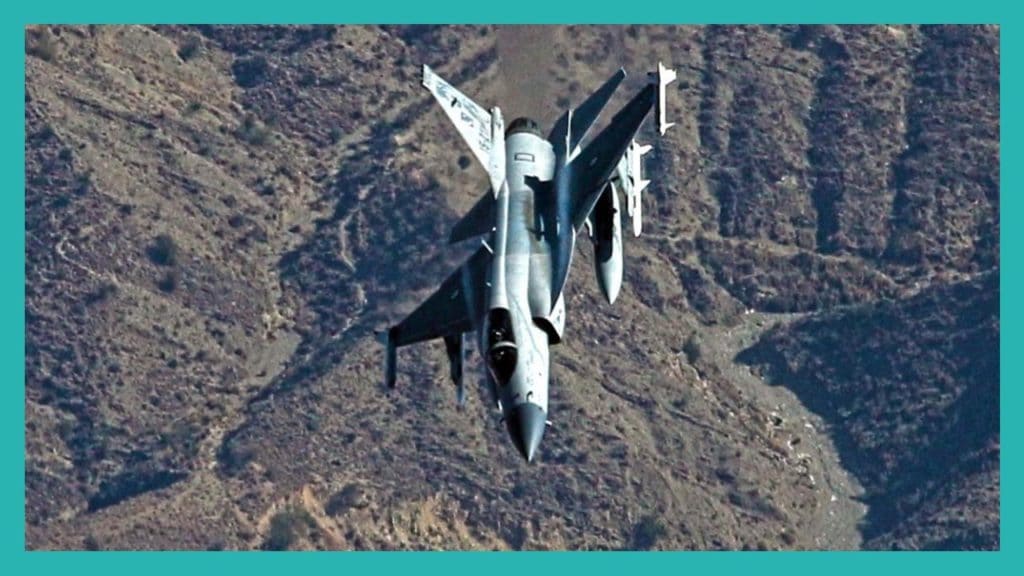
With a little over year passing since Operation Swift Retort – i.e., the Pakistan Air Force’s (PAF) retaliatory strikes in response to India’s action over Balakot, Khyber-Pakhtunkhwa (KPK) in February 2019 – the PAF has likely developed an idea of how to modernize its fleet through the 2020s. Granted, many will likely be drawn to the PAF Chief of Air Staff’s (CAS) hint that the PAF may pursue an off-the-shelf fighter[1], but that is not the actual story. Yes, the PAF’s Mirage III/5s and JF-17s played the lead role in attacking ground targets, while the F-16s downed at least one Indian Air Force (IAF) fighter (the PAF claims two). However, those fighters relied on critical supporting assets to deliver their respective munitions, including the Erieye airborne early warning and control (AEW&C) and Falcon DA20 electronic warfare (EW)/electronic countermeasures (ECM) aircraft. Moreover, the PAF also lauded the experience it gained through multi-national exercises as key to its execution in February 2019. Finally, tying all those assets together was the PAF’s investment in the electromagnetic spectrum, i.e., secure and working data links (and ability to apparently deprecate the IAF’s wireless communications and counter-deployment via EW/ECM).
If anything, the actual ‘story’ is that the PAF will need to continue improving its ‘supporting assets’ – i.e., AEW&C, EW/ECM, data-linking, etc – to keep up with emerging technologies and regional trends. If not, then it could potentially suffer in similar ways the IAF did during Operation Swift Retort, such as a loss in wireless data link/communications quality, or weaker EW/ECM employment. Though these assets are not as tangible (or celebrated) as combat aircraft, their absence or deprecation could cause aircraft loss, and potentially, wider tactical or even strategic defeats. Likewise, original equipment manufacturers (OEMs) and militaries are less transparent about the performance and technical specifications of these assets, so one will not know how effective they truly are until an actual engagement. However, though modernizing these assets adds fiscal strain, it is more affordable to keep these systems at-par, at least for now. In fact, significant (and comparatively lower-cost) gains in this respect could lessen the pressure of acquiring new high-performance combat aircraft (read: high-cost imports). Note: those combat aircraft are still valuable, but they are far from the sole measures of air warfare capability today as they were several decades ago.
For the PAF, its modernization goals for the 2020s will likely focus on the following areas: First, additional combat aircraft. This may contradict an earlier point, but ‘additional aircraft’ does not necessarily mean ‘high-cost off-the-shelf fighters,’ but rather, more JF-17 Block-IIIs and JF-17Bs (i.e., more than the 76 the PAF already has in its procurement pipeline). Second, diversification of EW/ECM assets, be it across pods for combat aircraft or dedicated, stand-off range assets like the Falcon DA20. Third, further investment in securing wireless communication/data-linking so as to mitigate enemy EW/ECM effects and ensure its reliability in contested electromagnetic environments. Fourth, training aircrews and other specialists from an early stage, and leveraging more exercises, so that the PAF can maintain and improve execution quality.
Quwa will break-out each of these four areas into detailed articles in April. In this article, Quwa will briefly look at the main challenges and intended outcomes for each area (and examine each in depth separately).
1. Add More JF-17s. Numbers Matter.
For the PAF, the primary benefit of acquiring a new fighter is that it introduces new technology and air-to-air and air-to-surface weapons. For the PAF, the biggest technology leaps occurred with the induction of the F-16C/D Block-52+ (and the F-16A/B Mid-Life Update for the already serving Block-15s). It brought a credible beyond-visual-range (BVR) capability plus tactical data-links (TDL) and precision-strike. Even in his most recent statements, the PAF CAS hinted as much; if there is a much-needed capability that would come through a new fighter, the PAF will try to acquire that fighter.[2] However, the JF-17 Block-III will alter this equation in that the PAF can now get the latest technologies through an in-house program.
Quwa Plus
Go Beyond the Headlines on Pakistan’s Defence and Security.
Quwa Plus gives you deeper reporting, briefings, and analysis on Pakistan’s defence programs, foreign policy, national security, and regional strategy. Follow the developments that matter to professionals, analysts, and serious readers tracking Pakistan’s security landscape.
Join ($29.99/Year) Already a subscriber?Sign in