
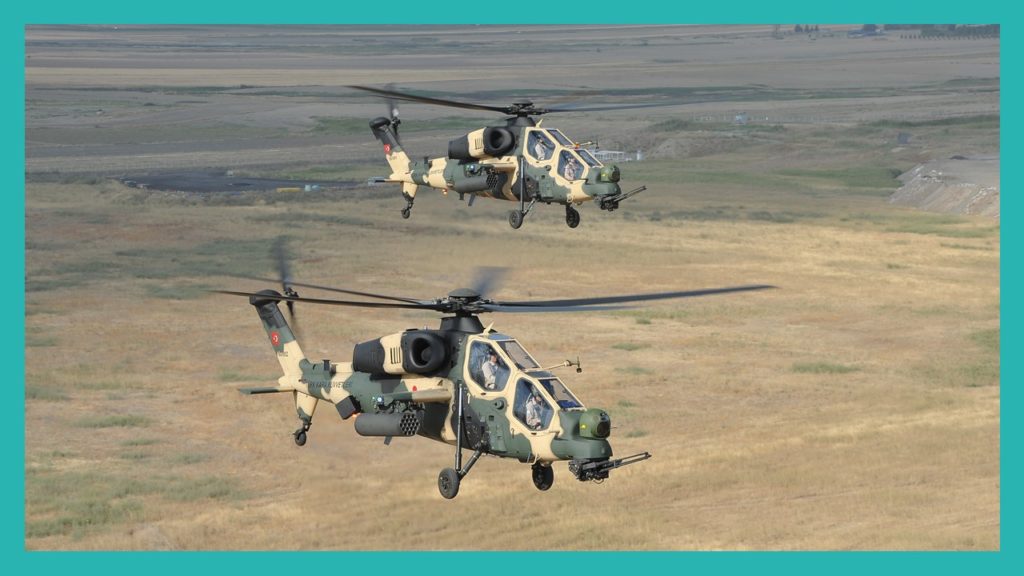
Speaking to Turkey’s state-owned TRT Haber news channel in early May[1], Turkey’s Undersecretary of Defence Industries (SSM) Dr. İsmail Demir stated that a much-anticipated contract for the sale of Turkish Aerospace Industries (TAI) T129 ATAK attack helicopters to Pakistan could be inked in the coming weeks.
“In Pakistan, we will have important developments related to the export of ships and attack helicopters. God Willing, we will have news about the ATAK helicopter sale to Pakistan next week”, Demir told TRT.[2]
In subsequent statements to TRT, Demir outlined that the Pakistani programs – which include both the ATAK and the MILGEM Ada-class anti-submarine warfare (ASW) corvette – were contingent on a credit-line to back both deals. The MILGEM line has been finalized, while a loan for the ATAK is in the process of being made or finalized.[3] However, it appears that credit has tentatively been settled, the matter is now proceeding to inking the contracts and bringing the programs to fruition.
Pakistan reportedly began contract negotiations for 30 T129s in June 2017.[4] Pakistan’s Minister of Defence Production (MoDP) confirmed the negotiations in November 2017, stating that the issue was “90 percent complete”.[5] The program also appears to include some transfer-of-technology.
At the 2018 IQPC Military Helicopter Conference, the Pakistan Army Aviation Corps’ (PAA) Major Gen. Nasir D. Shah stated that depot-level maintenance, repair and overhaul (MRO) would be a must for the PAA’s next mainstay attack helicopter.[6] However, TAI reportedly offered component manufacturing work to Pakistan Aeronautical Complex (PAC) as well.[7]
Building High-Altitude Close Air Support Capabilities
The PAA had evaluated the T129 in June 2016. In addition to testing the helicopter’s endurance and status in high-temperature environments, the PAA also flew the ATAK at 14,000 ft to test its high-altitude flight.[8] It appears that one of the reasons for pursuing the T129 was to build a high-altitude attack capability. The current AH-1F/S fleet is insufficient for the task, with the PAA citing “creaks and shakes” as an issue when flying the legacy Cobras at those altitudes.[9] In fact, Maj. Gen. Shah himself outlined that the Cobras could not fly above 8,000 ft, thus indicating that the PAA required an attack helicopter that could do so.[10] Quwa Premium has an in-depth look at the ATAK evaluation and selection process in February’s Monthly Report.
Interestingly, the ATAK would essentially complete an ongoing effort to modernize the high-altitude force: the PAA has already switched from operating the SA315 Lama to the Airbus Helicopters H125M[11], which it in fact employed for a high-altitude search-and-rescue (SAR) mission in January 2018.[12] The PAA has also procured at least one Leonardo AW139 utility helicopter, which was also – as part of the Pakistan Air Force’s (PAF) trials – tested for its high-altitude performance.[13]
The T129, H125M and AW139 can plausibly come together to form a complete high-altitude aviation force for attack, scouting, SAR and utility (this is discussed in detail in the Quwa Premium article, “Pakistan Army Aviation’s High-Altitude Capabilities”). The aim is unclear, though a robust high-altitude aviation force will be of utility in the Northern Areas and Kashmir. In this case, Pakistan would basically deploy the T129 in the same manner the Indian Army and Indian Air Force would the Light Combat Helicopter.
The Engine Constraint
Though TAI has export licenses for the ATAK’s CTS800 turboshaft engine, the instability of Pakistan-US ties – particularly in terms of defence and security cooperation – could be a constraint to any T129 sale to the Pakistan Army. Besides an alternative non-ITAR (International Traffic in Arms Regulations) variant of the CTS800 (which Rolls-Royce was reportedly slated to develop in 2016[14]), the only other option is the Turkish Engine Industries (TEI) turboshaft program. However, it would be seven to eight years before that engine can possibly enter serial production, if not longer (due to testing and certification).
Quwa Plus
Go Beyond the Headlines on Pakistan’s Defence and Security.
Quwa Plus gives you deeper reporting, briefings, and analysis on Pakistan’s defence programs, foreign policy, national security, and regional strategy. Follow the developments that matter to professionals, analysts, and serious readers tracking Pakistan’s security landscape.
Join ($29.99/Year) Already a subscriber?Sign in