
Is Pakistan Buying Wing Loong II UAVs from China?
There are reports of Pakistan Aeronautical Complex (PAC) co-producing 48 Wing Loong II unmanned aerial vehicles (UAV) in collaboration with Chengdu Aircraft Industries Group (CAIG).
The news originally came from a Facebook Page purporting to be an official account of the Sherdils, which are the PAF’s aerial display team.[1] However, Quwa was unable to verify the authenticity of the account or whether it was associated with the PAF. In fact, the account does not even list the official PAF website (or that of the PAF Media Directorate); rather, it directs to a news website called “PAF Falcons.”
In effect, this news – despite being widely picked-up – cannot be verified. In fact, each and every source that reported this news had pointed to this specific Facebook Page, which is not even linked to the PAF.
Besides this, there have been no official statements by the PAF, PAC or Ministry of Defence Production or any quotes attributed to Pakistani officials. Thus, the news is, until proven otherwise, a rumour.
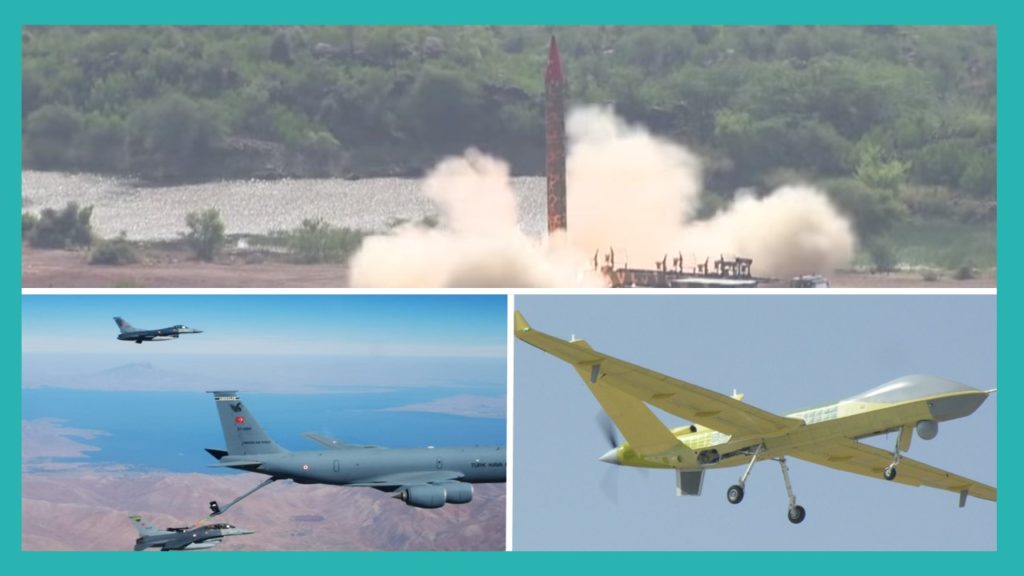
That said, Pakistan had been test-flying a Wing Loong UAV as recently as November 2017. Considering the PAF’s longstanding relationship with CAIG (via the JF-17), seeing the PAF procure the Wing Loong II is also plausible. However, the PAF has its own medium-altitude long-endurance (MALE) UAV program running through Project Azm. The Project Azm UAV is reportedly due to materialize in some form in 2019.
One might draw a link between Project Azm and the Wing Loong II, but this too is uncertain.
Firstly, PAC’s mock-ups show a MALE UAV design that, while broadly similar to other MALE UAV designs (i.e. inspiration from the Predator), has several design differences from the Wing Loong II. These include an engine intake underneath the fuselage (as opposed to the Wing Loong II, which has it above).
Secondly, in May PAC signed a memorandum-of-understanding (MoU) with the Turkish electronics vendor Havelsan to co-develop various subsystems for UAVs. These systems include mission computers, ground control stations, sensor integration and weapon control computers. Considering the scope, it is likely that the MoU is geared towards a major UAV program, i.e. Project Azm.
In theory, one could look at merging the Wing Loong II with domestic and third-party technologies. While plausible, it would depend on Turkey’s comfort with its technology being in close proximity to China (and vice-versa). Yes, China and Turkey bear no animosity towards each other, but they are competitors in the international drone market. In fact, Turkey has been marketing its Anka to China’s existing UAV customers.
Don't Stop Here. Unlock the Rest of this Analysis Immediately
To read the rest of this deep dive -- including the honest assessments and comparative analyses that Quwa Plus members rely on -- you need access.