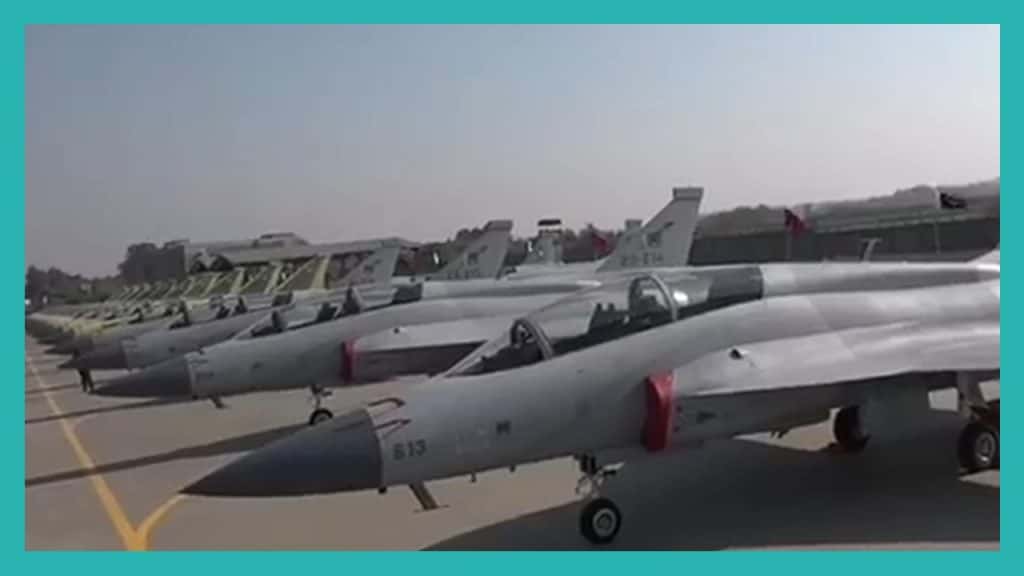
On 30 December 2020, Pakistan Aeronautical Complex (PAC) rolled out 14 JF-17B twin-seat fighters for the Pakistan Air Force (PAF). These aircraft will join the eight JF-17Bs PAC rolled out in December 2019 – they are part of a wider PAF order of 26 aircraft. It seems that the JF-17B program is on-schedule as the PAF had intended to acquire 22 aircraft by the end of 2020. The remaining four are due in 2021.
The PAF ordered the JF-17B as an add-on to its original plan of 150 JF-17s. The PAF will primarily use the JF-17B as an operational conversion unit (OCU) asset to support pilot transition to the JF-17, which is now the PAF’s mainstay combat aircraft. The F-7P’s OCU squadron – i.e., No. 18 Sharp Shooters – will switch to the JF-17B and operate as the JF-17’s OCU unit from Minhas Air Base in Kamra.[1]
Like its other multirole OCU assets, the JF-17B will also be combat capable. However, it is unclear if JF-17B units will offer additional capabilities above the standard features of the Block-II.
The PAF also announced that PAC will also start the production of JF-17 Block-3s. The PAF reportedly did confirm that the COVID-19 pandemic “inflicted serious impacts” on PAC, but it still seems that the Block-3 project is running on schedule.[2] PAC is aiming to roll out 12 JF-17 Block-3s a year from 2021 to 2024.[3]
The JF-17 Block-3 first flew at the end of 2019. The PAF is positioning the Block-3 as its primary counter to the Indian Air Force’s (IAF) induction of Dassault Rafale fighters. In addition to equipping the Block-3 with an active electronically scanned array (AESA) radar, the PAF is also adding “air dominance” and “enhanced EW [electronic warfare] suite and BVR [beyond-visual-range) capability” to its messaging.
Besides selecting the Nanjing Research Institute of Electronics Technology (NRIET) KLJ-7A AESA radar, the PAF did not confirm the specific make or model of the subsystems it will add to the JF-17. However, there have been rumours of the PAF seeking the PL-15 from China, though Quwa was told by a PAF official back in 2018 that several Chinese air-to-air missiles were under consideration.
In general terms, the KLJ-7A reportedly offers a maximum range of 170 km against a fighter-sized aircraft – thus, the PAF will certainly seek a BVR air-to-air missile with a range of in-excess of 100 km. Besides the overall range of the missile, the PAF will likely look to emulate some of the key features of MBDA’s Meteor, which the IAF is using from its Rafale fighters. A key capability would be a long-range ‘no-escape zone.’
In terms of ‘enhanced EW,’ the PAF is likely referring to both enhanced situational awareness capabilities (e.g., radar warning receiver) as well as an onboard jamming suite. The PAF can opt for a range of onboard EW and electronic countermeasures (ECM) subsystems from the market, including from Europe.
The PAF did not disclose any additional changes to the Block-3 compared to the preceding variants. At this time, it does not appear that the Block-3 houses a new turbofan engine (e.g., RD-93MA). Finally, the PAF did not confirm any plans for follow-up JF-17 batches on top of the 188 it already has in the pipeline.
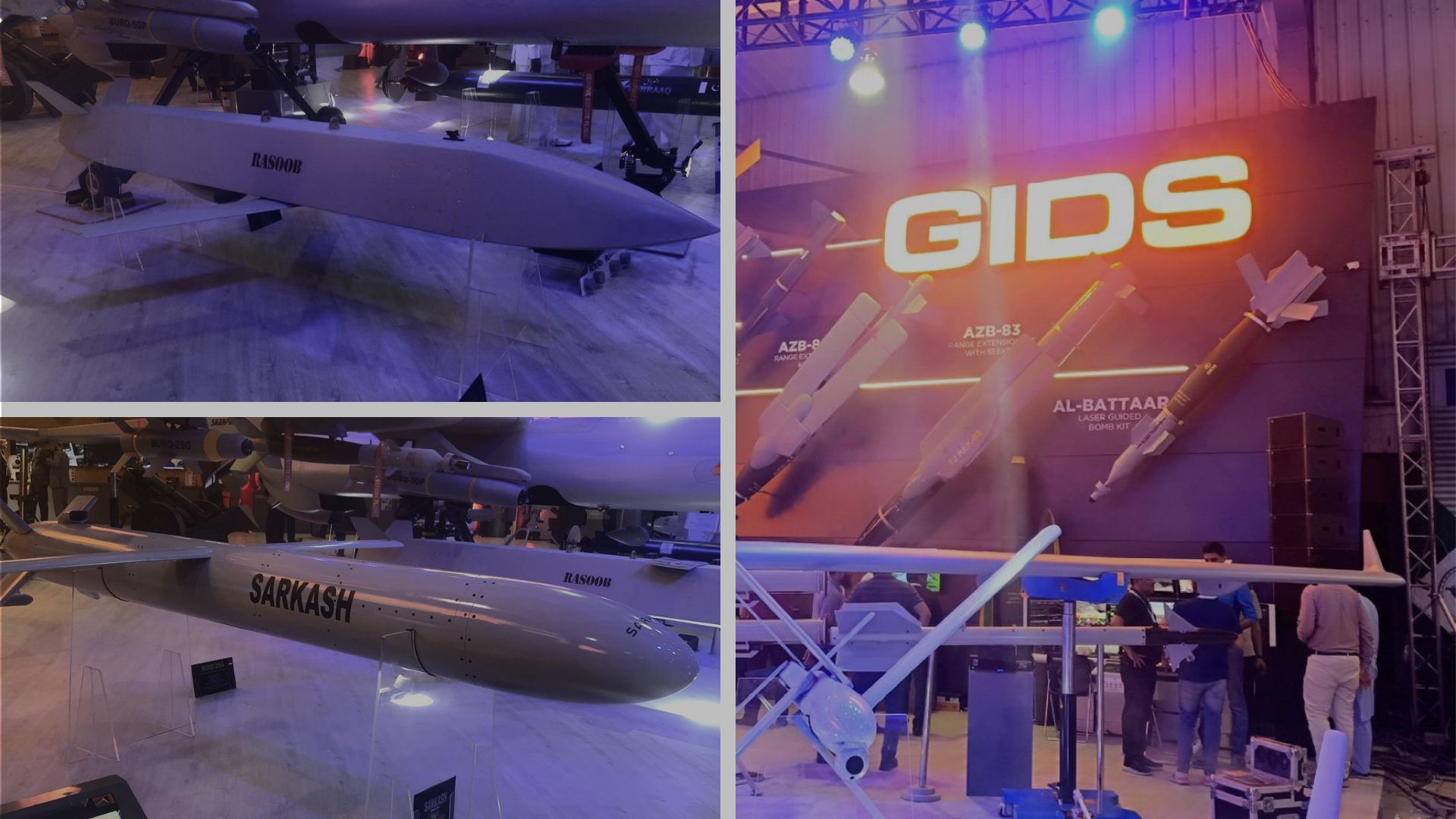
Glimpses of Project AZM’s Unmanned Aerial Vehicle (UAV)
The PAF also showed brief glimpses of its in-house unmanned aerial vehicle (UAV). PAC has been working on a medium-altitude long-endurance (MALE) UAV since 2017. Observers have noted that the PAC UAV’s vertical stabilizers do not bear identical similarities with the Wing Loong II, CH-4 or CH-5.[4] This follows the UAV’s early design concepts which – while broadly similar to other UAVs – showed an original design.
Don't Stop Here. Unlock the Rest of this Analysis Immediately
To read the rest of this deep dive -- including the honest assessments and comparative analyses that Quwa Plus members rely on -- you need access.