
By Syed Aseem Ul-Islam
Author Profile: Syed Aseem Ul Islam is a Research Scholar at the University of Michigan, Ann Arbor, USA, specializing in adaptive and model-predictive flight control systems. He received his bachelor’s degree in aerospace engineering from the Institute of Space Technology, Islamabad, and his master’s and Ph.D. degrees in flight dynamics and control from the University of Michigan.
Note: This is a republishing of a September 2021 article that unpacks how Pakistan could potentially design and develop an indigenous unmanned combat aerial vehicle (UCAV).
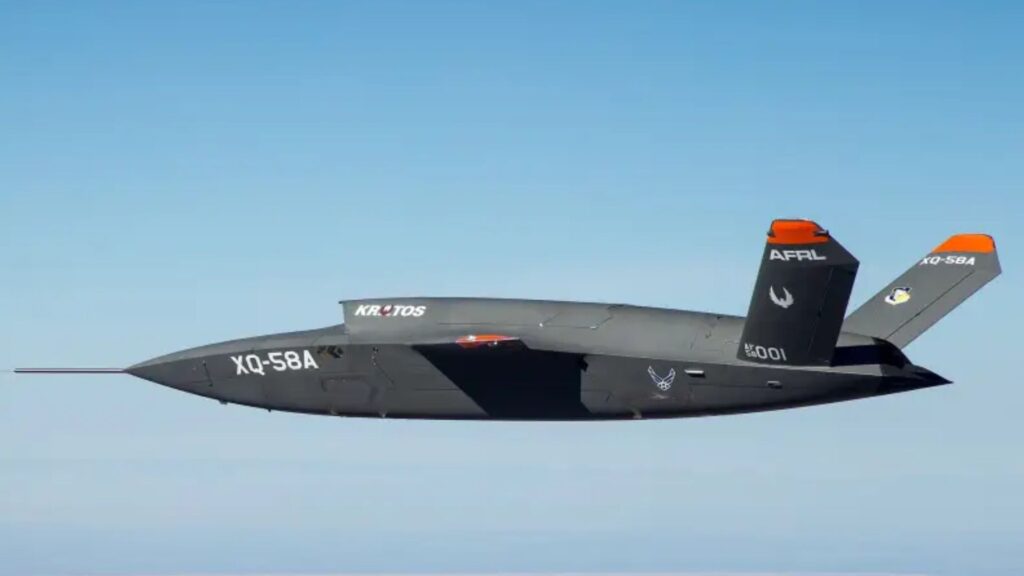
A previous article discussed how the goals and projects under Project Azm needed to be reoriented to make them achievable within the constraints of Pakistan’s aerospace ecosystem and the realities of TAI’s substantial existing investment in its TFX program. That article argued that the Pakistan Aeronautical Complex (PAC) should pursue a loyal wingman unmanned combat aerial vehicle (UCAV) project rather than a fifth-generation fighter aircraft (FGFA) program. This article will propose a possible roadmap for such a program.
The proposed program envisions two UCAV’s (named ‘Vafadar-1’ and ‘Vafadar-2’ for the purpose of this article). Vafadar-1 would serve as the first step in PAC’s quest towards developing a loyal wingman program. It can serve as a testbed for technologies and as a relatively low-risk, low-cost UCAV program. Towards the end of the Vafadar-1 program, the Vafadar-2 program could be initiated, building upon the successes of its predecessor. Vafadar-2 would be bigger, more capable, and more expensive than Vafadar-1. Both loyal wingman UCAVs will present the Pakistan Air Force (PAF), Turkish Air Force (TuAF), and potential export customers with two options that can work together seamlessly and provide the perfect mix of low and high-end loyal wingman capability.
Designing, constructing, and flying these UCAVs, which approach manned fighter jets in complexity, will give PAC valuable experience and build the human resources and infrastructure it currently lacks. Embarking on this program will lay the foundation for PAC to design and build major components of a manned fighter jet, as envisioned under Project Azm.
Get the Full Picture on Pakistan’s Defence and National Security
Get dedicated Pakistani defence news, force analysis, procurement tracking, and national security policy insight, backed by more than a decade of documented reporting and depth general news coverage cannot match.
Involving Private Industry
Since the design and development of these UCAVs will be a paradigm shift for Pakistan’s aerospace industry, this will make it the perfect time to start involving the private sector in the program.
PAC should put out a requirement for the Vafadar-1 loyal-wingman UCAV and invite proposals from Pakistani aerospace companies, such as Integrated Dynamics, Woot Tech, and Satuma.
Obviously, these companies currently do not have the capacity to undertake a program of such complexity. Thus, the intention of involving these companies in the program is to gradually build their capacity. Their proposals should include their own capacity enhancement plans and how they intend to collaborate with PAC and other private companies to address their individual deficiencies. For example, Solunux may be invited for expertise on turbines, Sherani Engineering for expertise on jigs and assemblies, and East-West-Infiniti for expertise in electronics. In Western fashion, two consortia of private companies might be selected as finalists, and two competing designs for Vafadar-1 might be taken to the prototype stage.
The rest of the article proposes the capabilities such a UCAV will need, in the author’s opinion. Additionally, “back-of-the-envelope” designs for both Vafadar-1 and Vafadar-2 are provided as inspiration if (or when) such a program is pursued.
Common Capabilities and Requirements
Since Vafadar-1 and -2 are to be developed under the same program with similar requirements, they will undoubtedly have a set of common requirements that will be established before the distinctions between the two UCAVs are discussed.
Network Centric Design
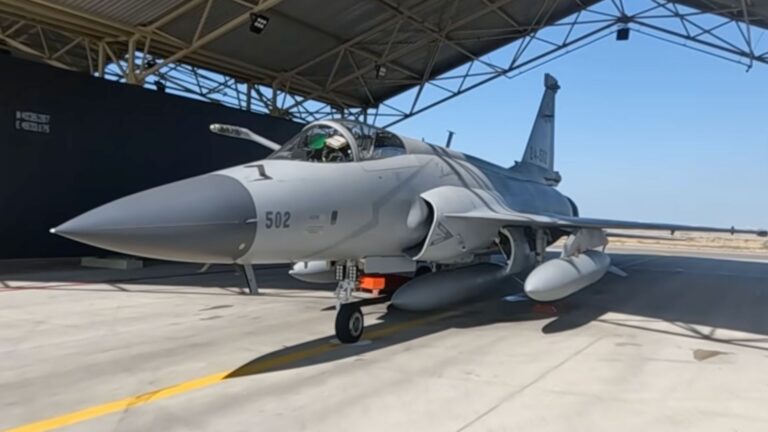
These UCAVs will be capable of communicating with other fighter jets, PAF’s early-warning aircraft, and satellites. There will be the ability to connect to Link 16 and Pakistan’s in-house data link protocol, Link 17. Other fighter aircraft, such as the JF-17 and the proposed TFX-Azm, will be able to issue high-level commands to the UCAV. These UCAVs will also be able to serve as network nodes, extending the reach of any network they are part of.
Autonomous Modes
The UCAV should be able to perform basic mission tasks autonomously. This includes takeoff, cruise, loiter, formation flying, and landing.
For strike missions on fixed targets, a “command-and-forget” mode may be programmed, in which the UCAV takes off, cruises to the target, deploys its weapons, and returns to base for landing.
The existence of autonomous modes will allow pilots of the commanding jets to issue high-level commands. For example, the commanding jet may issue a command to engage an enemy jet, and the UCAV will accomplish this mission on its own. The UCAV will be able to detect incoming missiles and perform basic evasive maneuvers.
Future software upgrades could enable the UCAV to loiter and track targets of opportunity, relaying this information to its network. The UCAV’s ability to respond to high-level tasks will be vital to its operation as a loyal wingman drone that doesn’t increase the commanding jet’s pilot’s workload.
Low Cost and Attritable
The UCAVs could be powered by overhauled jet engines that are just beyond their maximum hours in order to keep costs down. Furthermore, the number of systems will be minimized. For example, the UCAV will not carry its own radar but will rely on the commanding jet to provide targeting information. The UCAVs will be designed using mechanical assemblies from PAF platforms to minimize development and operational costs.
Rocket-Assisted Takeoff
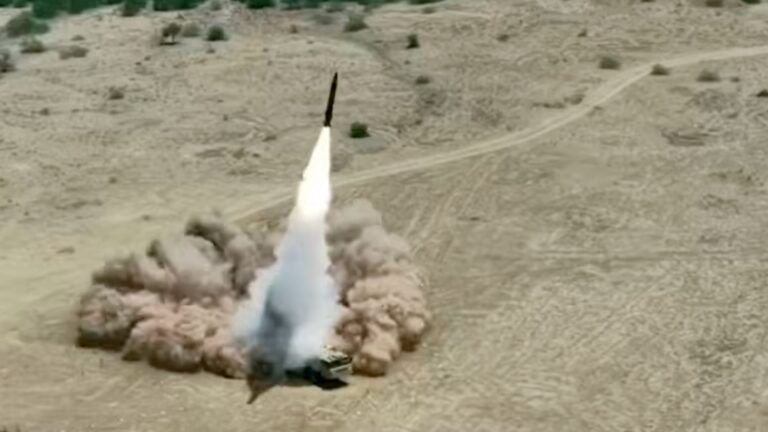
The UCAVs can be designed with rocket-assisted takeoff, allowing them to be launched independently of airstrips. This will allow the UCAVs to be operable even when airfields are inoperable or busy. Furthermore, this will make it very difficult for the enemy to predict where these UCAVs will come from.
Small Size and Internal Weapons Bays
To keep the radar cross-section small, the UCAVs will be compact and equipped with internal weapon bays. These weapons bays will also allow the mounting of specially designed electronic warfare and targeting modules.
Related reading
Vafadar 1
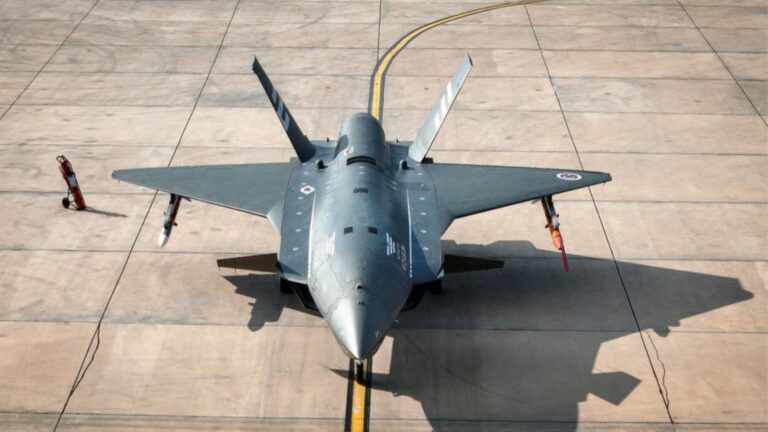
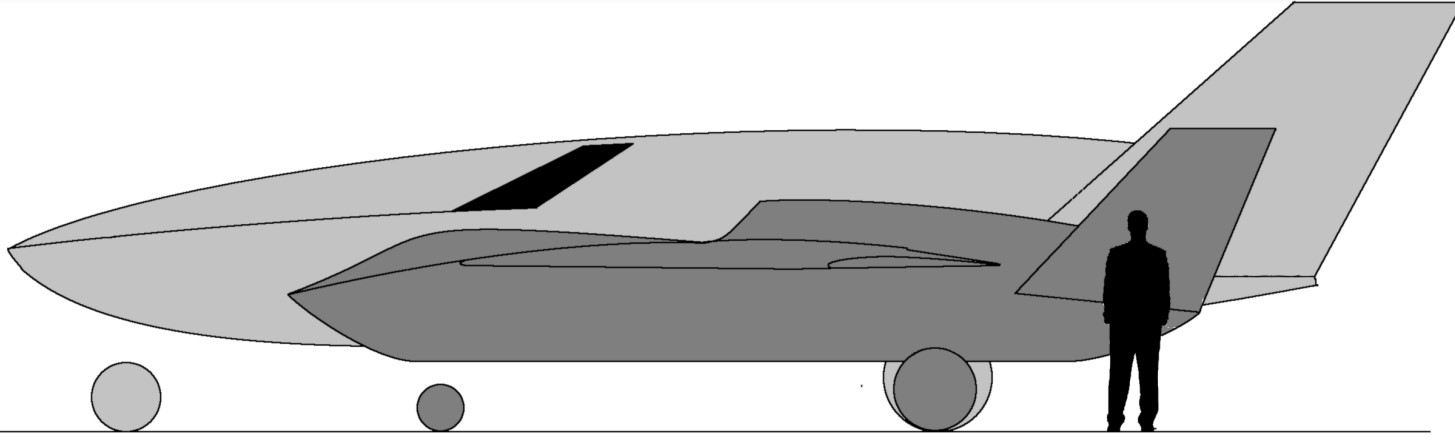
Vafadar-1 can be PAC’s first loyal wingman UCAV and a small aircraft. The author proposes that it is powered by an engine in the class of the Honeywell TFE731, which is the K-8’s powerplant. This would be a 4500-6500 lb aircraft, which will share the landing gears from the K-8 aircraft as well. A proposed design is illustrated in Figure 1.
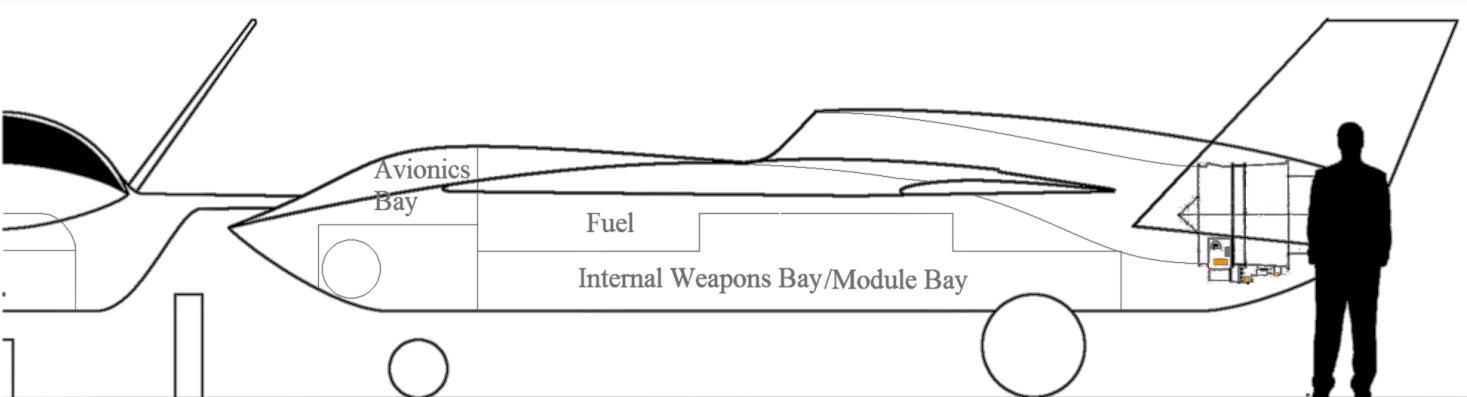
It is proposed that Vafadar-1 carry 2000-2500 lb fuel, thus giving it an endurance of two to three hours. This would be a high-subsonic design with a maximum speed of 430 kts. The approximate combat radius of Vafadar-1 would be 700 km.
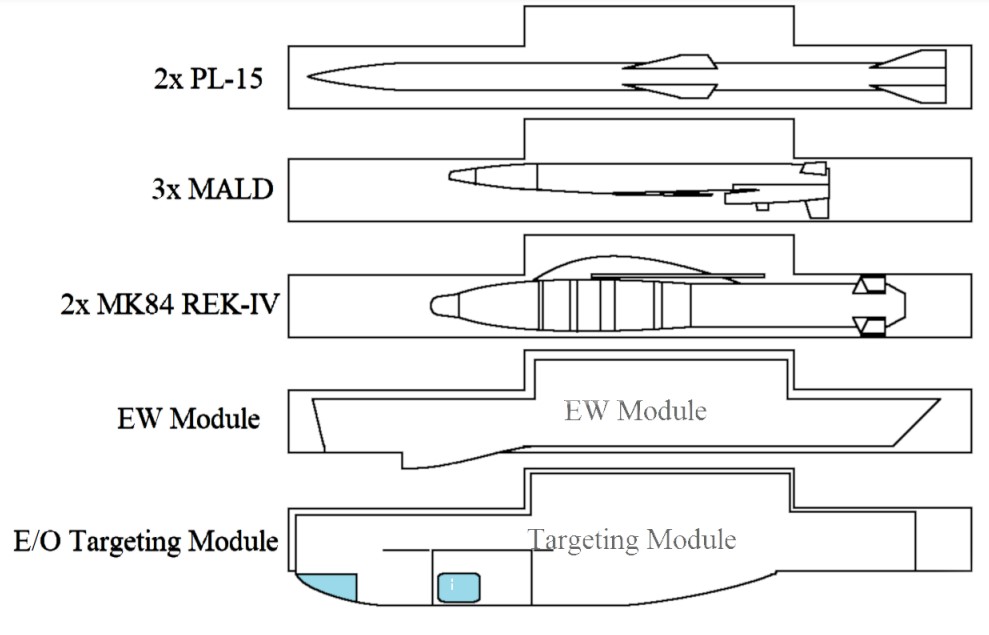
Vafadar-1 can be designed to carry a variety of payloads, as shown in Figure 2. Note that the weapons bay and the weapons in Figures 1 and 2 are drawn to scale.
Some of the proposed scenarios for Vafadar-1 (V1) are:
Missile Truck/BVR Wingman
A flight of two JF-17’s is joined by a flight of three V1 UCAVs, each carrying two PL-15s. The JF-17 detects the four targets beyond visual range and orders the flight of three V2S to engage them. The JF-17’s fall back while the V1s speed toward the bogeys, all the while receiving targeting data from the JF-17s. The V1s deploy their combined payload of 6 PL-15s at 30 miles to the bogeys, maximizing the probability of intercept, albeit by paying the price of being too close to the bogeys themselves. After launching their PL-15s, the V1s immediately break and perform evasive maneuvers to best avoid the missiles that have been undoubtedly launched towards them. Some V1s may be lost, but the enemy flight is in disarray as the JF-17s come in to clean up the stragglers. In this scenario, the V1s act both as decoys for the enemy’s air-to-air missiles and as missile trucks for the JF-17s.
Suppression of Enemy Air Defences
A flight of two V1S, armed with three MALD-type decoys, is launched from undisclosed locations via rocket-assisted launch. This flight is followed by another launch of a V1 armed with two MK-84 REK-IV rocket-assisted range extension kits and another V11 with an electronic warfare (EW) module capable of locating sources of radar emissions. This formation of four V1S flies towards an enemy air defence site and deploys MALD-type decoys, which successfully elicit a response from the air defence radars. The location of this radar is detected by the V11 with the EW module and conveyed to the V1 with the two REK-IV’s. The REK-IVs are launched towards the air defence battery, and the flight of four V1s return to base.
Strike Missions
A flight of four V1s are rocket-launched from an undisclosed location towards an enemy command structure deep within enemy airspace. Three V1s are carrying two REK-IV’s each and one V1 is carrying an electro-optical (EO) targeting module. Upon reaching the firing range, the target is confirmed by the EO-equipped V1, and a live video feed is transmitted to PAF high command, as the three V1s release their payload of six REK-IVs at the target and return to base. The EO-equipped V1 returns to base after confirming the target’s destruction.
Vafadar-2
Once Vafadar-1 is in advanced stages of design, the design of a Vafadar-2 (V2) loyal wingman UCAV can begin. This article proposes that building upon the design of V1, the V2 is a bigger and more capable UCAV. A size comparison between the proposed V1 and V2 designs is shown in Figure 3.
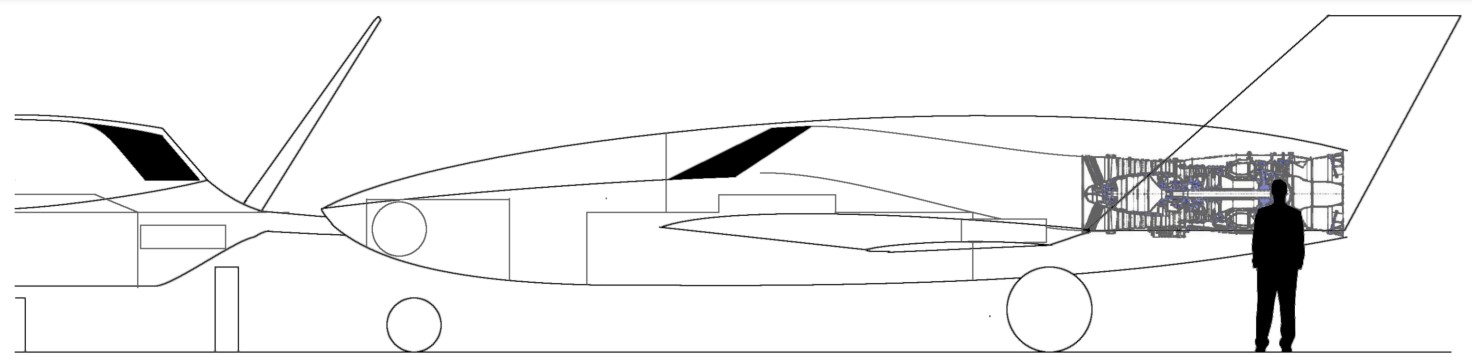
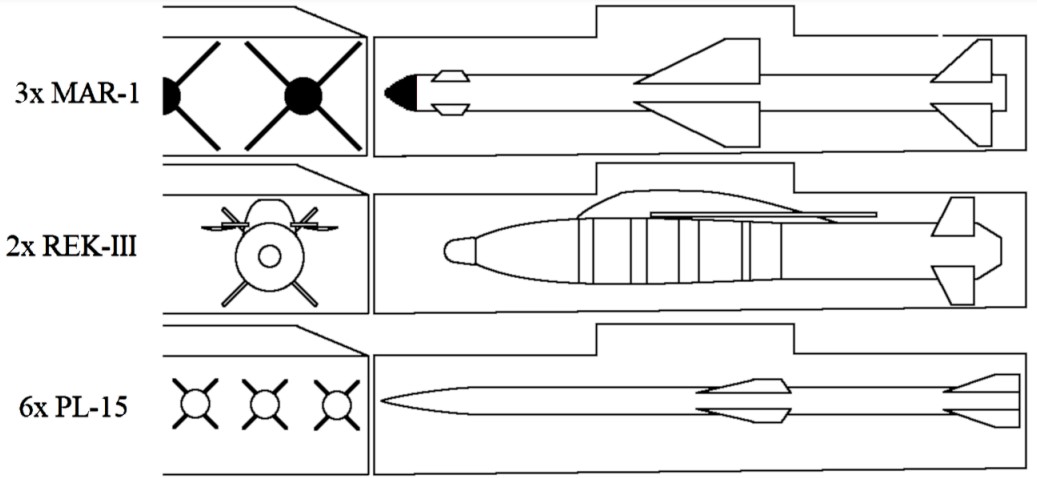
It would be powered by overhauled and sans-afterburner RD-93 engines from JF-17 aircraft and utilize many mechanical assemblies from it. The author proposes that the V2 has a maximum takeoff weight of 12,000 to 16,000 lbs and carries 4500 lbs of fuel. Like the V1, the V2 would have an internal weapons bay. However, the V2’s bay will be much larger, and thus able to accommodate bigger and heavier payloads such as the MK-83-based rocket-assisted stand-off weapon REK-III. Furthermore, it will be able to carry a much bigger missile payload, including specialized munitions, such as the MAR-1 anti-radiation missile. These options are shown in Figure 6. Of particular interest is the ability to carry up to six PL-15 air-to-air missiles, thus truly fulfilling the role of a “missile truck.”
Since V2 is a “full-size” UCAV, it will be much more expensive to build and operate than the V1. It will be for PAF to decide whether the V2 program should be pursued or scaled down in scope. The designs proposed in this article are an inference upon which informed decisions can be made.
Furthermore, the right mix of V1s and V2s would have to be decided based on the doctrinal needs of the PAF. Even though V2 will be a more expensive proposition, it will have greatly enhanced internal space for weapons and range.
Conclusion
This article has presented “back-of-the-envelope” designs for two possible loyal wingman UCAVs that can be developed at PAC in collaboration with private aerospace companies. These UCAVs are proposed as complements to the possibly combined TAI-PAC TFX-Azm FGFA.
The benefits of embarking on this loyal wingman program are many.
Firstly, this program will utilize existing infrastructure, human resources, and expertise to realistically extend local capabilities. Furthermore, these UCAVs could be produced in very large numbers to serve with the PAF and the TuAF, as well as for other export customers. Additionally, collaboration with private aerospace companies will build their capabilities, create long-term aerospace jobs in Pakistan, and pave the way for a much richer future for Pakistani aerospace research. Finally, the realignment of goals from developing a redundant FGFA to a complementary program to TFX will ensure that the limited resources available for aerospace R&D in Pakistan are spent as efficiently as possible.
Quwa Plus
To read more articles like this, subscribe to Quwa Plus.
Understand what Pakistan is acquiring, how its armed forces are evolving, and where national security policy is heading through dedicated defence news, force analysis, procurement tracking, Pulse Check briefings, and more than a decade of documented reporting.
Featured & Trusted By