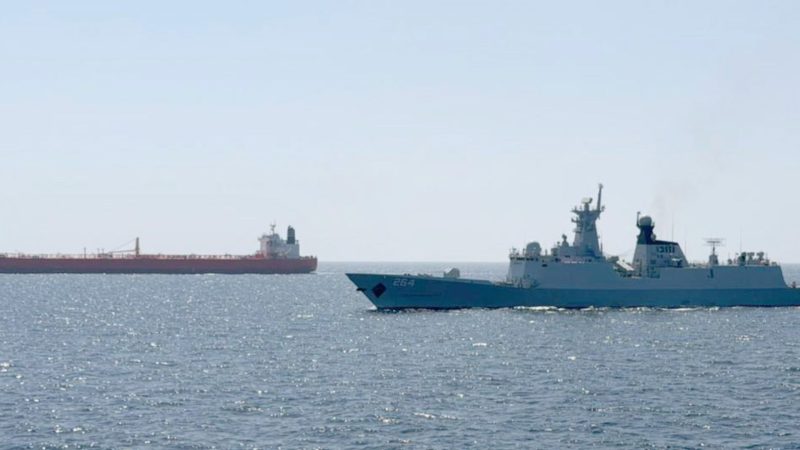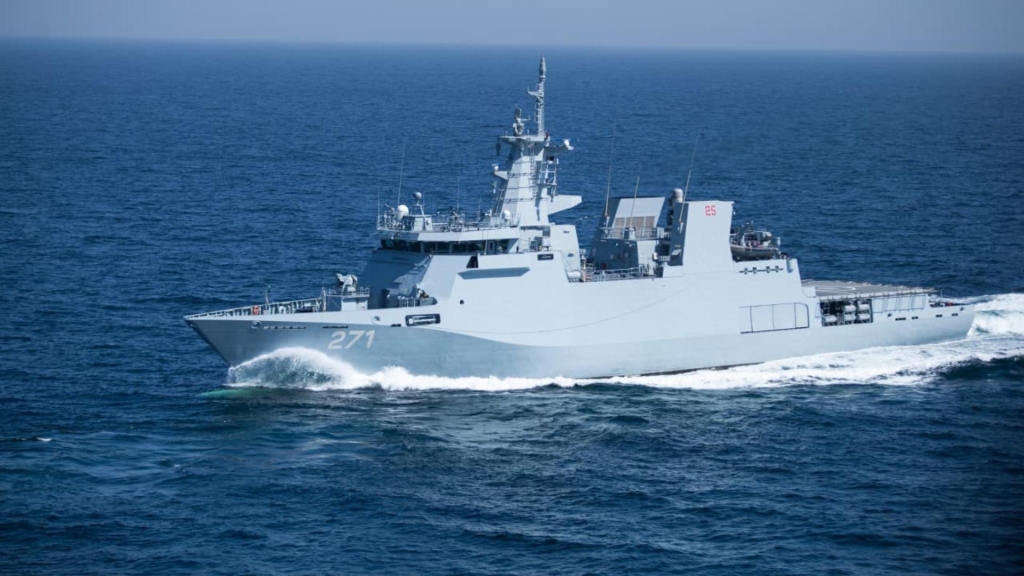
On 20 October 2025, the Combined Maritime Forces (CMF) issued a press release stating that PNS Yarmouk, one of the Pakistan Navy’s (PN) four Damen 2200/2600 offshore patrol vessels (OPVs), successfully executed an interdiction operation, seizing USD $972.4 million in contraband in the process.
The interdiction was done under Combined Task Force-150 (CTF-150), a multinational force of regional powers that operates in the Gulf of Oman, the Arabian Sea, and other adjacent areas along those seas.
Leadership of CTF-150 rotates between its members, with Saudi Arabia currently at the helm of the coalition since August 2025.
Under Operation Al-Masmak, PNS Yarmouk – in coordination with other friendly assets – carried out a boarding operation of two dhows, which both lacked external markings and failed to transmit on the Automatic Identification System (AIS).
In the first dhow, the VBSS (visit, board, search, and seizure) crew seized two tons of crystal methamphetamine (ICE), estimated at $822.4 million in value. Meanwhile, the second dhow was caught with 350 kg of ICE and 50 kg of cocaine worth $140 million and $10 million, respectively.
Lauding the operation, the current commander of CTF-150, Royal Saudi Naval Forces (RSNF) Commodore Fahad Aljoiad, remarked: “PNS Yarmouk has had one of its most successful narcotics seizures for CMF, which is directly attributed to the expertise and collaboration of our naval forces within the organization.”
For ships with a probable unit cost of under $100 million, a narcotics bust worth nearly 10 times that amount is a strong indicator of return on investment (ROI). However, that was precisely why the PN pursued these OPVs in the first place, i.e., dedicated surface combatants for sea policing and coalition support duties. Besides intercepting potentially billions of dollars worth of criminal activity, these OPVs also free the PN’s multi-billion-dollar investments in frigates and corvettes from undue peacetime risk, excessive wear, and escalating operational costs.
Therefore, the ROI or benefit accrued from the Damen OPV 2200s and OPV 2600s could be many times the price the PN paid for them. However, besides justifying the expense, these OPVs could signal the PN’s underlying intention to build Pakistan’s peacetime naval presence.
In an earlier article on the Yarmouk-class OPVs, this author stated:
The PN has an active interest in assuming a more engaged role in the Arabian Sea across both its multinational coalition commitments and as a naval power. The Yarmook-class OPVs provide the PN with a sufficiently capable platform to support most of the missions managed by Combined Task Force (CTF)- 150 and CTF-151, which are primarily focused on anti-piracy and anti-terrorism operations.
Don't Stop Here. Unlock the Rest of this Analysis Immediately
To read the rest of this deep dive -- including the honest assessments and comparative analyses that Quwa Plus members rely on -- you need access.