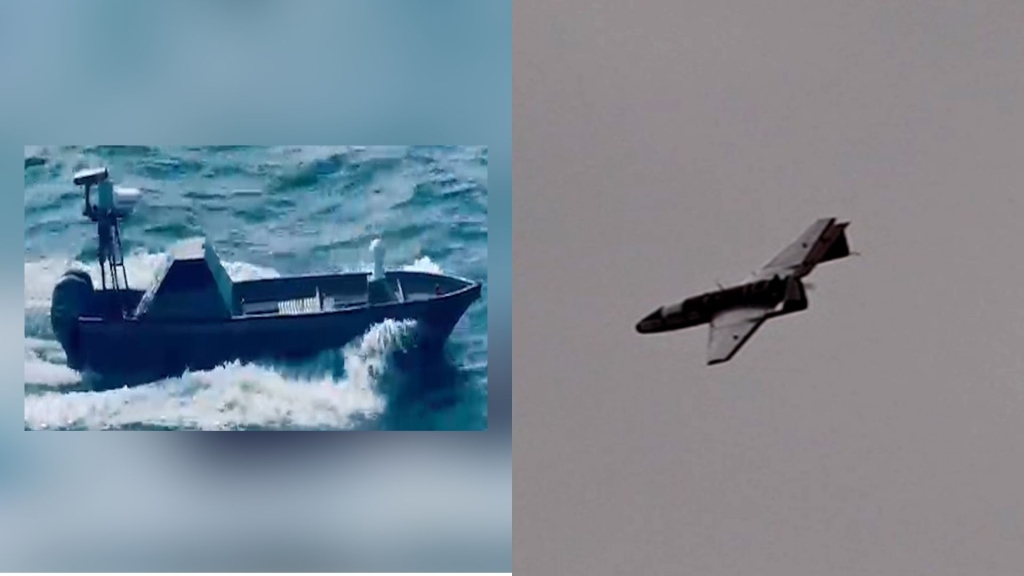
On 10 January, the Pakistan Navy (PN) announced that it tested a new unmanned surface vessel (USV) and a loitering munition during an exercise that was recently held in the North Arabian Sea.
In a statement, the PN Director General of Public Affairs (DGPR) stated that the loitering munition “successfully engaged and destroyed surface targets,” while the USV provided “extreme maneuverability, precision navigation and weather resilience.”
Quwa learned that both the USV and the loitering munition were sourced from Pakistani private companies, i.e., Woot-Tech and Sysverve Aerospace, respectively.
In this exclusive report, Quwa was able to learn a number of key details about both the unnamed USV and the Mudamir-LR loitering munition (LM), as well as the PN’s broader plans for leveraging new unmanned platforms.
Get access to this article and all other Quwa content today.
Click Here
Related Reads
- Pakistan Revealed New Naval Drones. Does it Signal a New Shift?
- Offshore Patrol Vessels (OPV) Will Play a Key Role in the Future of the Pakistan Navy Fleet.
- Extending Deterrence: How the Hangor-Class Reshapes Pakistan’s Maritime A2/AD Posture
- The COTS Advantage of the Pakistan Navy’s Sea Sultan LRMPA
- After a Decade of Growth, the Real Test for Pakistan’s Navy Has Begun
Sources told Quwa that the Sysverve Aerospace Mudamir-LR was entirely designed and produced in Pakistan. However, the technical specifications are currently classified, but the LM’s operational range exceeds 600 km.
Leveraging an “in-house developed” artificial intelligence-based guidance system, the LM can operate in GNSS/GPS-denied environments.
In addition, the PN also used the Hadaf-III target drone to test the LY-80N surface-to-air missile (SAM) system. The Hadaf-III has a speed of 100-160 metres per second, carries infrared (IR) flares, and has a “built-in RCS enhancer.”
The latter is an integrated device that enhances the target drone’s radar observability by simulating a wider range of threats, including larger aircraft. For example, the PN might look to validate its air defence systems against maritime patrol aircraft (MPA).
Don't Stop Here. Unlock the Rest of this Analysis Immediately
To read the rest of this deep dive -- including the honest assessments and comparative analyses that Quwa Plus members rely on -- you need access.