

Youtube
X-twitter
Linkedin
Spotify
Rss
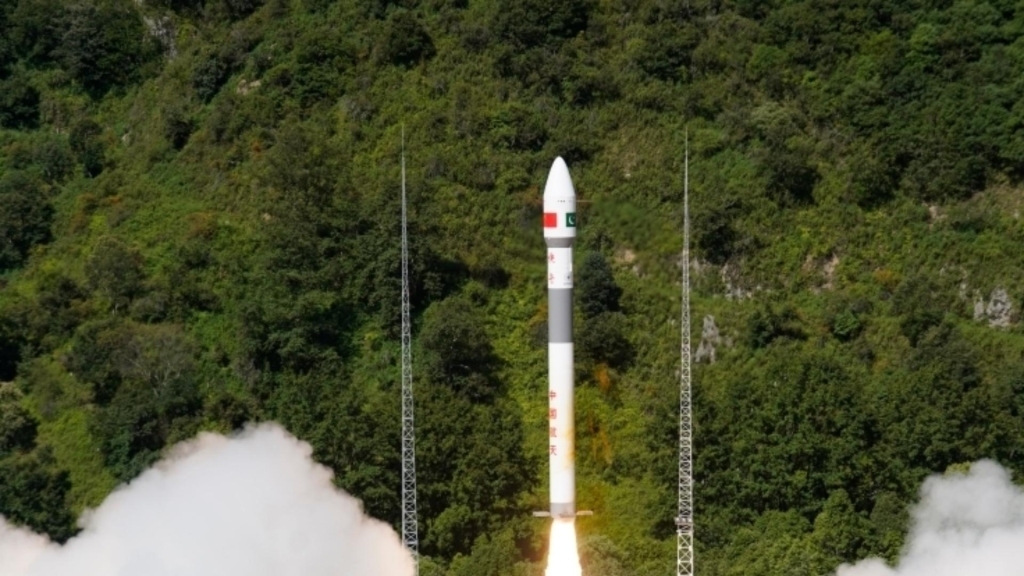
On 31 July 2025, China launched a remote sensing satellite for Pakistan using a Kuaizhou-1A satellite launch vehicle (SLV) from the Xichang Satellite Launch Center.
The PRSC-S1 was developed by Pakistan’s Space & Upper Atmosphere Research Commission (SUPARCO) in collaboration with the China Electronics Technology Group Corporation (CETC), and MICROSAT China.
This new Pakistan Remote Sensing Satellite (PRSC) will join the PRSC-EO1, an electro-optical earth observation satellite which was launched into orbit earlier in January from China’s Jiuquan Satellite Centre.
Under Space Vision 2040, which was revealed in the early 2010s, SUPARCO would deploy a series of remote-sensing satellites through the 2020s and 2030s. One detail that has become less clear since its initiation is the split between electro-optical (EO) imaging satellites versus synthetic aperture radar (SAR)-equipped satellites. Originally, SUPARCO had designated the EO-types as ‘PRSS-O1, O2, etc’ – with the “O” referring to “Observation” – while the SAR as “PRSS-S1, S2, etc” – with “S” likely meaning “Sensor.”
It seems that the first EO-type was the recently launched PRSC-E01, while this new one – i.e., PRSC-S1 – is the first known SAR-equipped model. One of these also replaced the PRSS-1 in orbit, which was launched in 2018 and may be reaching the end of its lifecycle of seven years and, thus, in need of replacement this year.
According to a SUPARCO press release (sourced from Business Recorder), the PRSC-S1 will “play a crucial role in infrastructure monitoring, mapping transportation networks, and supporting regional planning efforts…[and] help identify geohazard risks and provide timely warnings for natural disasters such as floods, earthquakes, and landslides,”
SUPARCO now has three main satellites in orbit – i.e., the PakSat-MM1R for communications, PRSC-O1, and the PRSC-S1. These are further complemented by PakTES-1A and ICUBE-Q.
Being a SAR-type satellite, the PRSC-S1 is still, at its core, an imaging system. However, it captures images differently from EO-type satellites, using microwave signals and analyzing the returning echoes. SAR’s main advantage over EO is that it can provide imaging in all weather conditions and in day and night.
Get access to this article and all other Quwa content today.
Click Here
Don't Stop Here. Unlock the Rest of this Analysis Immediately
To read the rest of this deep dive -- including the honest assessments and comparative analyses that Quwa Plus members rely on -- you need access.