
Executive Summary
The May 2025 conflict between Pakistan and India, which saw the first large-scale, reciprocal use of loitering munitions (LMs), has reshaped Pakistan’s defence procurement priorities.
Acknowledging a diminished conventional conflict threshold in South Asia, Pakistan’s military leadership is now driven by a strategic imperative to rapidly expand and diversify its LM inventory.
This creates a substantial and immediate market opportunity for international LM manufacturers and solution providers.
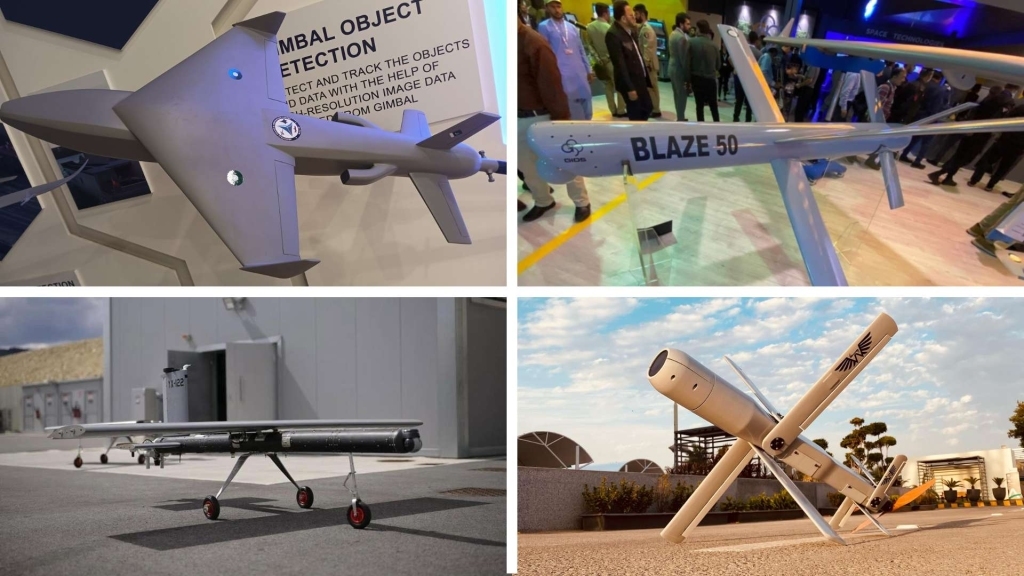
While Pakistan possesses a growing portfolio of indigenous LM designs (from tactical FPVs to miniature air-launched cruise missiles), its current domestic industrial capacity for scalable manufacturing is still insufficient to meet the urgency and volume of the new requirements.
Consequently, near-term procurement will heavily rely on imports, with a strong and explicit preference emerging for solutions that offer comprehensive pathways to local manufacturing, technology transfer, and potentially joint development.
The potential scale is considerable, aiming for a large stockpile to effectively deter and, if necessary, mount a robust, symmetrical response to regional adversarial threats, including the ability to rapidly replenish stocks during sustained operations.
Market Drivers & Rationale
Post-Conflict Capability Gaps
The May 2025 conflict exposed critical insights. India deployed a diverse array of LMs, including systems like the IAI Harop/Harpy and Polish WB Electronics Warmate.
Pakistan responded with its own assets, reportedly launching 300-400 YiHA-III LMs against Indian military airfields and depots, while its EW systems targeted LM command links and GPS, and anti-air guns (AAG) provided a final kinetic defence.
Both nations actively used LMs to probe opposing ground-based air defence systems (GBADS) to locate radars, command-and-control stations, and surface-to-air missile (SAM) launchers.
The perception that India’s LM campaign was more assertive, whether due to Pakistan’s de-escalation efforts or actual materiel shortfalls, underscores the urgent need for a larger, more diverse, and rapidly replenishable LM arsenal.
Shift in Strategic Posture
Gen. Shamsir Mirza’s remarks at the 2025 Shangri-La Dialogue signalled a pivotal shift. His assertion that the conventional conflict threshold in South Asia has eroded and that, in place of an internationally-driven crisis management framework, a full-scale conflict will likely occur.
This directly implies that Pakistan will not ‘hold back’ in future responses and intends to escalate in kind with India. This removes policy as a primary limiting factor on LM employment and necessitates a robust indigenous capability for a wide range of LM operations – offensive strikes, defensive counter-air, and comprehensive SEAD/DEAD campaigns.
Lessons from Global Conflicts
Beyond regional experiences, Pakistan and India are meticulously studying the tactical successes and evolving doctrines of LM employment globally (hence the reason why both sides adopted LMs initially), including Ukraine’s use of low-cost FPV (First-Person View) drones for precision strikes against Russian armour, infrastructure, and strategic assets.
This is broadening the scope of desired LM types, pushing demand towards more agile, cost-effective, and rapidly deployable solutions for asymmetric advantages.
Domestic Production Shortfalls
Pakistan’s defence industry, spearheaded by entities like NASTP and NESCOM (producing licensed YiHA-III, Dark Angel-II, and indigenous systems like Python, KaGeM V3, SARKASH), is design-heavy, production-light.
The capacity to manufacture these designs at the scale required for a large, rapidly replenishable stockpile is lacking, especially when benchmarked against Ukraine’s wartime output achievements (potentially millions of drones annually).
Several structural constraints impede this scaling:
- Economic Headwinds: Poor economic management de-incentivizes the crucial private sector investment needed for expanding manufacturing capacity.
- SOE Inefficiencies: State-Owned Enterprises are often not agile enough to pivot to current needs, leading to underutilized capacity. A traditional focus on high-value platform production (e.g., tanks and combat aircraft) over munitions and sub-systems has tied up scarce resources and capacity in high-overhead projects reliant on foreign inputs, often forcing the import of advanced munitions. This model struggles with the economics of scale and rapid replenishment vital for munitions.
- Recognition & Transition: While entities like NESCOM are reportedly recognizing this and shifting focus towards original munition products, building a robust domestic production base will take several years. This interim period necessitates reliance on imports.
Geopolitical Context & Regional Arms Dynamics
The persistently volatile security environment in South Asia, coupled with the demonstrated utility and proliferation of LMs, positions these systems as critical components of national deterrence and warfighting capability. An observable LM arms race dynamic is emerging, pushing Pakistan to ensure its capabilities are not outmatched.
Opportunity Analysis for Pakistan’s Industry Partners
Based on Pakistan’s current development trajectory and recent conflict lessons:
Probable LM Categories in Demand
- High-Tier (Miniature Cruise Missiles): Systems akin to the KaGeM V3 (air-launched, implying a need for lightweight solutions for smaller platforms) and surface-launched SARKASH. These are longer-range and higher-speed solutions for penetrating strikes against strategic assets.
- Mid-Tier (‘Workhorse’ Munitions): Simpler, relatively lower-cost, but effective designs for large-scale, high-intensity deployment. Examples include licensed systems like the Turkish YiHA-III, Chinese Dark Angel-II, and NASTP’s indigenous “Python.”
- Low-Tier (FPV-Style Drones): Small, highly cost-effective drones inspired by Ukrainian tactical successes, for use in anti-tank/anti-armour roles, tactical SEAD/DEAD, and close air support. This is an area of significant emerging interest with few mature domestic products currently on offer.
Potential Scale of Procurement
- While exact figures are an intelligence gap, comparisons to Ukraine’s multi-million annual LM production and consumption in wartime suggest Pakistan will aim for a capacity that can sustain high-intensity operations and allow for rapid replenishment.
Avenues for Industry Participation
- Direct Sales: Crucial for immediate fulfillment of urgent operational requirements and capability gaps identified post-May 2025.
- Turnkey Domestic Production Solutions: This is the most strategically attractive avenue for Pakistan. Foreign OEMs offering comprehensive packages for establishing local manufacturing lines (potentially structured with offsets or direct investment into Pakistan’s private sector players) will gain a significant competitive advantage.
- Partnerships with Local Industry (Public & Private): Collaborating with Pakistani companies that possess original designs but lack scaled production capabilities. Foreign OEMs specializing in efficient, large-scale manufacturing setups can bridge this gap.
- Technology Transfer (ToT) & Co-Development: Fully aligned with Pakistan’s long-term ambitions for self-reliance and indigenous innovation in critical defence technologies.
- Multi-Product Engagements: Given the diverse requirements, Pakistan may adopt a range of different LM products. Suppliers who can offer a portfolio approach, frontloading with imports while concurrently establishing domestic production, will be well-positioned.
Key Selling Points and Value Propositions
- Comprehensive Indigenous Production Roadmap: Clear, phased plans for ToT, local assembly, progressive manufacturing, and long-term sustainment are paramount. Offers emphasizing a quick start with imports, followed by a tangible domestic production setup, will be favoured.
- Scalability, Speed of Delivery & Manufacturing Expertise: Demonstrable ability to rapidly supply initial batches and, more importantly, efficiently establish and ramp up local production lines.
- Cost-Effectiveness & Affordability at Scale: Especially critical for ‘workhorse’ and FPV-type munitions to enable mass deployment and attrition tolerance.
- Combat-Proven Technology & Reliability: Post-May 2025, systems with documented operational success and high reliability will be heavily preferred.
- Empowerment of Pakistan’s Private Sector: Proposals that actively seek to involve and invest in Pakistani private defence companies will align with national industrial development goals.
- EW Resilience & Counter-Countermeasures: Given Pakistan’s use of EW against LMs and India’s capabilities, systems incorporating robust protection against jamming and spoofing, or employing novel guidance techniques, will be highly valued.
Competitive Landscape & Considerations
Existing Suppliers/Preferences
Pakistan’s current licensed production of Turkish (e.g., YiHA-III via NASTP) and Chinese (e.g., Dark Angel-II via NASTP) designs indicates established defence relationships.
Suppliers from these countries, or others willing to offer similarly favourable terms regarding ToT and local production, may have an existing advantage.
Role of the Local Pakistani Defence Industry
- NASTP is a central player in licensed production and indigenous design (e.g., Python). Its capacity for scaling will be a key factor.
- SOEs like NESCOM are increasingly focused on original product development, but systemic inefficiencies and the legacy focus on platforms over munitions need to be overcome for mass LM production.
- The private sector, though currently hampered by economic conditions, is seen as a vital area for future growth and partnerships in scalable manufacturing.
- A strong governmental push for maximizing local industrial participation in all major defence procurements is expected.
Potential Challenges & Barriers to Entry
- Competition from established Turkish, Chinese, and other suppliers with existing ties to both the institution generally and key decision-makers specifically. That said, because the needed volume is high, there should be scope for new entrants.
- Pakistan’s prevailing economic conditions may impact procurement timelines, funding availability, and preferred payment terms. In other words, OEMs with pre-secured credit or loan systems will likely stand out among Pakistani decision-makers.
- Offset programs will need to navigate and overcome the processes of Pakistan’s state-owned defence industrial complex. The private sector is generally constrained by strong state-driven security controls and approval processes. In this sense, the simplest way to build a compelling offset narrative is to partner with SOEs. The Air Force leadership, for example, currently has a strong focus on supporting NASTP; thus, connecting a deal with NASTP could be prudent.
Strategic Implications for Business Development & Marketing:
Positioning Offerings
- Adopt a phased, partnership-centric approach: Propose immediate delivery of off-the-shelf systems to meet urgent needs, coupled with a clear, credible, and committed roadmap for establishing local manufacturing, assembly, and long-term sustainment capabilities.
- Showcase proven expertise not just in LM technology, but critically, in setting up efficient, scalable production lines and successfully transferring complex manufacturing know-how.
- Develop tailored offerings that address the distinct requirements across Pakistan’s identified LM tiers (high-end, workhorse, FPV), demonstrating a nuanced understanding of their evolving operational needs and industrial aspirations.
Market Intelligence Next Steps for Business Development Teams
- Quantify specific stockpile targets and replenishment rates envisioned by the Pakistan Army and Air Force for each LM category. Generally, the simplest way to acquire this information is to directly speak with Pakistani military officials at defence industry trade shows.
- Ascertain detailed timelines and desired levels of indigenization for transitioning from imports to domestic production.
- Identify specific Pakistani private and public sector entities being primed for partnerships, joint ventures, or investment in LM production.
- Gather precise technical performance thresholds (range, endurance, payload, accuracy, EW resistance) and target unit/lifecycle price points for different LM tiers.
- Understand the specific lessons learned by Pakistan from both its own and India’s LM employment in the May 2025 conflict (e.g., effectiveness of IAI Harop and Harpy, Warmate; the performance of EW/AAG, etc) and how these inform new requirements.
- Assess NASTP’s (and other entities’) current actual production capacities, bottlenecks, and expansion plans for existing LM lines (YiHA-III, Dark Angel-II, Python, KaGeM V3, SARKASH) to pinpoint exact gaps for foreign collaboration.
- Clarify expectations on local value addition, job creation, and export rights from co-produced systems, but consider committing to these elements at a high level when marketing or building messaging during first-touch sales engagements (e.g., at trade shows).