
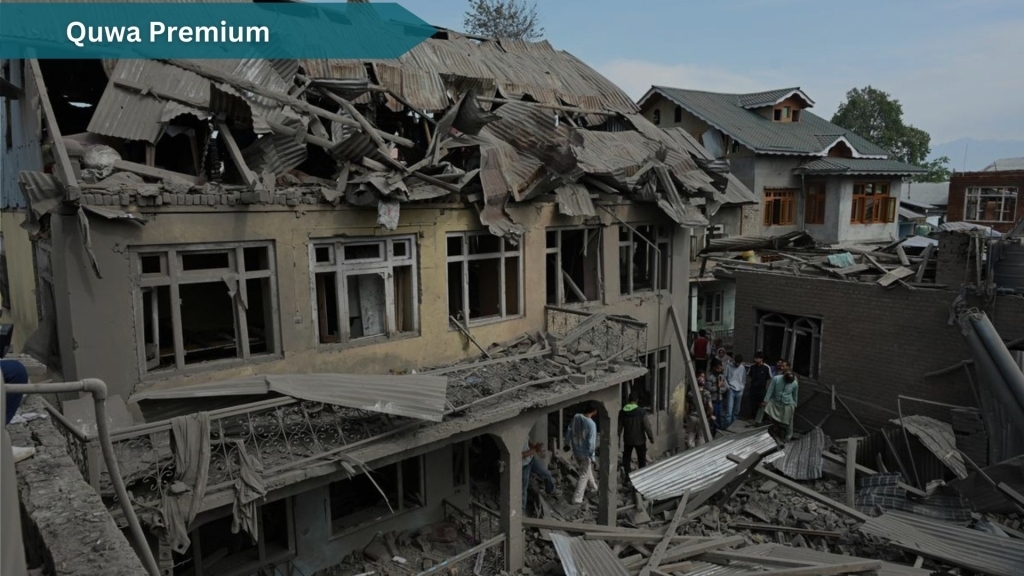
South Asia’s security environment has again entered a phase of heightened tension following a deadly attack targeting tourists in Pahalgam in Indian-administered Jammu and Kashmir, on 22 April. This attack triggered a sharp deterioration in bilateral relations between the nuclear powers, which was promptly followed with each country’s militaries going into full alert.
On 28 April, Pakistan’s defence minister, Khawaja Muhammad Asif, told Reuters that the Pakistani military was expecting an “imminent” incursion by Indian forces.
These flare ups are not new; rather, this episode is another iteration of the long-standing Kashmir conflict. This conflict showcases a uniquely intense and accelerating arms race, one that may – if it has not already – outpaced the procurement trends of every region except for East Asia.
For example, India already implemented this strategy when developing SAMs before 2019 via the off-the-shelf acquisition of Barak-1 SAMs from Israel while also collaborating with the latter on the Barak-8 program, which fed into India’s MR-SAM and LR-SAM programs.
Likewise, in tandem with the off-the-shelf purchase of 36 Rafales for the IAF (and 26 Rafale M for the Indian Navy), major agreements were signed with Dassault, Safran Group, and Thales. These partnerships are poised to support the Tejas, Prachand, Vajra, and others.
India’s homegrown platforms are world-class designs and are built to industry standards one can expect from Western or East Asian (e.g., South Korean) OEMs. Once inducted in numbers, these platforms will give the Indian military high-caliber solutions at scale. However, the impact of these systems will fully materialize through the long-term, not in this current crisis.
In terms of today, India’s centerpieces on air and land are similar to what Pakistan has done since 2019. The centerpiece is the Rafale, which is armed with the MBDA Meteor, a LRAAM with a very long-range no-escape zone (NEZ). This is supported by the S-400 long-range SAM acquired from Russia, which offers a range of 400 km, and a dense GBADS consisting of Israeli and indigenous SAMs, like the SPYDER, Akash, QR-SAM, and MR-SAM.
Thus, India’s defensive posture is technically more developed and varied than that of Pakistan – i.e., presenting a major risk for any ingressing PAF strike formation. Offensively, India fields many of the same types of weapon systems as Pakistan, e.g., multirole fighters with PGBs and SOWs – including air-launched cruise missiles (ALCM), the Pinaka-series of guided artillery rockets/SSMs, and the Prahar SSM, among others. India also still maintains its large fleet of Su-30MKIs as well as other credible platforms, like the Mirage 2000H and MiG-29.
Quwa Plus
Go Beyond the Headlines on Pakistan’s Defence and Security.
Quwa Plus gives you deeper reporting, briefings, and analysis on Pakistan’s defence programs, foreign policy, national security, and regional strategy. Follow the developments that matter to professionals, analysts, and serious readers tracking Pakistan’s security landscape.
Join ($29.99/Year) Already a subscriber?Sign in