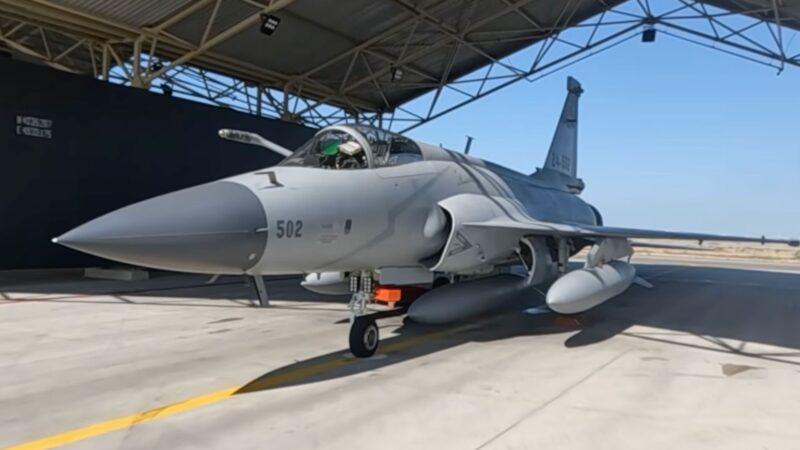

One year after the 7 May 2025 air battle, one of the dominant narratives for Pakistan Air Force’s (PAF) shoot-downs of Indian Air Force (IAF) fighters had settled on a specific and now widely recited claim – i.e., PAF J-10C fighters armed with PL-15E beyond-visual-range (BVR) missiles engaged at 160–190 km using AWACS-to-missile guidance via the Erieye airborne early warning and control (AEW&C) system.
This account now appears across Wikipedia’s PL-15 entry, multiple defence media aggregators, and YouTube channels on both the Indian and Pakistani sides.
However, tracing the claim back to its origins raises questions about how much of it is sourced from participants and how much was constructed backwards from outcomes by analysts.
Where the ‘Kill Chain’ Claim Originated
The earliest post-conflict framing of the kill chain came from China Space News (中国航天报), a Chinese defence-industry publication, which described the engagement on 12 May 2025 in abstract doctrinal terms – a weapon “launched by ‘A’, guided by ‘B’, and hitting the target assigned by ‘C’.” The report did not name the XS-3 or any specific data link protocol.
This framing was picked up in English-language reporting through Michael Dahm, a senior fellow at the Mitchell Institute for Aerospace Studies and former U.S. Navy intelligence officer. In an interview with Air & Space Forces Magazine published on 19 May 2025, Dahm reconstructed a sequence in which a ground radar illuminated the target, a J-10C launched its missile at range, and “an airborne early warning and control aircraft used a midcourse datalink to update and guide the missile to the Indian fighter.”
Dahm’s language was hedged throughout – i.e., “may have started,” “probably at range.” His core point, however, that the kill chain’s effectiveness mattered more than any individual platform’s performance, was valid and had played out. However, the specific AWACS-to-missile guidance mechanism he described was at best an educated hypothesis, not a verifiable fact from any first- or second-party source.
Around the same time, defence writer Sébastien Roblin independently described the PL-15 as “designed to receive mid-course guidance via datalink from AEW&C platforms such as the Saab 2000” in Asia Times on 15 May 2025. Roblin was describing the PL-15’s design capabilities as a system, but he did not confirm whether its operational use on 7 May involved that exact workflow.
The XS-3 designation itself was first introduced to the conversation by Colonel (Retd.) Ajai Shukla, an Indian defence journalist, in his Diplomat article “The 100-hour War: India Versus Pakistan” on 9 June 2025.
Shukla named the XS-3 – i.e., a real PLAAF tactical broadband data link – and inferred that Pakistan had “likely switched to Chinese data links such as the XS-3.”
He then constructed what he called a “visualization” of PAF staging an “air ambush, facilitated by common XS-3 data links and the PL-15E BVRAAM.”
Shukla’s language was hedged – “likely to have switched,” “in this visualization.”
However, subsequent sources adopted the XS-3 claim without those qualifications. In effect, the trail runs from China Space News‘ abstract framing to Dahm’s speculative reconstruction to Shukla naming XS-3 specifically – and from there to Wikipedia and wider online media treating it as an established fact.
No Pakistani, Chinese, or Western intelligence source has confirmed that PAF operates the XS-3 or any comparable data-link system.
What the First-Person Evidence Describes
The only published account based on direct PAF access is Alan Warnes’ “Understanding the Rafale Kills,” published in Key Aero (September/October 2025), following Warnes’ mid-July 2025 grant of PAF access.
Warnes’ article describes two engagement modes, and they do not fully align.
A senior PAF pilot told Warnes that “my radar is then locked onto the target and is linking info to the missile until a certain range, when the missile switches on to its own AESA seeker.”
This describes a conventional AWACS-assisted engagement. The Saab 2000 Erieye assigned targets and provided the air picture via Link 17/Skyguard, but the J-10C’s active electronically scanned array (AESA) radar performed the actual missile guidance.
Separately, Warnes speculated: “Unless of course the J-10 did not switch on its radar, and the target information was data linked to the fighter that then fired the PL-15.”
He also cited IISS, noting that the PL-15’s guidance “supports a mini-course two-way datalink led by AEW&C aircraft” via “Chinese XS-3 tactical data links” – but did not attribute this to PAF officers.
Given the engagement ranges PAF claimed – 160 to 190 km – these fall within the J-10CE radar’s detection envelope, which is generally assessed at approximately 200 km. Full AWACS-to-missile guidance may not have been required for any of the claimed engagements.
The Actual Achievement
The debate over whether PAF used XS-3, Link 17, or fighter radar guidance is, in a sense, the wrong question. Warnes’ article describes a kill chain that succeeded due to the interplay of multiple layers.
EW and cyber operations disrupted IAF data links, jammed communications, and degraded Spectra’s warning capability. PAF’s Space Command provided intelligence, surveillance, and reconnaissance (ISR) and Global Navigation Satellite System (GNSS) data distribution that bypassed line-of-sight constraints.
Link 17/Skyguard provided a unified, encrypted air picture across Western and Chinese-origin platforms. The Erieye managed the battlespace, assigned targets, and maintained track on IAF formations from deep inside Pakistani airspace. J-10Cs engaged at ranges where their own radars could plausibly reach.
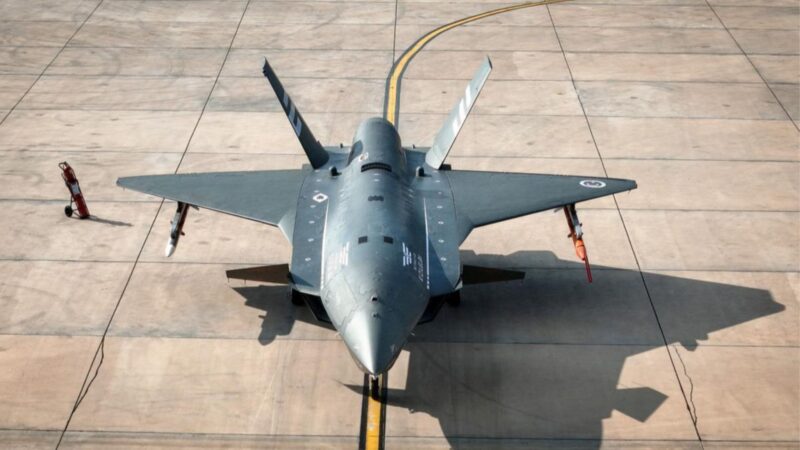
That said, it is certain that the PAF would like to acquire a genuine distributed sensor/shooter network as well as the capacity to drive other workflows, like seamless manned-unmanned teaming (MUM-T) through crewed aircraft and unmanned combat aerial vehicles (UCAV). In other words, a next-gen TDL program is likely in existence, but in the developmental stage.
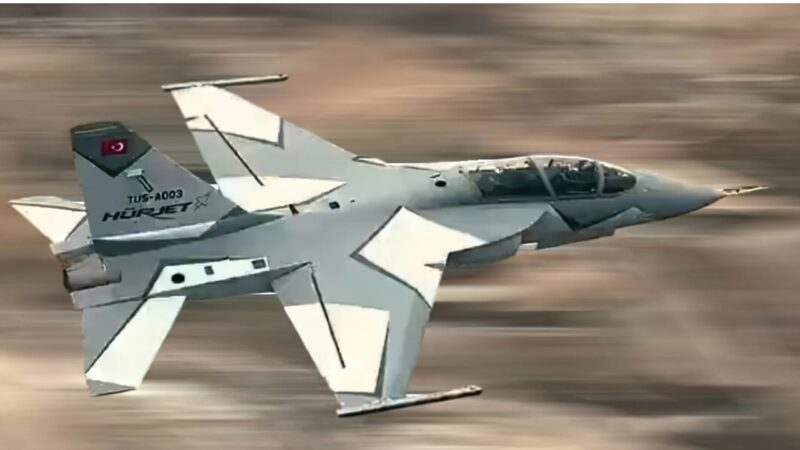
However, the tactical data-link (TDL) architecture for achieving these capabilities will be different from the way Link-17 or Skyguard is designed today. The latter was designed in the late 2000s and early 2010s via the software-defined radio (SDR) and other commercially off-the-shelf (COTS) technology inputs available to the PAF at the time. Moreover, even as Link-17 progressed, the Pakistan Navy (PN) had leveraged the assistance of Turkiye’s MilSOFT to develop its own TDL, Link-Green.
What these two facts illustrate is that the PAF’s TDL stack is limited to the hardware available at the time of development, and that the trajectory of its co-development partner, Turkiye, offers an indication of the actual advancement of that stack. Turkiye’s Aselsan is still developing a next-gen TDL for the workflows described above. Moreover, even within India’s domain, this technology is not widely available, which is the reason why it is also still in the development phase across the border.
In actuality, this specific AWACS-to-Munition capability is very limited in availability, perhaps only deployed at scale by China and the United States. The XS-3 is unlikely to be available for export at this time, though China could be working towards offering an analogous solution through the apparent J-35AE and KJ-500E offer in June 2025. It is likely that for the PAF to acquire this capability, it would need to purchase both the key munitions and the guiding sensors in a package. However, on critical inputs such as TDLs (which ties back to the underlying communications and data-transfer stack), the PAF – and the Pakistani military as a whole – would likely prefer a sovereign-controlled, indigenous solution.